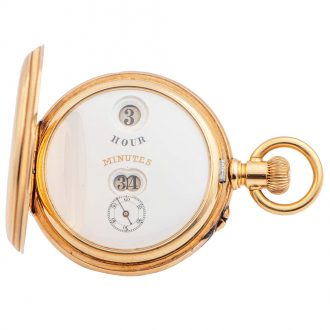
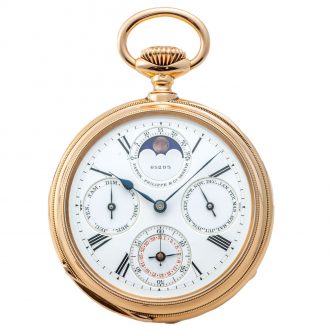
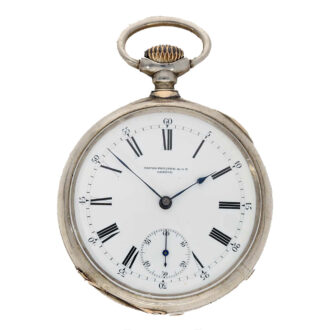
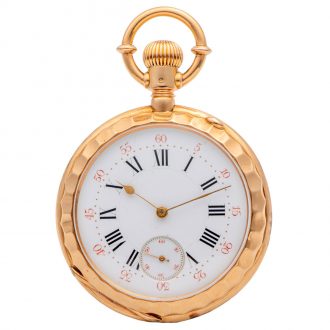
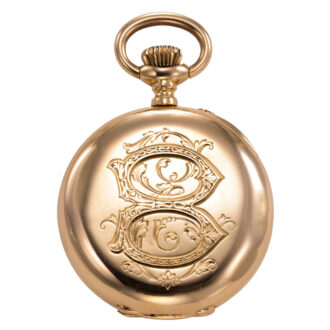
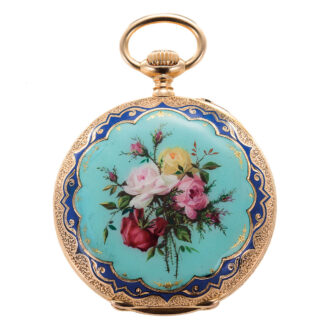
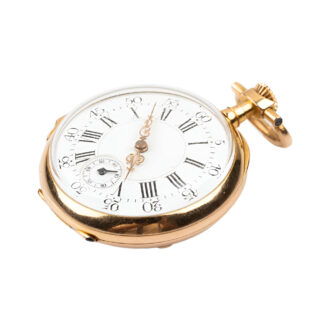
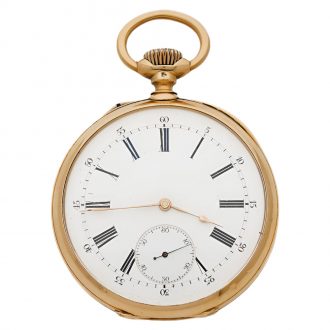
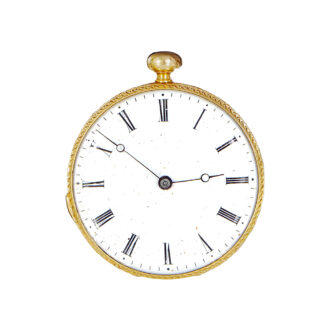
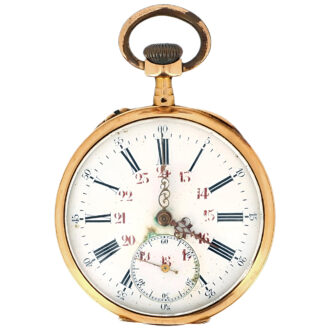
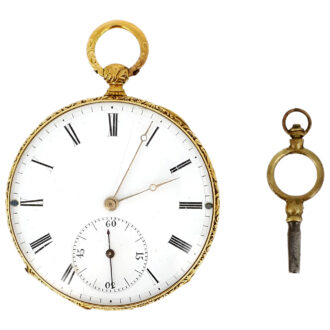
Elegant Swiss 18K gold and enamel ladies’ watch Circa 1885
- Kenmerk
- BA3613
- Diameter
- 36 mm
- Estimate
- € 1.750 - 3.500
- Price sold
- -
Gold cylinder pocket watch
–
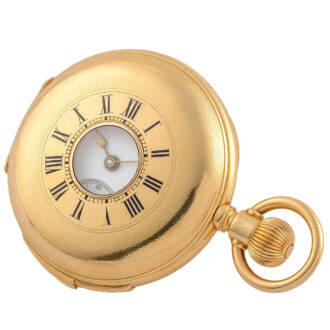
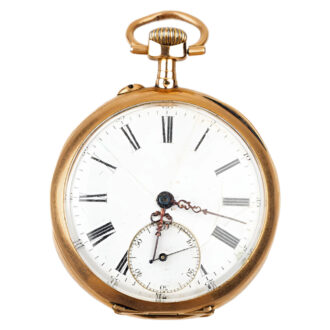
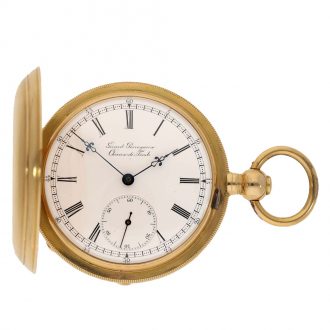
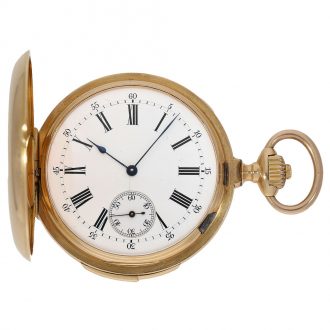
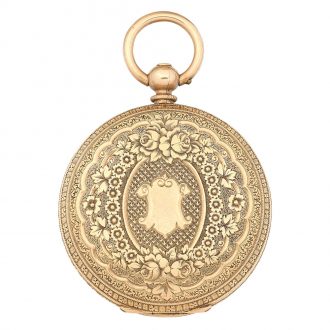
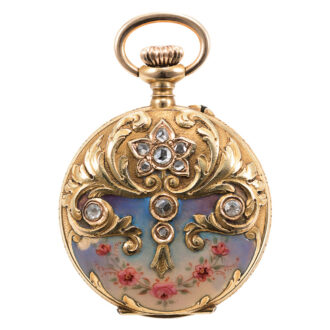
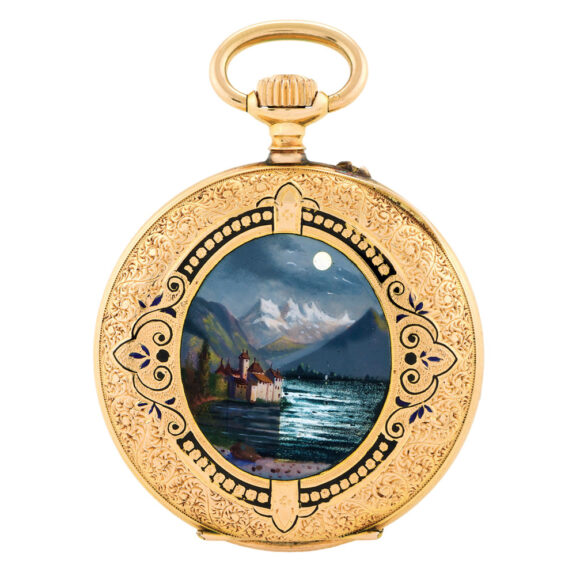
A fine and elegant Swiss 18 carat gold and enamel open faced keyless ladies’ pendant watch made by Ducommun & Cie (P.-E. Jaccottet) in Travers, circa 1880-1892. The matte gilt movement with 10 jewels, a cylinder escapement, plain three arm balance, flat balance spring and an index regulator. Lilac enamel dial with silver paillon Arabic hour numerals on circular black reserves, outer silver paillon minute divisions and original gilt hands. The case with a foliate engraved bezel, polished band, fine polychrome enamel depiction on the back of the Château de Chillon and Lake Geneva by moonlight with the snow capped Alps in the background, and a black champlevé enamel and foliate engraved border. A further hinged gold cuvette. Movement signed, case numbered.
–
Diameter: 36 mm
–
Signed: Jaccottet
–
In 1842, Paul-Emile Jaccottet (also Jacotet or Jacottet) established a manufacturing business in Travers, Val-de-Travers, Neuchâtel. The company soon became one of the premier ebauche manufacturers in Switzerland. Under the management of Mauler, Ducommun, Blanc and Méroz, the business lasted until the early 20th century. Jaccottet’s success led to broader watchmaking in the Val-de-Travers.
–
P.-E. Jaccottet was born in Fleurier in 1813. He was a gifted watchmaker and mechanic, focused on improving watchmaking through mechanical resources. Many of the industrial processes that were later credited to the Americans originated with Jaccottet, but his ideas were not appreciated in Geneva, where they were seen as a threat to the status quo.
–
Relocating to Travers, Jaccottet initially focused on making anker escapements, while also working on designing his own movements. His first ebauches were key winding and intended for the burgeoning Chinese market.
–
Jaccottet’s ebauches were valued for both their technical qualities and their superior factory finish. Although he charged more than his competitors, his ebauches were in such demand that he remained relatively insulated from the fierce price competition that plagued those companies during the 1860s. His movements were appreciated not only by Swiss manufacturers but also in France, where quality was prized over volume. In addition to various types of key and crown winding movements, he also manufactured blanks for marine chronometers, assortments for anker escapements, compensated balances and finished wheels.
–
Around 1857, Paul-Emile further founded both a cement factory and a factory for metal components in Le Furcil near Noiraigue. The metal factory specialized in laminated steel for springs, watch and clock hands, as well as other watchmaking supplies. Jaccottet also designed and manufactured machine tools for other manufacturers.
–
Paul-Emile Jaccottet had political ambitions as well. He served on the Grand Council and his newspaper “La Gazette Neuchâteloise” would promote his political ideas.
–
Jaccottet fell ill in 1864 and moved to Lucerne to benefit from the favourable climate. He died there from a stroke on July 17.
–
Eugene Mauler, born in 1835 in Lille, France, apprenticed as a watchmaker, working in England, before being summoned by Paul-Emile Jaccottet to join his company in 1858. Because his mother came from Môtiers, Val-de-Travers, he was able to claim Swiss nationality. Eugene married Louis, daughter of Paul-Emile, and naturally took over the firm after his father-in-law’s death in 1864. Although still called Fabrique Paul-Emile Jaccottet, the company operated under the name Eugene Mauler & Cie.
–
By 1871, Mauler partnered with Paul Ducommun and the company was renamed Mauler & Ducommun. Failing health forced Mauler to retire to Neuchâtel in 1880, where he continued to manufacture special watches using movements produced by the Travers factory. Eugene Mauler died in 1893 at 58.
–
Paul Ducommun operated the ebauche factory as Ducommun & Cie. Unable to divide his focus between Travers and Le Furcil, he sold the ebauche works to Alphonse Emile Blanc and Hainard in 1892. Thereafter, Paul focused on the manufacture of springs, hands and other components in Le Furcil.
–
Blanc and Hainard, ran the business as Blanc & Cie. By 1894, the Travers factory was supplying ebauches to Paul-D. Nardin of Ulysse Nardin for marine chronometers, allowing them to be produced entirely in the Canton. Blanc & Cie was liquidated in bankruptcy on May 25, 1905.
–
After the bankruptcy of Blanc & Cie, the factory was purchased by John Méroz. He advertised heavily and was a proponent of the use of the metric system in watchmaking. He also opened a watch factory in La Ferriere, but the business was liquidated in bankruptcy on September 27, 1909. This sale included both the La Ferriere business and factory, and all of the machines and tooling from the Travers factory.
Signed: Jaccottet
Share this page: