Swiss early erotic gold and enamel verge watch Circa 1750
- Kenmerk
- FF0030
- Diameter
- 39 mm
- Estimate
- € 6.000 - 12.000
- Price sold
- -
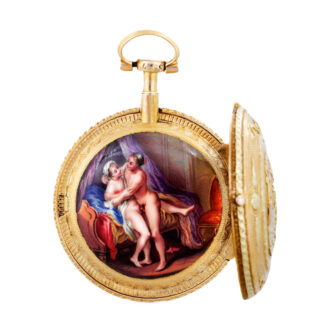
Watch with skeleton movement and hidden erotic scene
–
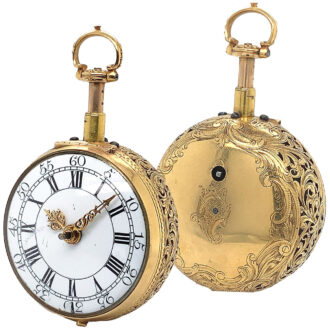
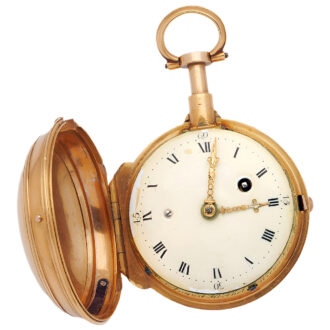
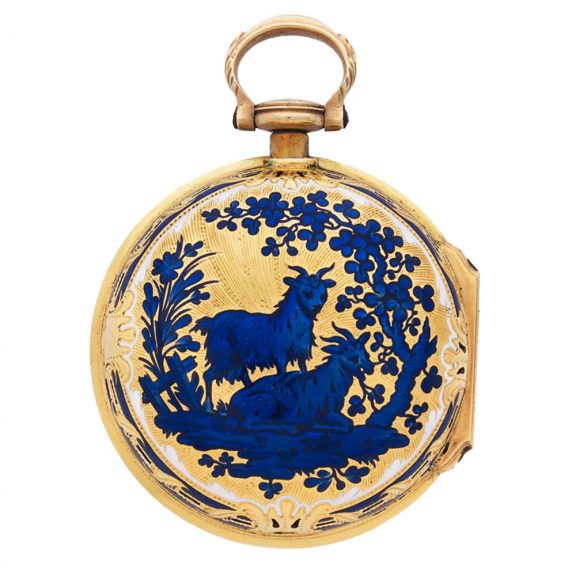
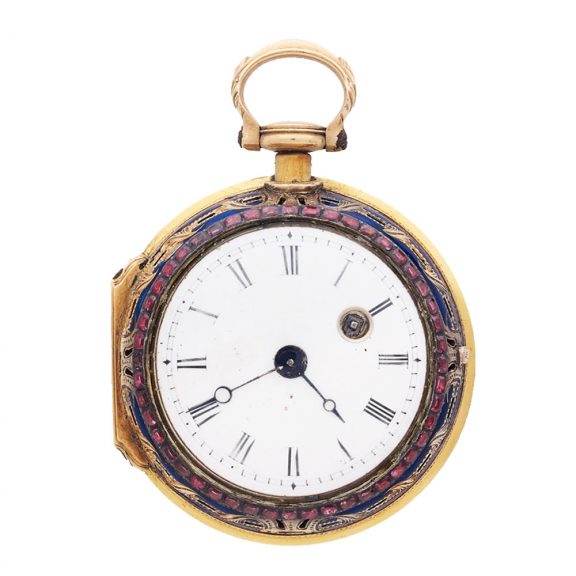
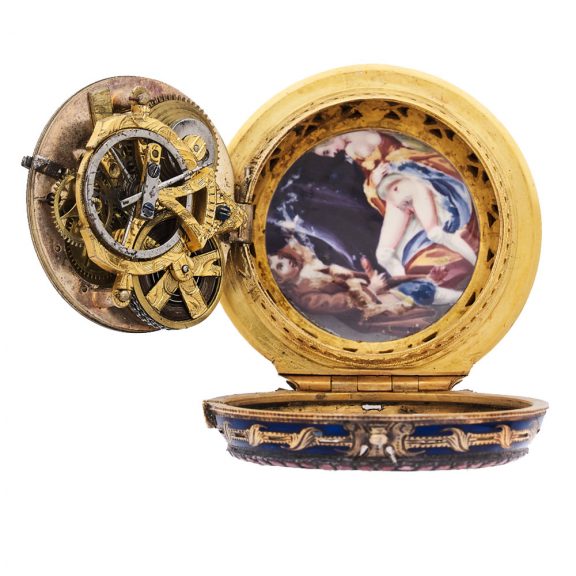
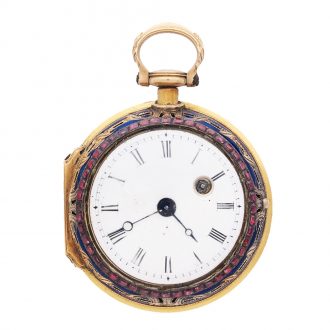
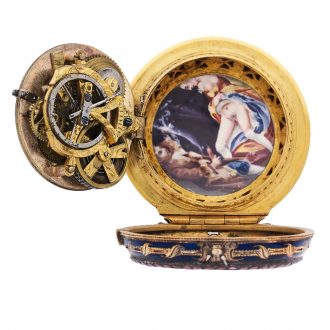
A Swiss naughty gold and enamel watch The two goats with skeleton movement and hidden erotic scene, circa 1750. Full plate gilt movement with key winding, the skeleton assembly with large visible spiral balance, cylinder escapement, fusee and chain mechanism, advance and delay adjustment disc.
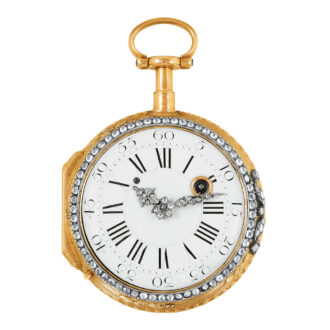
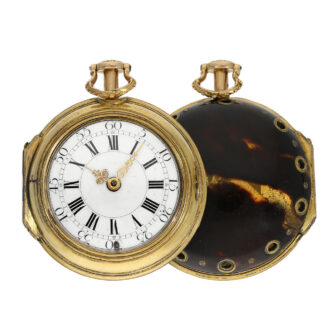
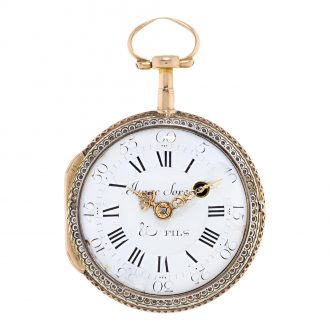
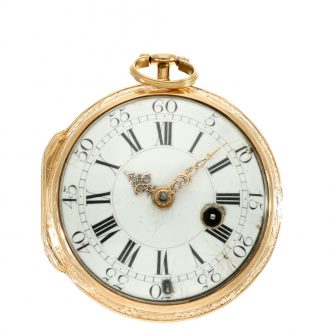
White enamel dial with Roman numerals and railroad minute track, steel Breguet hands, opening for the winding square.
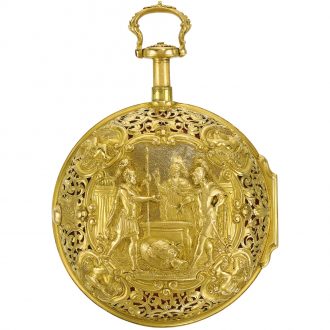
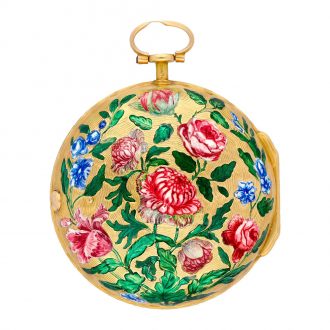
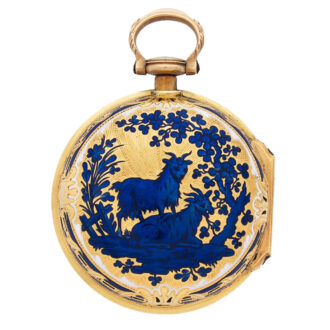
18 Carat round case, the bezel decorated with blue enamel and red stones, the back decorated with a scene in translucent blue champlevé enamel representing two goats in an undergrowth, the entire case conceals on the back of the movement an erotic scene painted on polychrome enamel.
–
Diameter: 34 mm
–
Weight: 38.6 g
–
Signed: No name
–
The dichotomy that exists on this naughty watch between the representation of the two goats on the back of the case and the erotic scene hidden under the movement symbolizes in itself the cult of secrecy that developed during the 18th century. Naughty watches are presented at the time as the art of dissimulation, for the most part they are special orders in an era where Libertinage takes all sorts of forms, including through “secret watches”.
–
The two goats are a recurring motif in the decorative arts of the 18th century, particularly in the Rococo and Neoclassical styles, where they are often used in paintings, sculptures, engravings, and furniture. Their symbolism is rich and multivalent, rooted in mythology, pastoral, and cultural traditions. Here are the main meanings attached to this motif.
Pastoral and the bucolic ideal
In the 18th century, under the influence of the Rococo style, pastoral became a central theme in art and decoration.
Goats evoke an idyllic way of life, in harmony with nature, often idealized in rural or gallant scenes.
They symbolize simplicity, innocence and a nostalgia for a peaceful rural life, in contrast to the tumult of urban or courtly life.
Fertility and abundance
In classical mythology, goats are often associated with ideas of fertility and wealth: Amalthea, the nurse goat of Zeus in Greek mythology, represents abundance and protection. This association has influenced the use of goats in the arts to symbolize the generosity of nature.
The two goats together can also symbolize a harmonious duality or complementarity in nature.
The mythology of Pan and libertinism
Goats are linked to the Greek god Pan, a deity of wild nature, sexuality and personification of lust, symbol of the decadence of Libertinism.
In this context, the two goats can symbolize the cult of dissimulation that is at the origin of the secret watch, the idea of showing in appearance and hiding the deep truth.
This interpretation finds an echo in the libertinism of the 18th century, where the goats can represent a game between apparent innocence and desire, symbol of a certain decadence of morals at the end of the Age of Enlightenment.
Duality and opposition
The two goats can be interpreted as an allegory of duality: good and evil, mind and body, or wild nature and domesticated civilization.
In this sense, they are a decorative motif that invites reflection on the fundamental contrasts of existence.
Share this page: