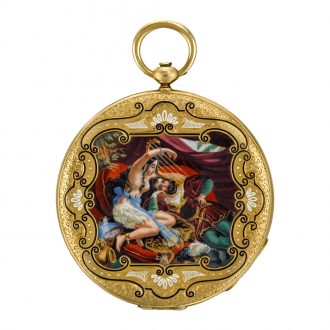
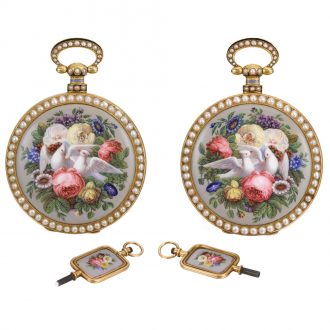
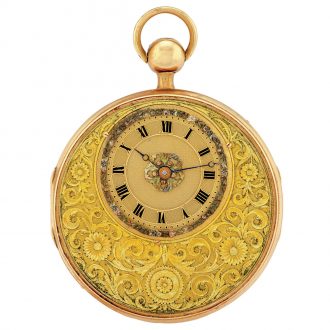
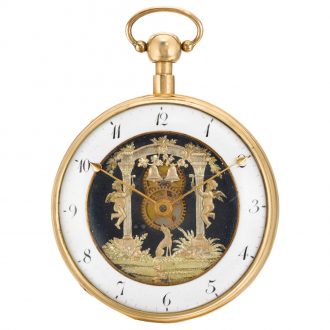
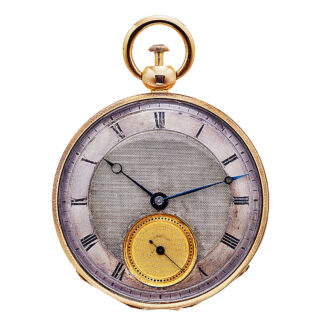
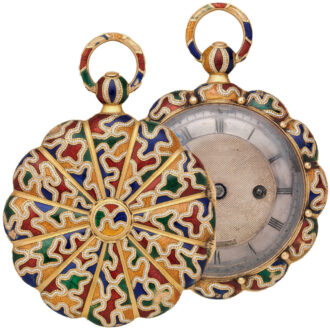
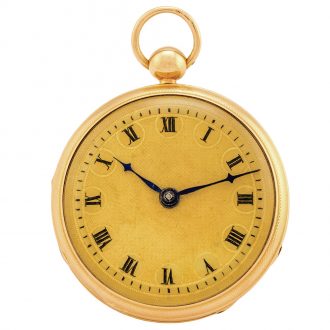
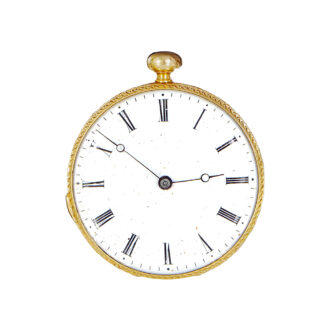
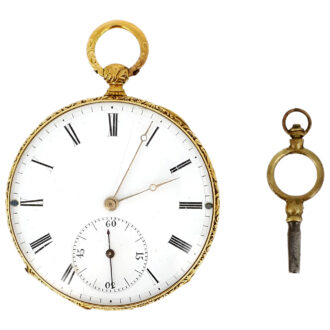
Fine Swiss 18 carat gold open faced cylinder watch Circa 1825
- Kenmerk
- TA1979
- Diameter
- 57 mm
- Estimate
- € 3.500 - 6.500
- Price sold
- € 4.700
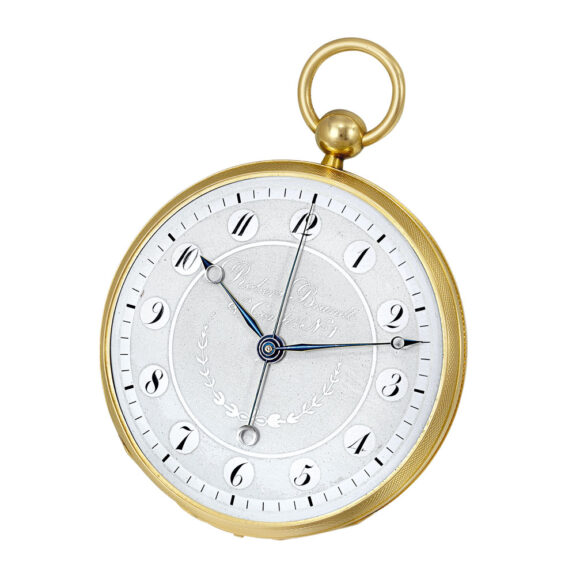
Gold watch with special acid etched enamel dial
–
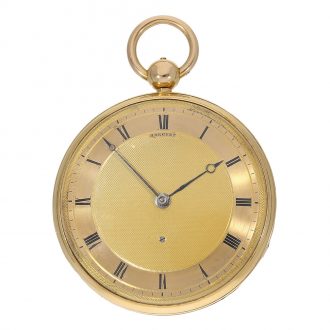
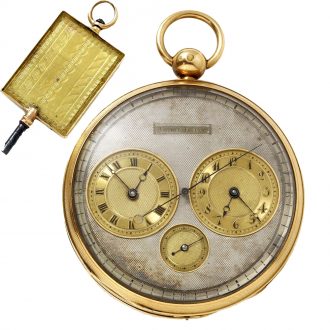
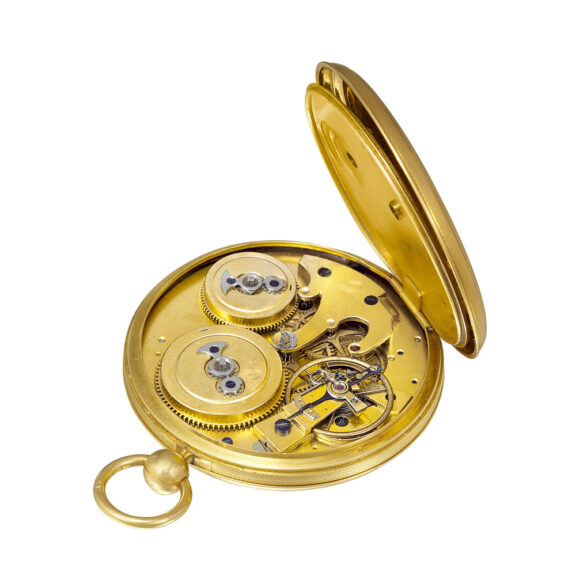
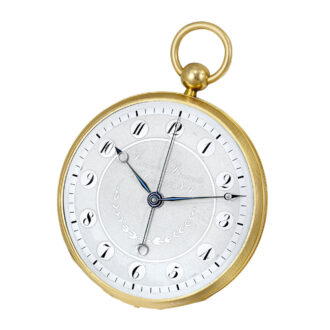
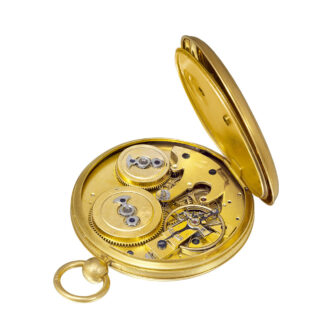
A very fine and very rare Swiss 18 carat gold open faced pocket watch with independent deadbeat center seconds made by Robert Brandt & Compagnie in Geneva, circa 1825. An engine turned case with a vacant cartouche on the back cover, a bolt at 6 o’clock to stop the seconds and a hinged gilt metal cuvette. White enamel dial with painted black Breguet hour numerals on circular reserves, outer minute divisions, the center with a signature on a matt acid etched ground visible in raking light and blued steel hands. A frosted gilt movement with standing barrels for the going and seconds trains, cylinder escapement, plain three arm brass balance, the top pivot with a parachute and blued steel flat balance spring with a bimetallic compensation curb on the index regulator, the escapement and third wheel are jewelled. Dial and cuvette signed.
–
Diameter: 57 mm
–
Signed: Robert Brandt & Compe Genève
–
This sophisticated, high quality watch shows many influences from Breguet watches: the jewelled cylinder escapement with parachute suspension, the numerals and hands, and the simple and stylish design. Of particular interest and highly unusual is that the dial has been acid etched leaving the signature, numerals and decoration in relief, so the signature is not immediately visible unless the watch is held at an oblique angle.
–
Robert Brandt & Compagnie were working in La Chaux-de-Fonds and Geneva in the first half of the 19th century. The company specialized in slim and unusual watches, many of which had Bagnolet caliber movements.
–
The seconde morte, also known as deadbeat seconds, is a complication of a mechanical movement in which the second hand moves every second. This is in contrast to the usual ‘running’ of the second hand. This complication is rare and was seen in the years before the quartz revolution, the 1970s and 1980s, but died a silent death because of the same quartz revolution. The reason for this was that the second hand moves per second in almost the same way as quartz watches, which ultimately also use a frequency of 1Hz. With that, the ‘running’ second hand became the distinction between mechanical and quartz watches. Incidentally, that external similarity only applies to the second hand jumping per second, the underlying mechanism of the dead seconds complication is of course of a completely different order.
Signed: Robert Brandt & Compe Genève
Share this page: