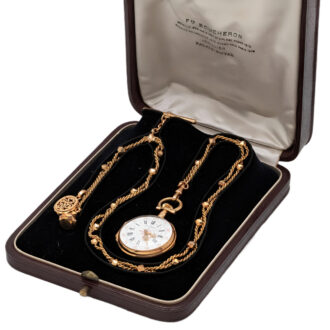
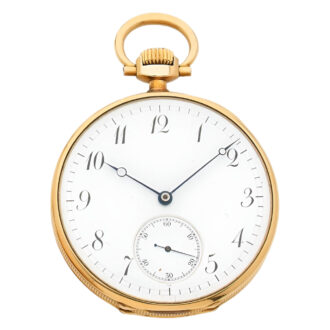
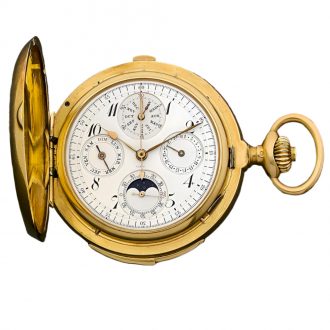
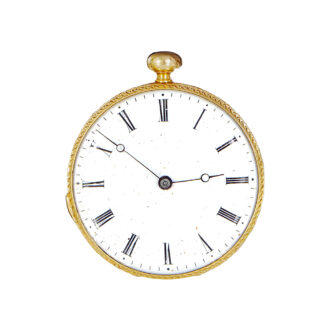
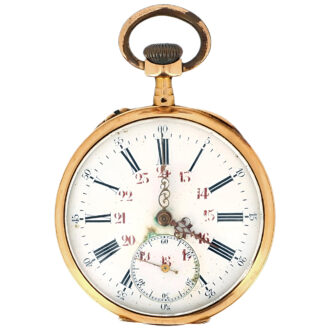
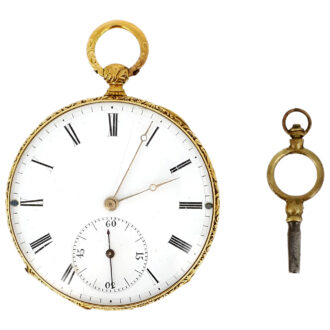
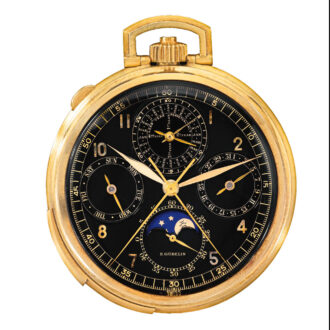
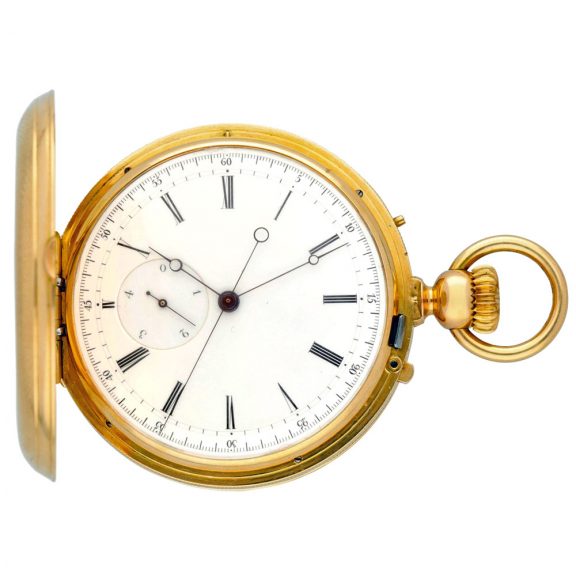
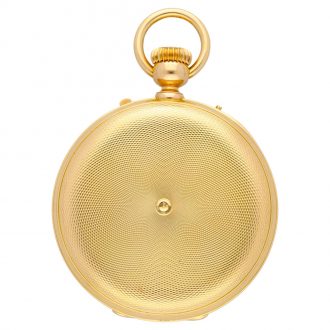
French gold hunting cased keyless lever pocket watch Circa 1880
- Kenmerk
- AS2384
- Diameter
- 54 mm
- Estimate
- € 3.000 - 6.000
- Price sold
- € 3.250
Gold full hunter watch by Bernard Poitevin
–
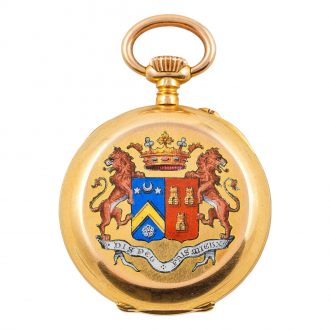
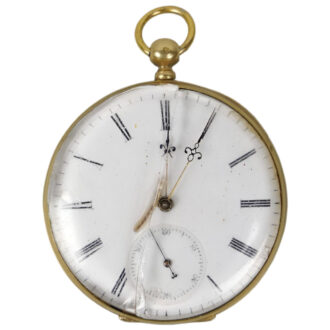
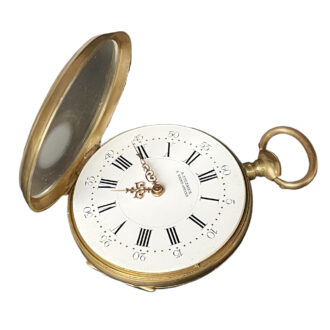
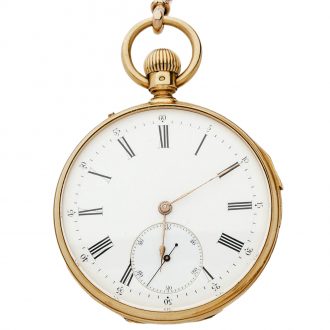
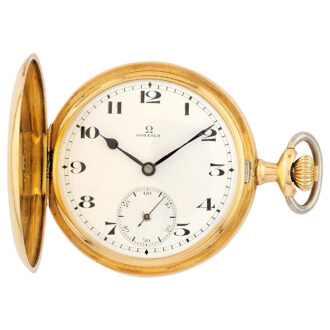
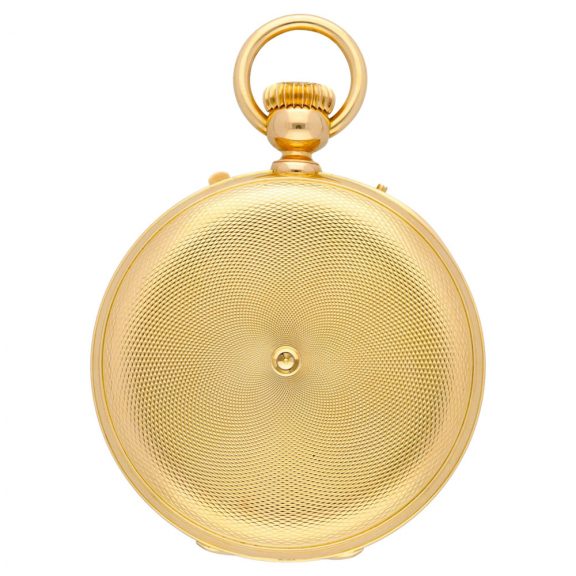
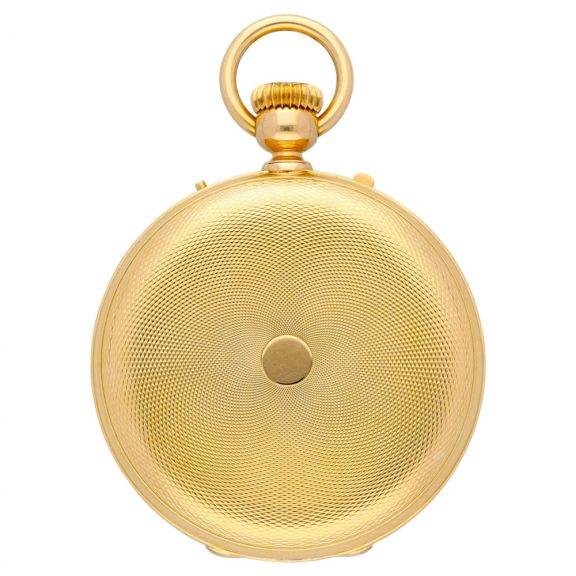
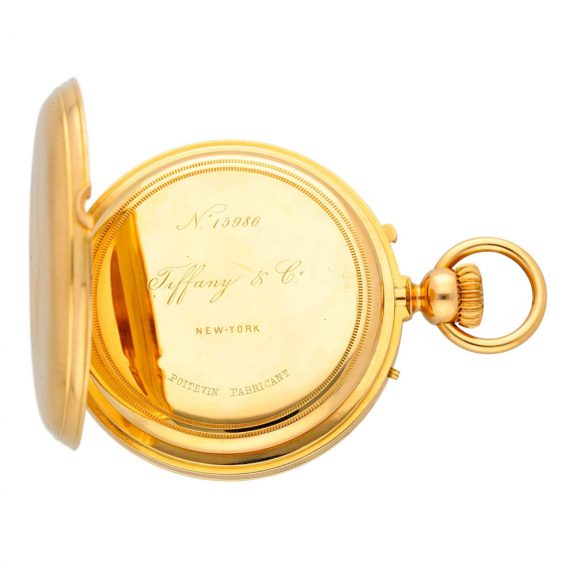
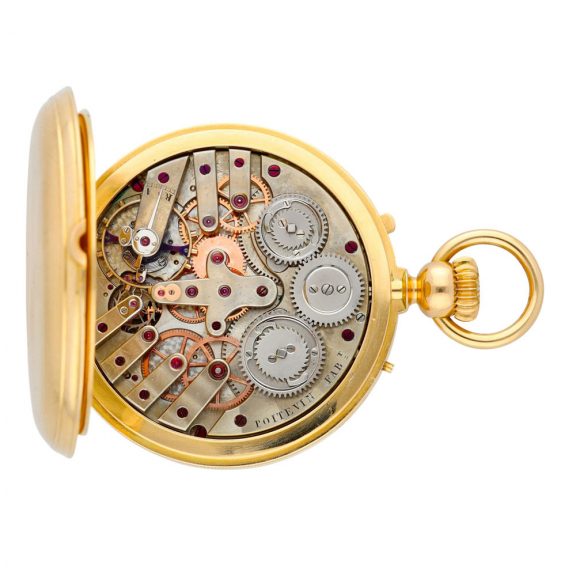
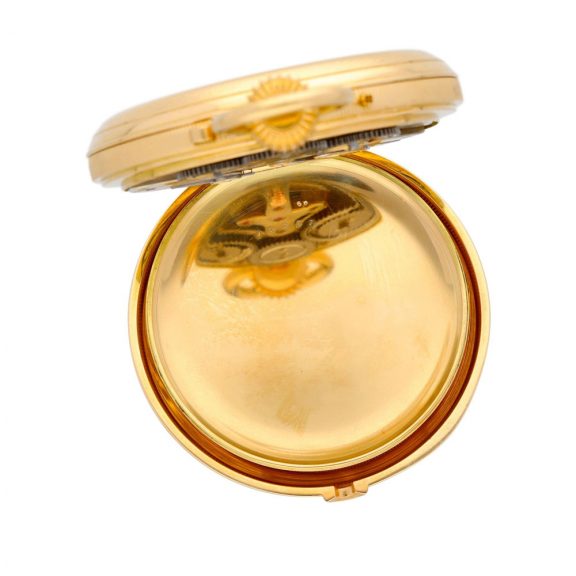
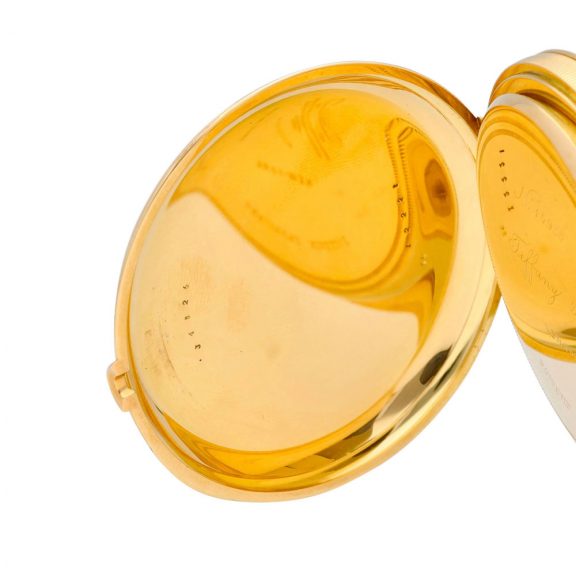
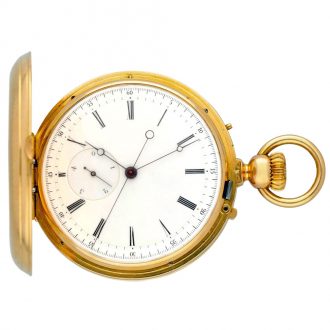
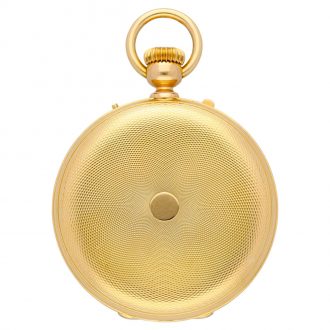
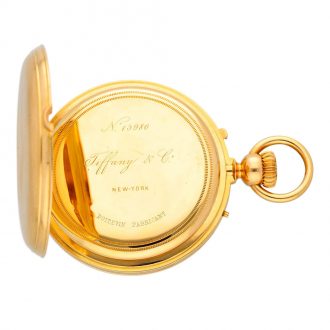
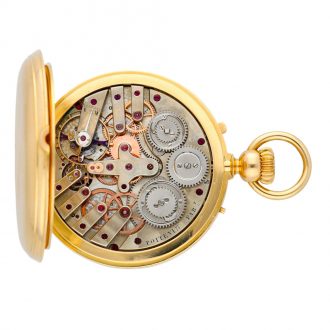
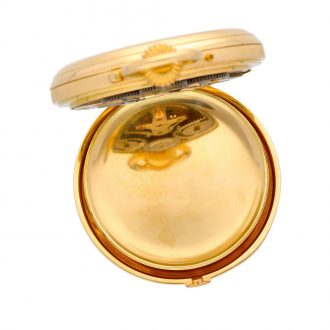
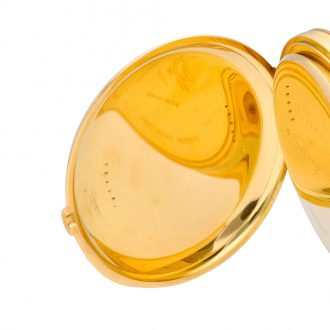
A French gold hunting cased two train keyless lever watch featuring jumping fifths and independent centre seconds, circa 1880, crafted for Tiffany in New York. The watch features a damascened nickel movement, signed Poitevin Fabr, with two trains with differential winding, a lever escapement, a gold wheel train, a bimetallic compensation balance, and a blued steel overcoil hairspring. It boasts a white enamel dial with Roman numerals, blued steel moon hands, independent centre seconds, a subsidiary dial for flying fifths, and outer scales calibrated for minutes and fifths of a second. The 18 carat gold case has engine turned covers, a pusher on the band for operating seconds, an olivette for handsetting, and a polished gold cuvette signed Tiffany & Co. New York, Poitevin Fabricant. In contrast, the inside of the case back and cuvette are numbered, with an additional number on the inside back.
–
Diameter: 54 mm
–
Signed: Tiffany & Co. New York / Poitevin Fabr
–
The movement operates only for brief intervals. The handsetting mechanism is currently stuck in handset mode, but the hands adjust smoothly. The pusher appears to be activating the centre and flying seconds correctly. There is some slight oxidation and tarnishing on the movement. The dial has some scratching between 4 and 5 o’clock. The case is in good condition, with the engine-turned decoration remaining crisp and clear, although there are minor scuffs and scratches.
–
Poitevin, Bernard, Parisian watchmaker and dealer, France
Bernard Poitevin was a Parisian watchmaker and chronometer maker, active from approximately 1850 to 1890. He founded the company B. Poitevin & V. Lejeune, with his business located at Rue Richelieu (1850) and 22 Rue Vivienne (1860-1900), among other sites. Poitevin supplied high quality watches, including complicated models such as striking watches, chronographs, and first class chronometers accompanied by bulletins from the Geneva Observatory. In Bordeaux, he ran a shop at 4 Quai des Chartons for several years, but his more significant establishment was in Geneva. Initially situated at 17 Rue du Mont-Blanc (1861), the Geneva store moved to 21 Rue du Mont-Blanc in 1870. From 1880, Rizzoli Dechamps took over from Bernard Poitevin, and from 1900 to 1935, the company was managed by L. Gironde, who continued to operate it as Poitevin, Gironde Successeurs. The shop was located in Geneva at 14 Boulevard James-Fazy, while the Paris branch remained at Rue Vivienne. Additionally, Poitevin provided watches with striking mechanisms to Louis Raby, such as No. 6890. He married Josephine Louise Vannier on 5 October 1851 and resided at 27 Rue Saint-Marc-Feydeau.
–
The diablotine is a small subsidiary dial found on a chronograph or an independent center-seconds pocket watch. The hand of this dial moves in a jumping manner, typically at intervals of 1/4 or 1/5 of a second. The term “diablotine” literally translates to “little devil.“ When the chronograph or center-seconds is stopped, the diablotine hand halts, allowing the user to read fractions of a second.
Signed: Tiffany & Co. New York / Poitevin Fabr
Share this page: