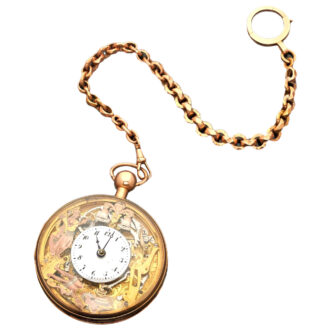
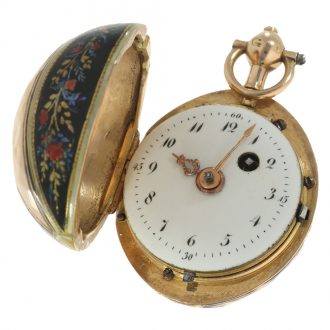
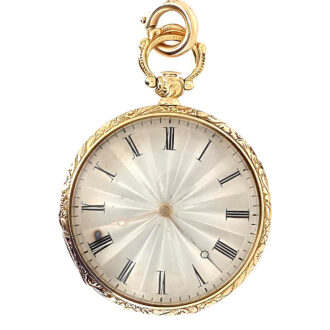
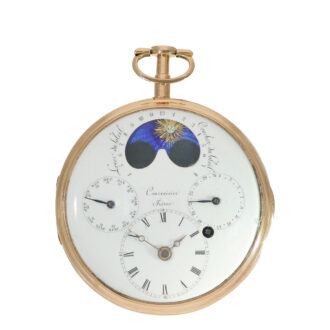
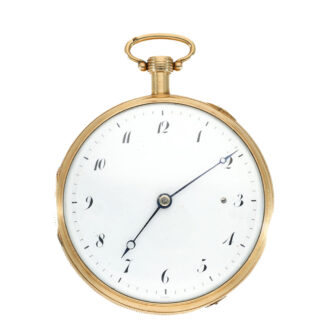
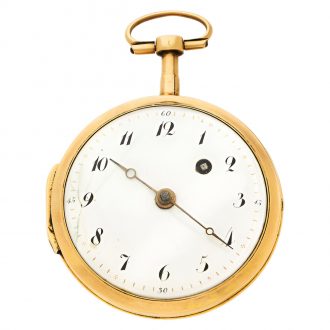
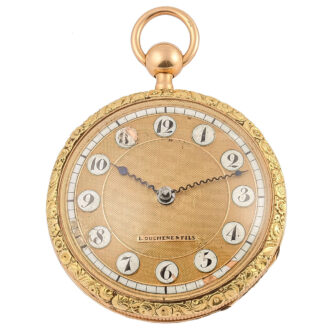
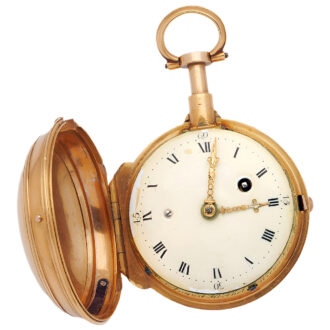
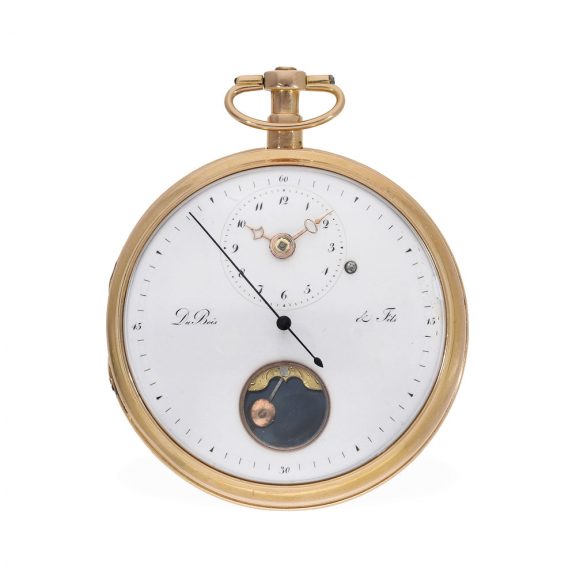
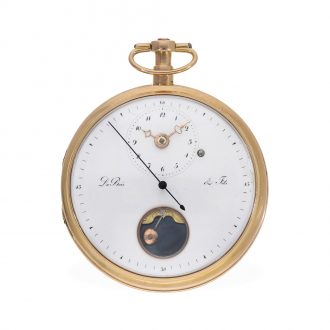
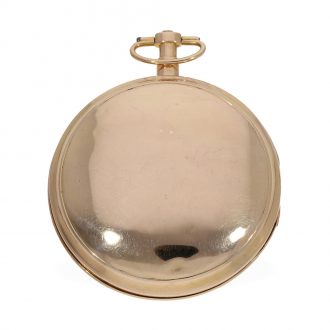
Swiss 18 carat gold watch with mock pendulum Circa 1800
- Kenmerk
- HC1175
- Diameter
- 58 mm
- Estimate
- € 6.000 - 12.000
- Price sold
- € 12.400
Pocket watch with Debaufré escapement
–
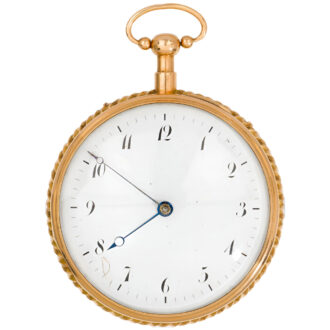
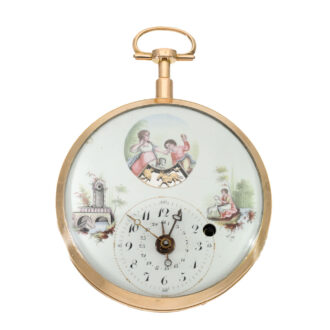
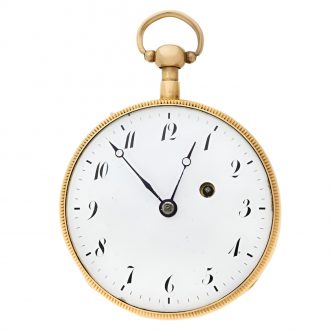
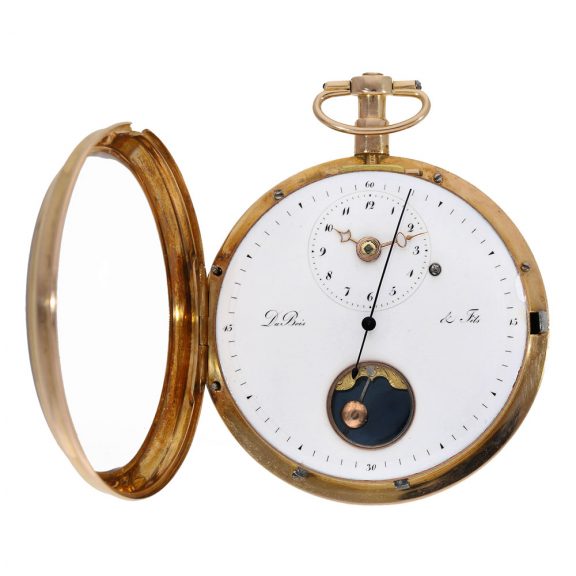
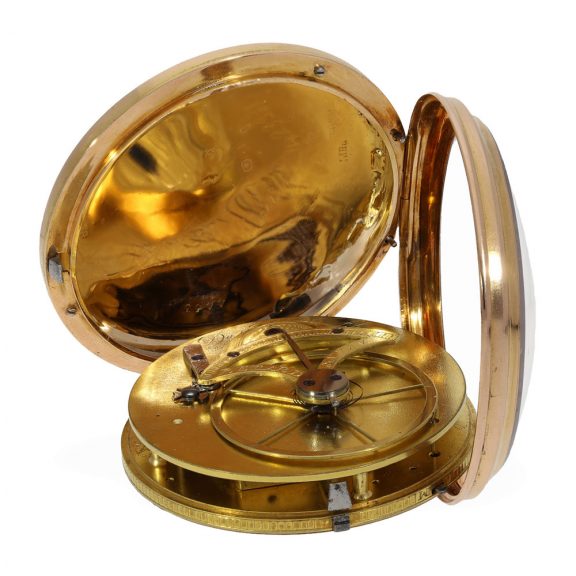
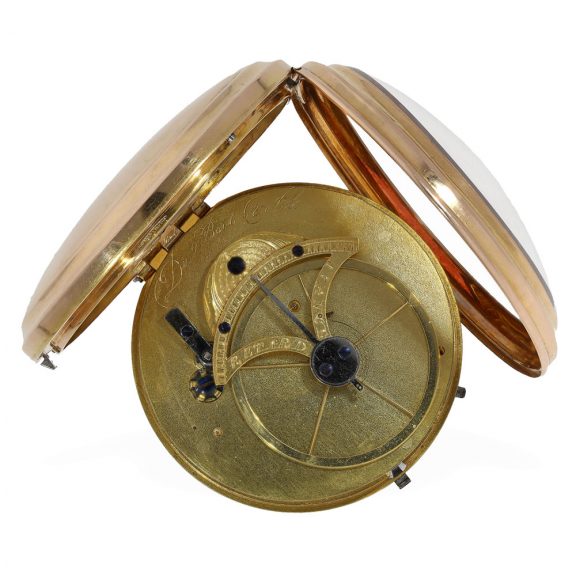
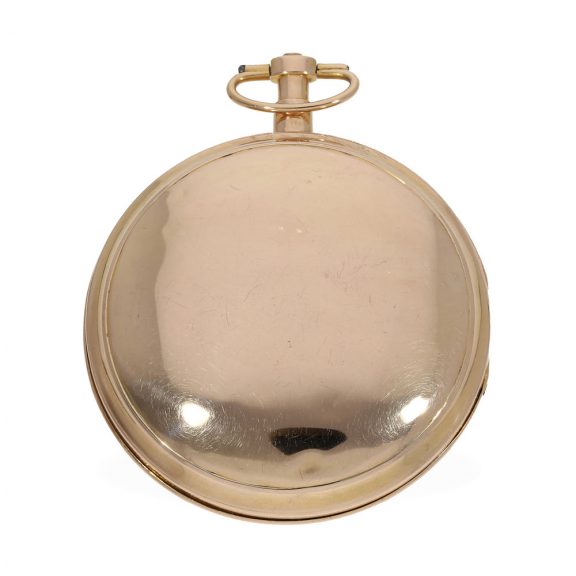
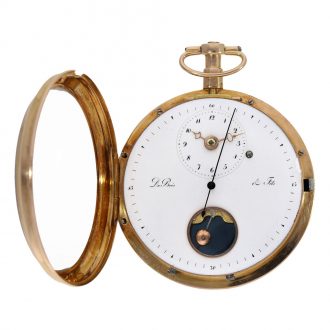
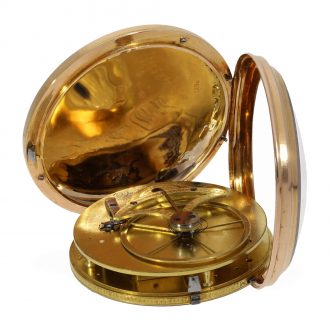
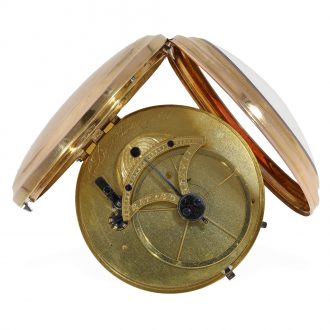
A pocket watch with mock pendulum, Pouzait balance, a pirouette and a Debaufré escapement, made by Du Bois & Fils in le Locle, Switzerland, circa 1800. The plain case of this open faced watch is crafted from 18 carat gold and has a hallmark under the dial. The white enamel dial has an outer ring with Arabic numerals for the center seconds, decentralized time display at 12 o’clock, and an open window at 6 o’clock showing the mock pendulum. The full plate movement a Debaufré escapement, a pirouette and a Pouzait balance wheel.
Dial and movement are signed.
–
Diameter: 58 mm
–
Weight: 109 g
–
Signed: Du Bois & Fils
–
The case of this item has been restored on the inside edge area and only five different signed watches of this type are known to date. They all have a three digit number and the hallmark “PG” under the dial. The watch presented here is so far the only gold example with a Pouzait balance. Du Bois built these clocks in two versions, one with pirouette and a second one without pirouette. All of these watches are rarities, but the Pirouette ones are the rarest. The sister watch was sold in 2012 for around € 30.000 and will be presented in detail by “Pieces of Time” in London. Another gold specimen was auctioned in Geneva in 1994, formerly in the Time Museum collection and fetched CHF 27.600.
–
Du Bois
In 1785 Philippe Du Bois and his sons founded the Du Bois & Fils 1785 watch company at the family seat in Le Locle. Du Bois had already established extensive business connections all over Europe and America as a cloth merchant, which made things much easier for the start-up watch company. During the 19th century, Du Bois & Fils opened branches in Germany, the Netherlands, Spain and the United States and business boomed. Due to its proximity to the trade fairs, the German Frankfurt branch was particularly important.
The Debaufré Escapement, Invented by P. Debaufré in 1704, this escapement is distinguished by having two escape wheels which are mounted on the same arbour. The escape wheels are staggered. They interact with a semi-circular, wedge-shaped pallet on the balance staff which has chamfered edges. The wheels, which alternately rest on the flat underside or escape past it, impart the impulse to the balance.
–
Pirouette
The pirouette is a very old complication used to increase the balance amplitude permanent contact type escapements. As so often when reviewing the accomplishments of past generations one must come to the conclusion that even without today’s hi tech and fast prototyping our great-great-grandfathers’ watchmakers were at least as ingenious as today’s engineers.
Signed: Du Bois & Fils
Share this page: