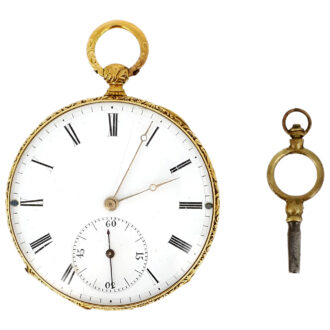
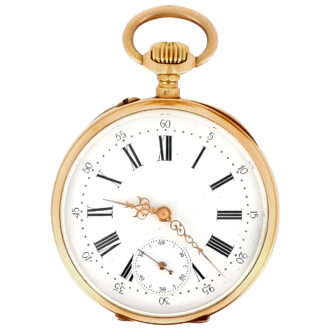
Swiss 18 carat gold and enamel chronometer Circa 1850
- Kenmerk
- TA5191
- Diameter
- 46 mm
- Estimate
- € 8.000 - 16.000
- Price sold
- € 11.900
Gold pivoted detent chronometer
–
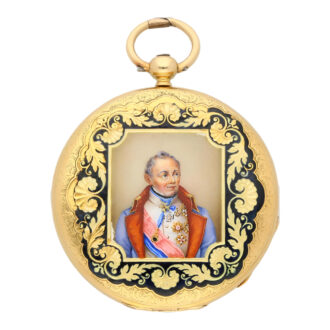
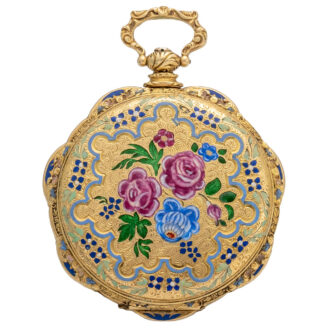
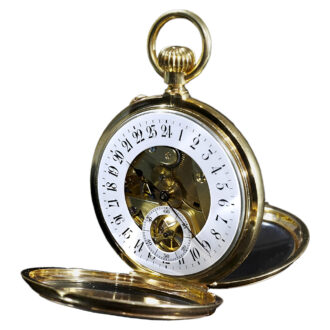
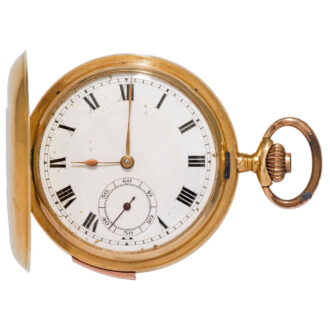
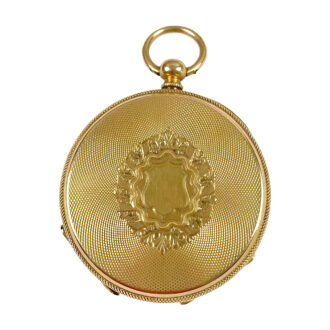
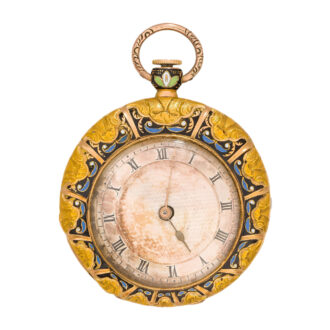
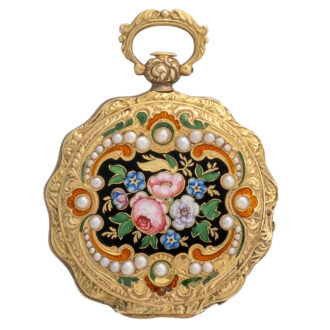
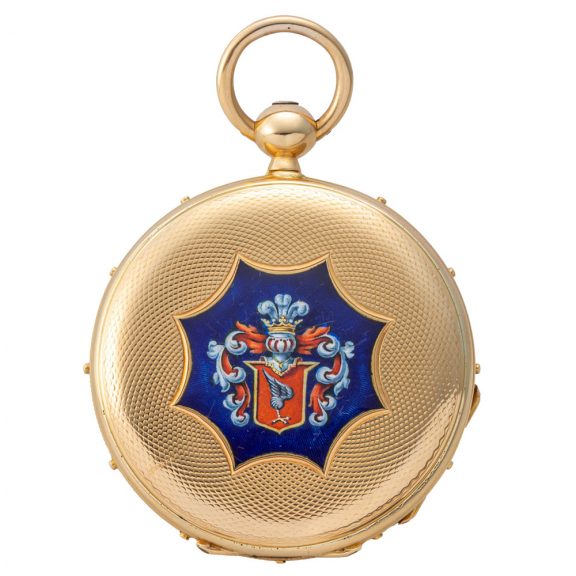
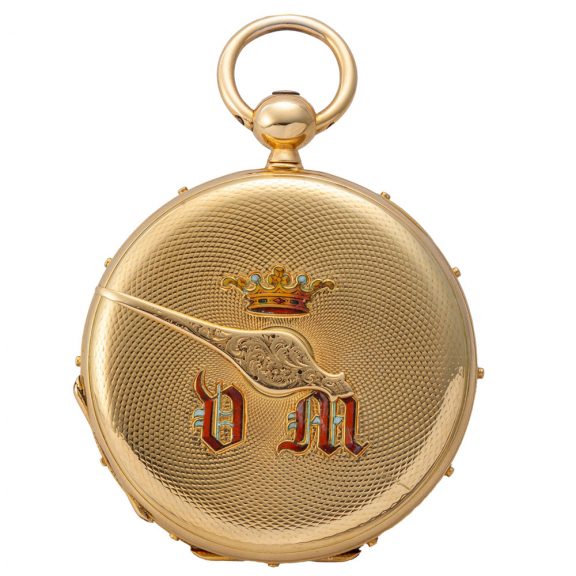
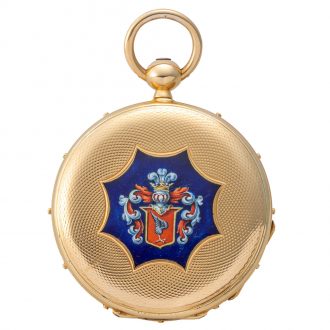
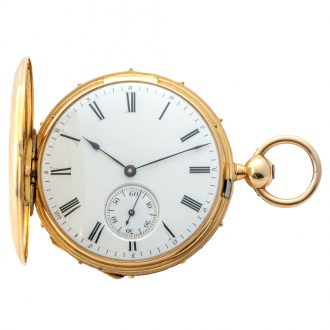
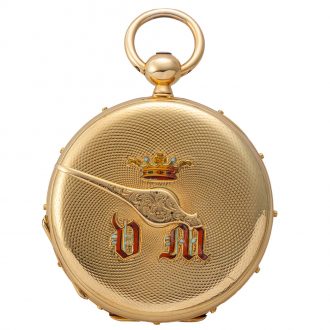
An important Swiss 18 carat yellow gold and enamel hunting cased pocket chronometer made by Bautte & Co. in Geneva for the Polish nobleman Meleniewski, circa 1850. A montre à tact watch with pivoted detent chronometer escapement, sidereal time chart and special dial. The front cover from the engine turned case with the finely painted polychrome enamel coat of arms of the Kopacz Meleniewski family on a translucent royal blue enamelled ground, a foliate engraved à tact hand and the multicoloured enamel initials UM beneath a Polish Noble Crown on the reverse, further polished borders and a coin edged band with pins for the à tact time indication.
–
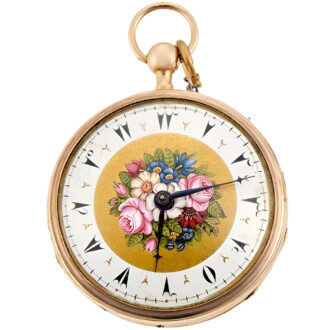
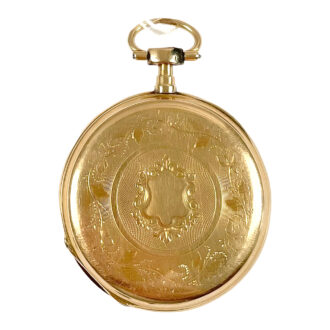
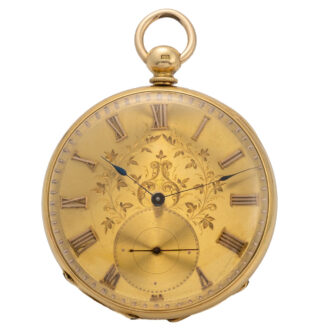
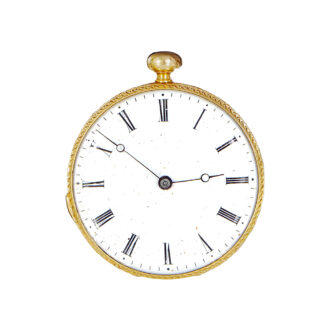
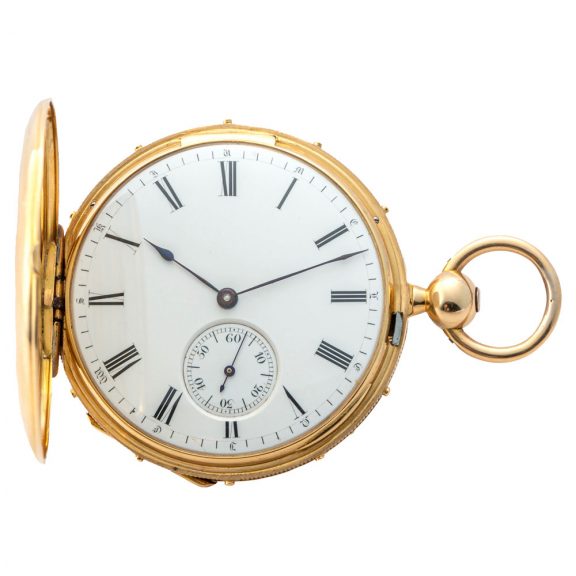
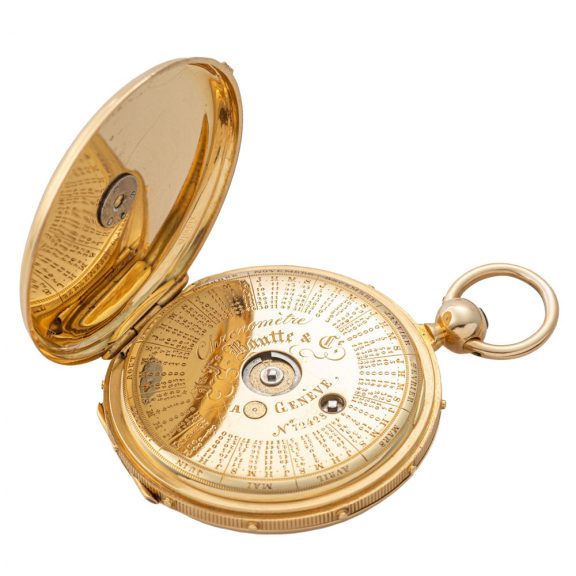
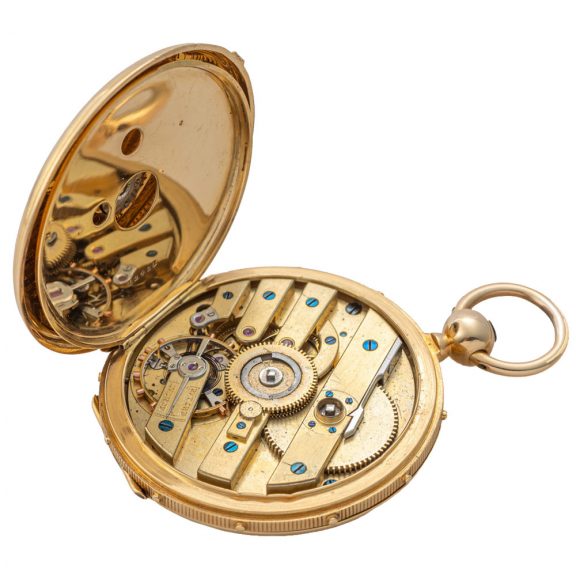
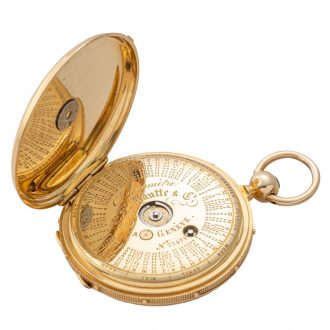
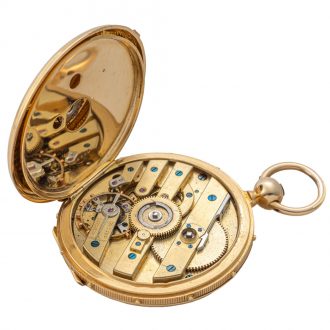
The hinged gold cuvette engraved with a sidereal time chart for each month, featuring dates and hours, and minutes and seconds. White enamel dial with Roman hour numerals, an outer minute track with gothic letters at each five minute spelling the name U. Meleniewski, subsidiary seconds and blued steel spade hands. A matte gilt bar caliber movement, 12 jewels, pivoted detent escapement, cut bimetallic compensation balance, Breguet balance spring and an index regulator. Signature on the dial, case and movement.
–
Diameter: 46 mm
–
Signed: Bautte & Co. Geneva
–
A montre à tact watch with detent chronometer escapement, whilst not unknown, is exceptionally rare. This watch was evidently specially ordered by Meleniewski not only because it bears his coat of arms and initials, but the dial also spells out his name by a gothic letter at each five minute interval.
The Polish Noble Crown is very similar to that of a Marquis. The Meleniewski family, originally from Podolia in the southwest of the Ukraine, conquered in 1793 by the Russian Empire, is an illustrious noble Polish family, on a par with the Poniatovskis, Radziwills and the Wiśniowieckim.
Stanislas Kopacz de Meleniewski (1846-1908) was a commander of the Order of Saint John of Jerusalem and the Sovereign Order of Malta. He was an officer in the Russian Imperial Army and a deputy in the Assembly of the Nobility of Kiev. He was decorated with the pontifical order of Saint Gregory.
–
In 1876, he married Countess Ernestine Rzewuska (1848- 1908), also from a noble Polish family, and the niece of Mme Hanska, the second wife of Honoré de Balzac. They acquired a home in Hyères in the south of France in 1869, where they spent a great deal of time. Many members of the family are buried in the chapel of the former Hôtel-dieu in Hyères, which was given to the city by Count Darius Poniatowski, an uncle of Ernestine.
–
Sidereal time. A unit of time used by astronomers. The sidereal day is the interval between two consecutive upper transits of the vernal point in the plane of the meridian. Since in practice this can be measured as the Earth’s rotation with respect to distant celestial objects, it is called sidereal or star time (sider means star in Latin). The sidereal day is 23 hours, 56 minutes and 41 seconds. The sidereal year contains one more day than the solar year.
Signed: Bautte & Co. Geneva
Share this page: