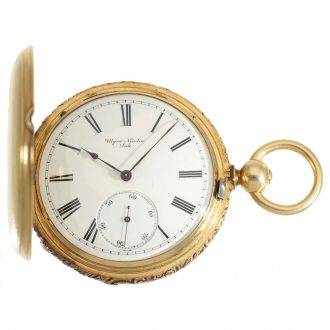
Swiss 18 Carat gold watch with five complications Circa 1860
- Kenmerk
- FA0467
- Diameter
- 51 mm
- Estimate
- € 7.000 - 12.000
- Price sold
- € 7.650
Gold complicated watch attributed to Eugène LeCoultre
–
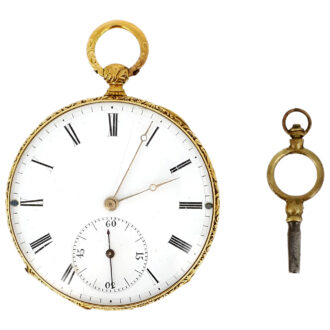
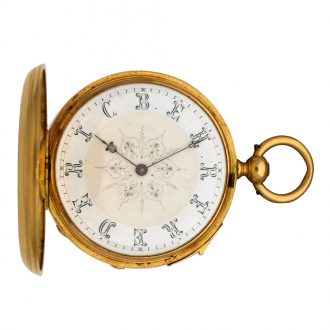
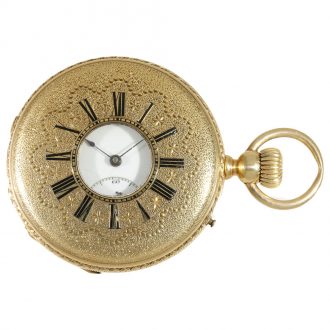
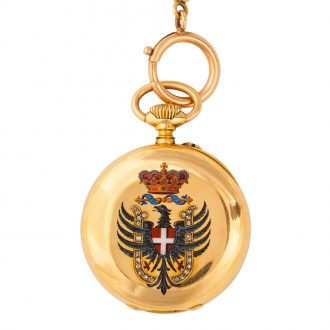
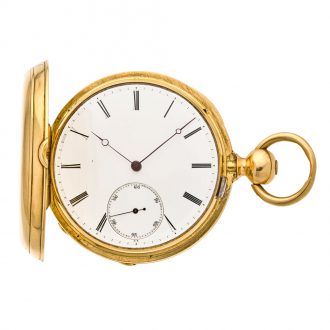
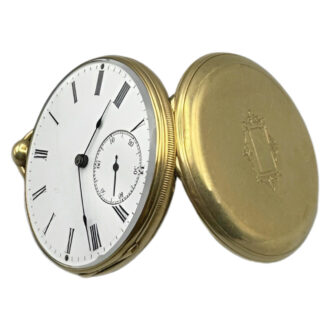
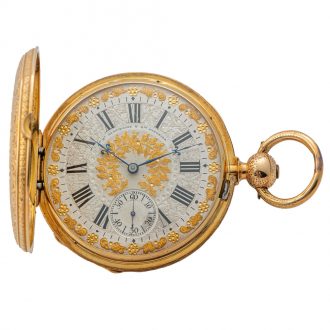
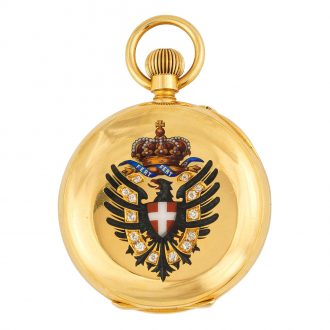
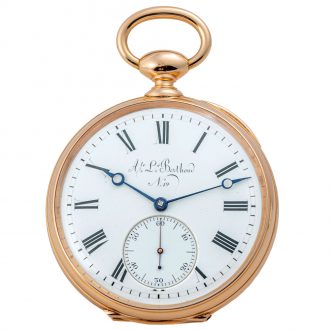
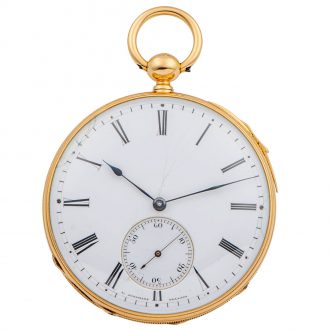
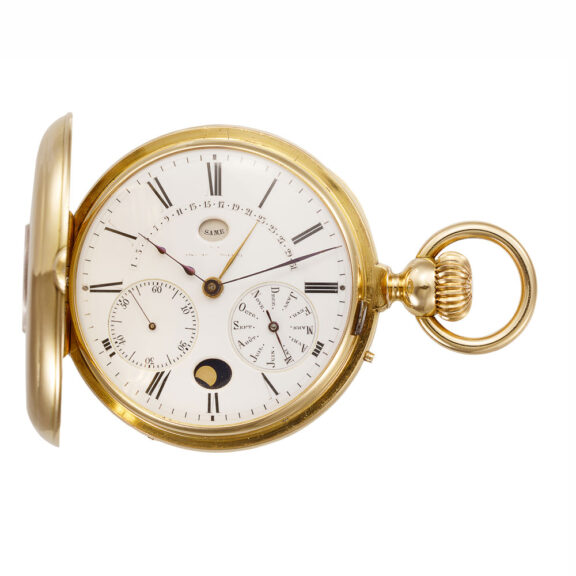
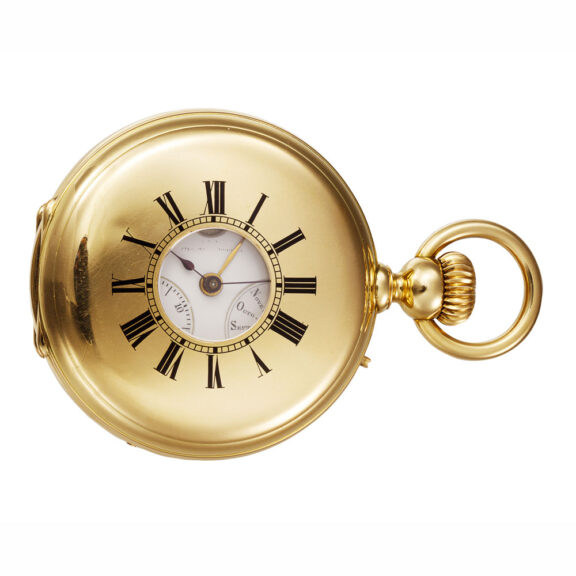
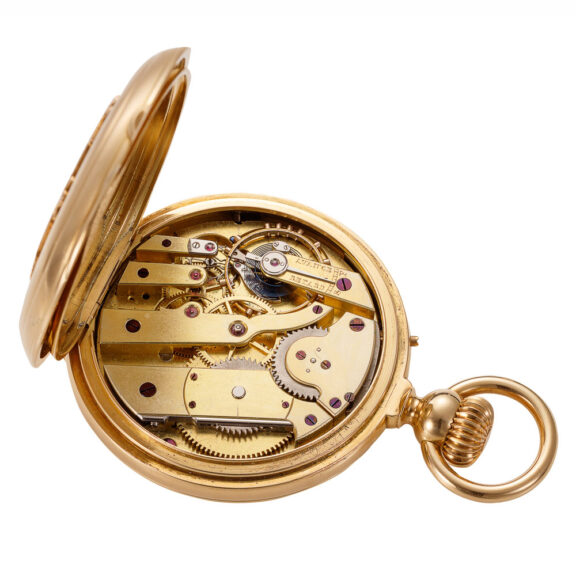
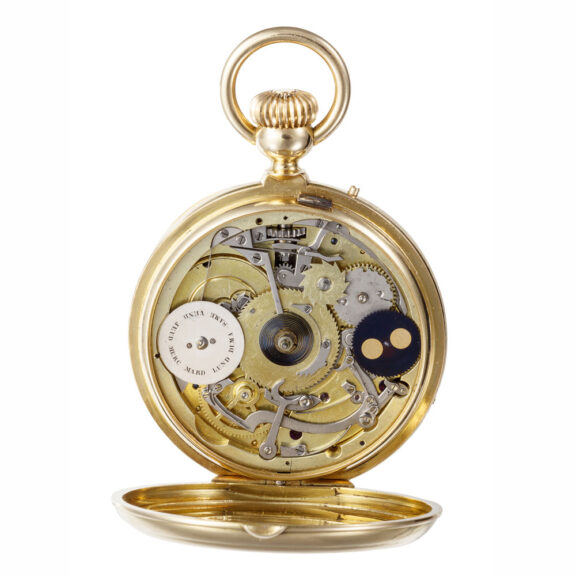
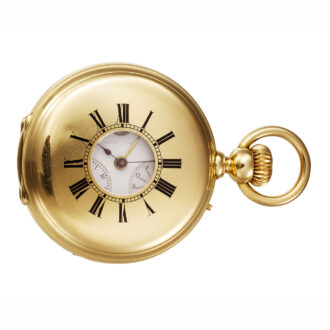
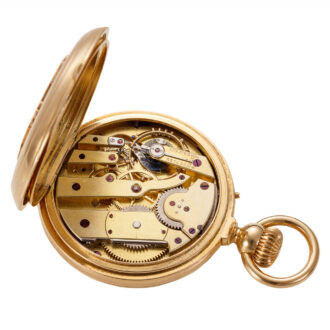
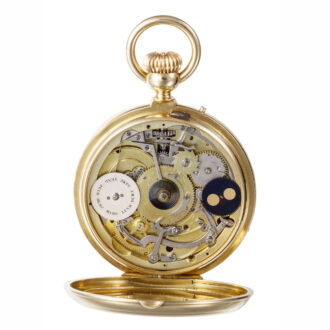
A fine Swiss 18 Carat yellow gold half hunter cased keyless lever pocket watch with five horological complications attributable to Eugène LeCoultre, circa 1860. Retailed by Mercier & Fils, Geneva. Gilded brass movement, going barrel, straight line equilibrated lever escapement, compensated balance with gold poising screws and blued steel hairspring with terminal curve.
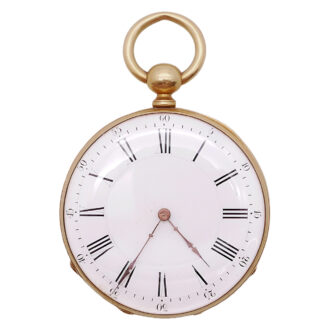
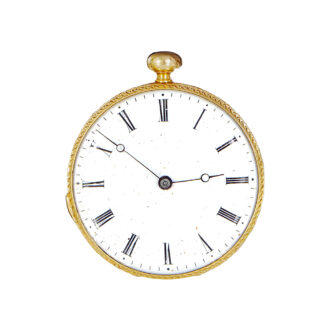
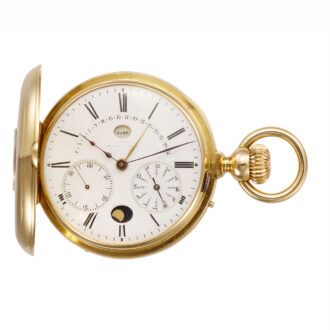
Plain round shaped case, hinged back engraved in taille douce with the cypher EC, hinged cover. White enamel dial with Roman hours and outer minute divisions, subsidiary seconds at eight o’clock, five horological complications: instantaneous perpetual calendar, retrograde (flyback) date of the month (half circle graduation at 12 o’clock), days of the week (aperture at 12 o’clock, indications given in French), months of the year (subsidiary dial at four o’clock, indications given in French), moon phases (aperture at 6 o’clock).
Cuvette signed by the retailer.
–
Diameter: 51 mm
–
Signed: No name
–
Retrograde perpetual calendar watches with perpetual calendars and a flyback indication of the date, socalled retrograde, were produced in very few examples in the 1860-1880’s by some Genevan workshops, including those of Eugène Lecoultre (1819-1882), Henri-Robert Ekegrèn (1823-1896) and Patek, Philippe & Cie. Note that at this time, other watchmakers in the Vallée de Joux produce a few rare pieces with this same horological complication. The Breguet House of Paris on order at Louis Audemars & Cie, Le Brassus. Eugène Lecoultre is most likely the author of this watch, whose main plate is punched “Geneve”.
–
Eugène-Constant Lecoultre (1819-1882), originally from Le Chenit, Vallée de Joux, Switzerland, married in 1842, in Geneva, with Louise-Jacqueline-Simone Soldano (1820-1858), a precision timekeeper adjuster, the couple has three children. His spouse, in his second wedding, in 1861, Eglantine Cellier (1838-1924), the couple has 14 children, at least six of whom arrive in adulthood. He seems to open his workshop in Geneva in 1848. He manufactures watches with horological complications, very neat, including those with a retrograde perpetual calendar that seems to be his invention. He also looks after the precision adjustment of watches. In 1880, he won First prize at the timing contest of the Geneva Astronomical Observatory (for a Chronometer with lever escapement, Breguet hairspring, set by himself, No. 2 370, with 192.3 points). He is mentioned in Geneva as a manufacturer, adjuster and watchmaker-merchant (in 1848, 1857, 1862, 1874, etc.), under the trade-names Lecoultre-Soldano, Lecoultre-Cellier, and Lecoultre & Cie. He was located in Geneva, 8, rue François Bonivard, at the foot of the Saint-Gervais district, on the right bank of Lake Geneva. A watch with minute-repeater, chronograph and retrograde perpetual calendar, signed by him, was sold by Antiquorum, Geneva, April 18, 1998, lot 561, for the amount of CHF 35.650.
–
His eldest son (from the first marriage), Marius Lecoultre (1847-1915) works with him and takes over the paternal affair, it is to him that we owe the invention of watches known as Boules de Genève. Note that the relationship between Eugène-Constant Lecoultre (1819-1882) of Geneva and Charles-Antoine LeCoultre (1803-1881) of the Vallée de Joux – founder of what is today Jaeger-LeCoultre manufacture on Le Sentier – dates back to eight generations, with the honourable Pierre (I) Le Coultre (circa 1532 – circa 1602).
Share this page: