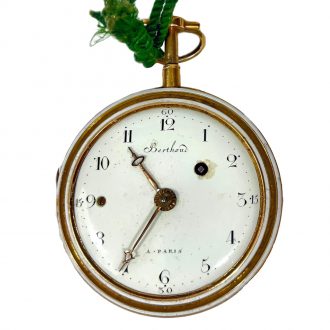
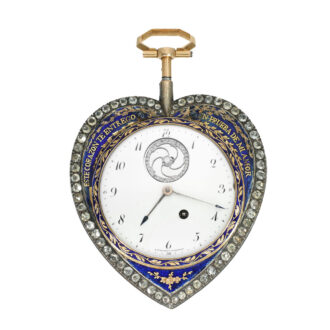
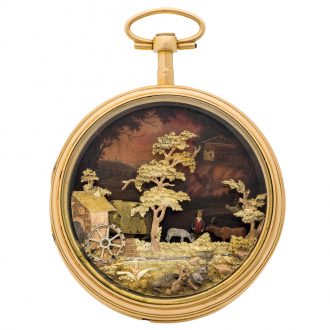
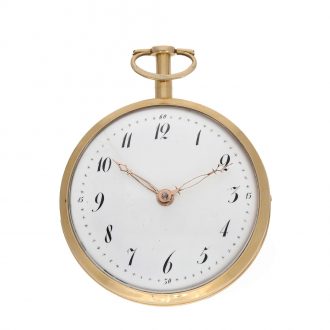
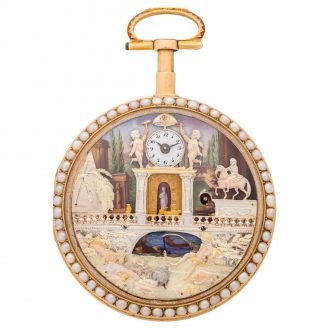
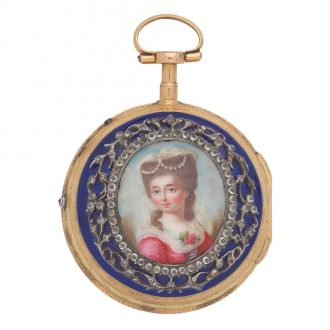
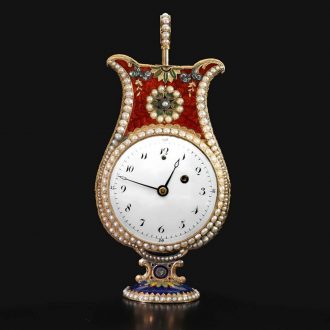
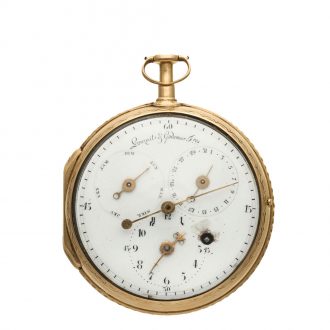
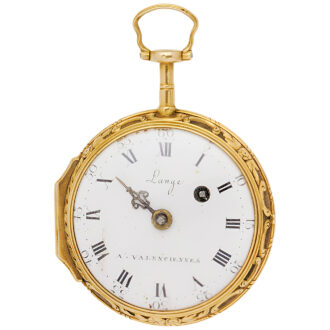
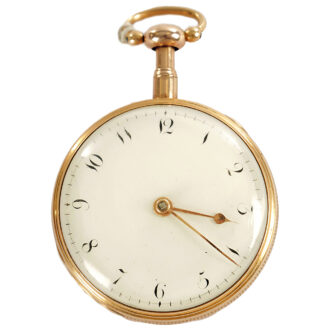
Swiss gold watch made for the Spanish market Circa 1790
- Kenmerk
- TA5425
- Diameter
- 54 mm
- Estimate
- € 9.000 - 17.500
- Price sold
- € 11.300
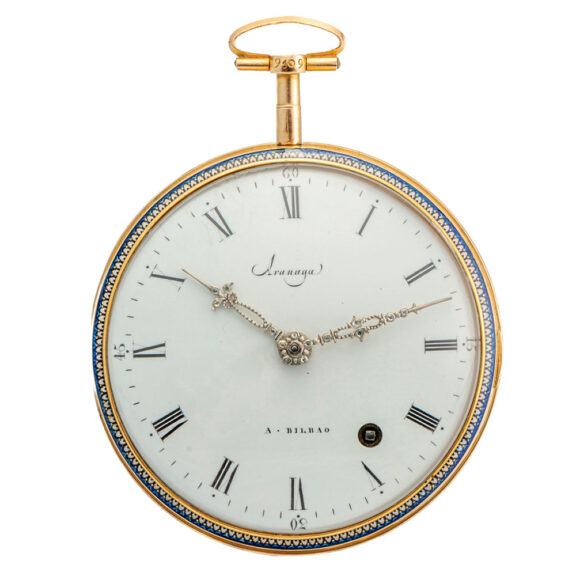
Gold verge retailed by Aranaga, Bilbao, Spain
–
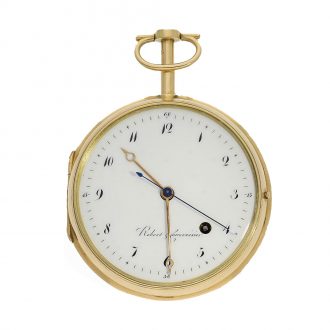
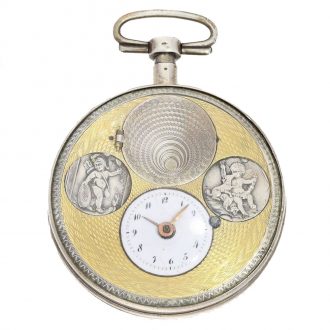
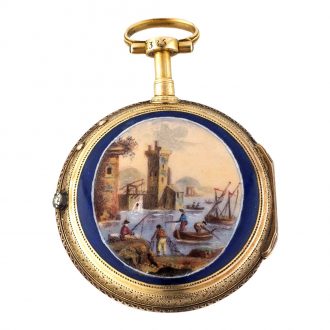
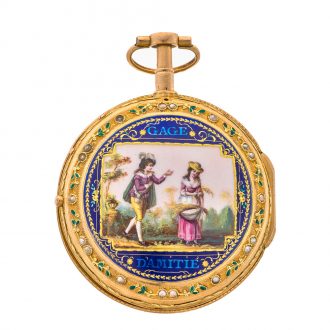
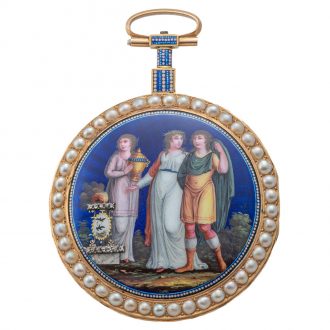
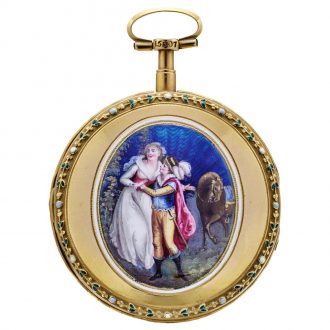
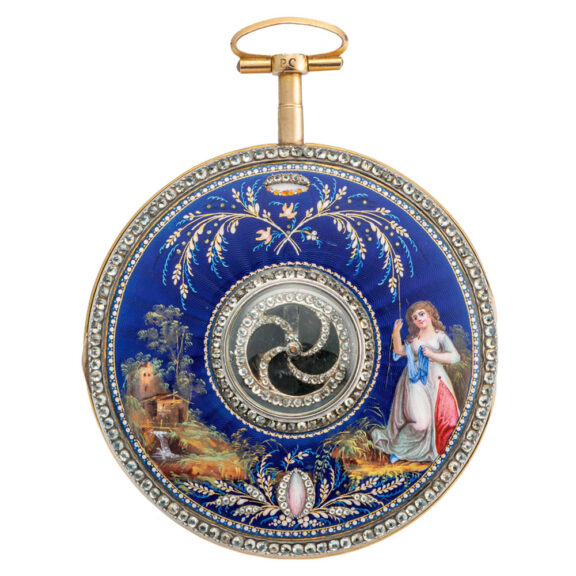
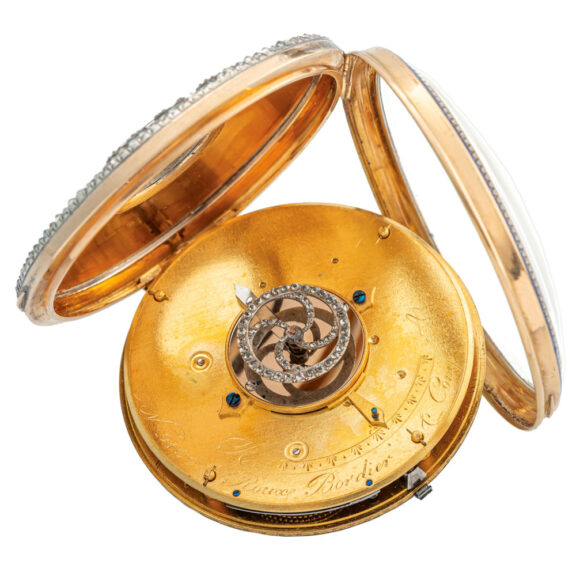
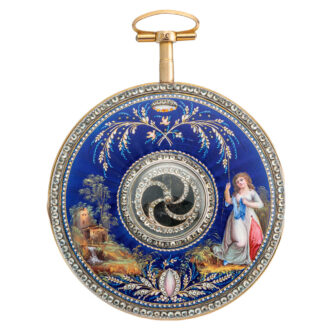
An excellent Swiss, 18 carat yellow gold, silver, enamel and diamond keywinding pocket watch, made by Roux, Boudier & Cie in Geneva, circa 1790. Made for the Spanish market, an open faced Directoire pocket watch with visible paste set balance, enamel in the manner of Jean-Louis Richter. Royal blue translucent enamel over guilloché case back with gold paillon and rose cut diamonds flower garlands, in the center, the aperture for the balance inside a silver frame border set with rose cut diamonds. On the right, a young lady and on the left, an old tower near a stream.
–
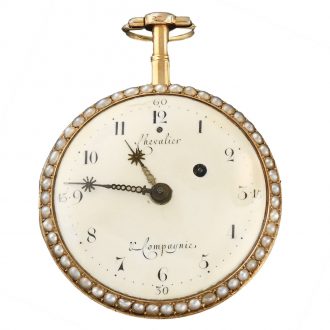
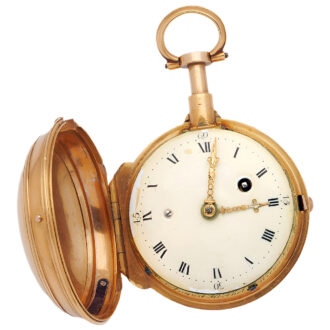
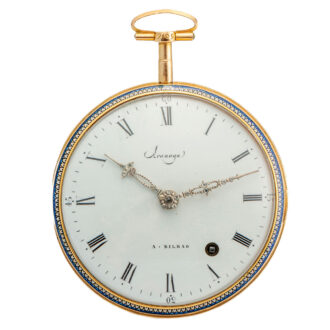
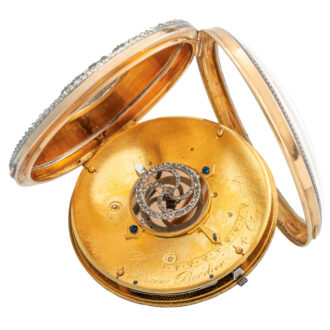
Silver border set with rose cut diamonds, the painting on enamel on gold, attributable to Jean-Louis Richter (1766-1841), Geneva. White enamel dial with radial Roman numerals, outer minute track and yellow gold beautiful paste set hands. A full plate, gilded brass movement with fusee and chain, verge escapement, monometallic balance and blued steel flat hairspring; mirror-polished steel cock with a mirror polished plate on which the balance oscillates. Signature on the case, dial and movement.
–
Diameter: 54 mm
–
Weight: 81 g
–
Signed: Roux, Boudier & Cie, Geneva
–
Accompanied by a contemporary brass key.
–
Roux, Bordier & Cie
The Bordier brothers were associated with watchmaking in Geneva as early as 1794. In 1815, they worked at the Grand Mézel. In 1794, they took Roux and Romand into partnership, establishing the company Bordier, Roux, Romand & Cie. Between 1794 and 1811, they were specialised in automaton repeating watches as well as complicated or skeletonized watches, with calendar, often decorated with painted enamels, pearls and gemstones.
–
Richter, Jean-Louis (1766-1841)
Learned his art in Geneva under David-Etienne Roux and Philippe-Samuel-Théodore Roux, becoming a most renowned enamel painter. His speciality was the painting of landscapes and particularly lake-side scenes and marine-scapes, often representing ships in a harbour or battles with fighting Men-of-War, but, on occasion, also portraits and hunting scenes. He did not often sign his work, but it is clearly recognised as being in his hand from the style and quality of the painting. He applied his art principally to watch cases and snuff-boxes, and these were largely destined for the Chinese, Turkish, British and Italian markets. In 1828, he was in partnership with Aimé-Julien Troll (1781-1852), and one can find work signed “Richter et Troll”. Richter, like other great enamel painters of the time, often found inspiration for his work from paintings or engravings by the artists then in fashion, particularly Claude Vernet or the romanticised English and Irish rural life.
Signed: Aranaga, A. Bilbao
Share this page: