Extremely rare Swiss gold miniature cylinder watch Circa 1850
- Kenmerk
- FA0260
- Diameter
- 14 mm
- Estimate
- € 2.000 - 4.000
- Price sold
- € 4.850
Gold and enamel miniature watch
–
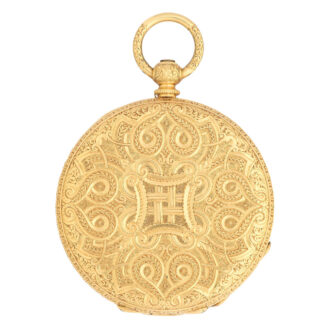
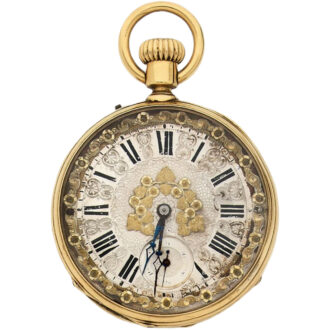
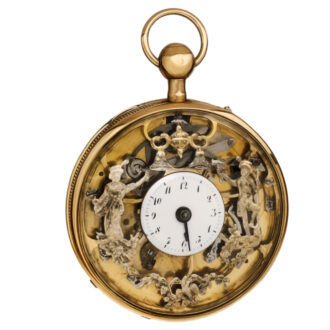
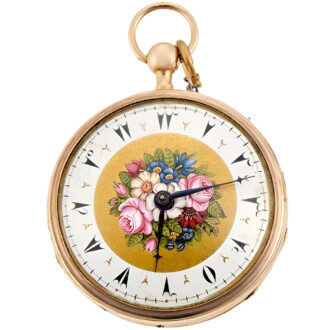
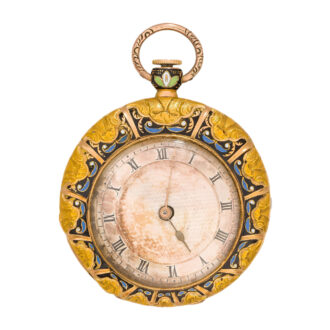
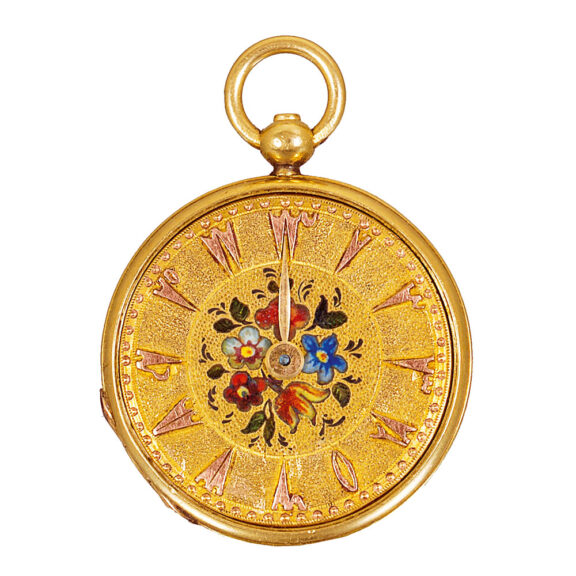
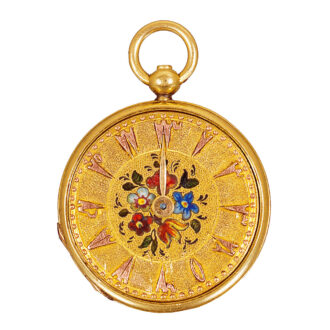
A very fine and extremely rare Swiss 18 Carat gold and enamel key-wound miniature watch with a gold cased key made for the Islamic market, circa 1850. Gilt brass bar movement, 8 jewels, cylinder escapement, plain gilt balance with blued steel flat spring, index regulator.
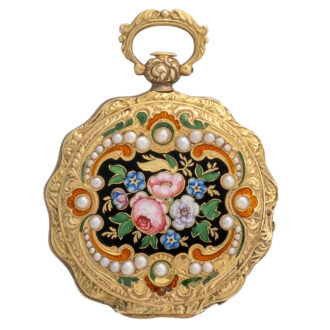
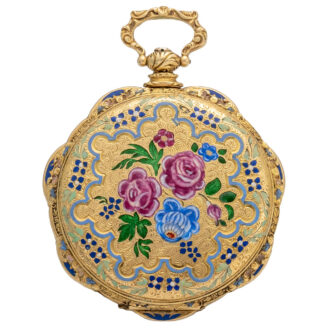
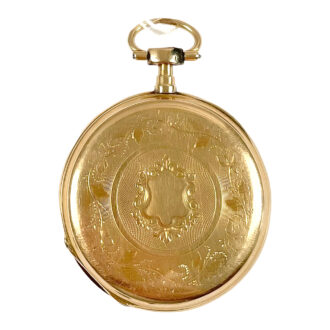
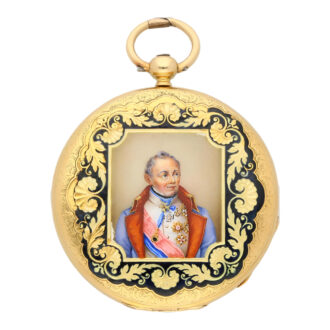
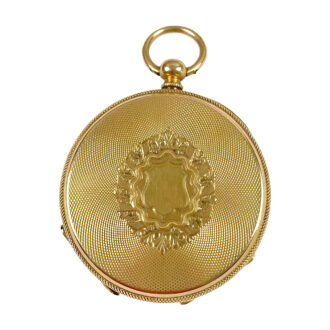
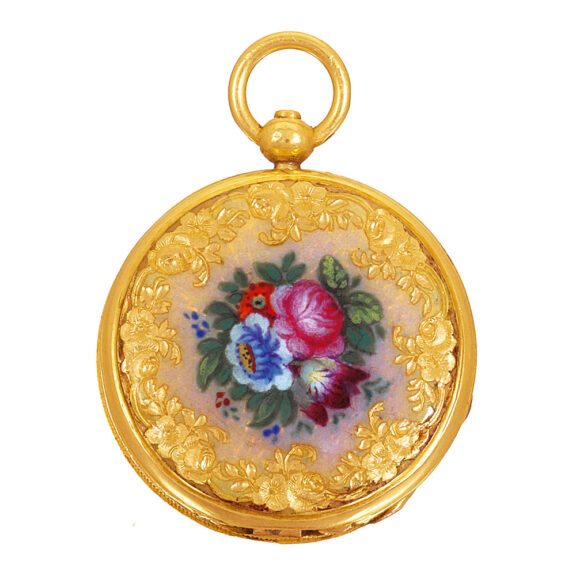
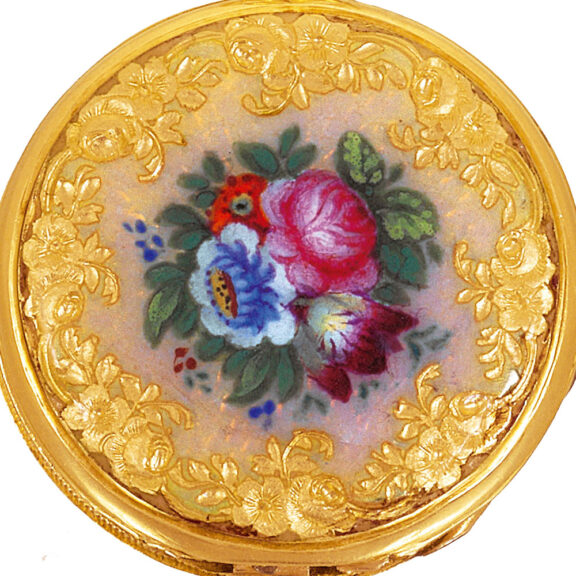
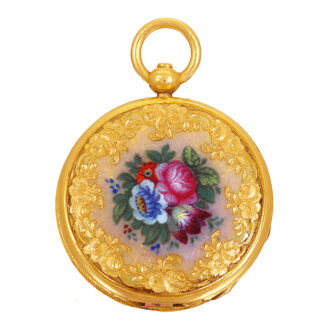
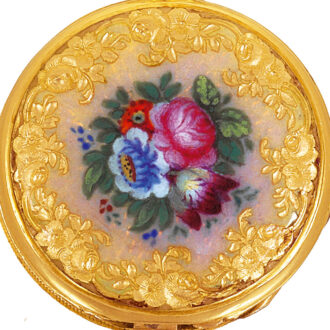
The spring-loaded case back with a polychrome enamel bouquet of flowers within an engraved flower and leaf border, and a reeded band. Hinged gold cuvette.
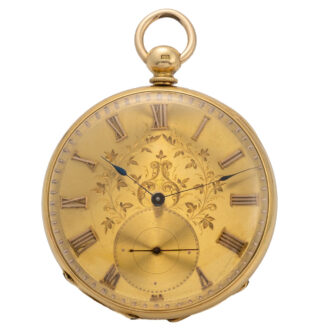
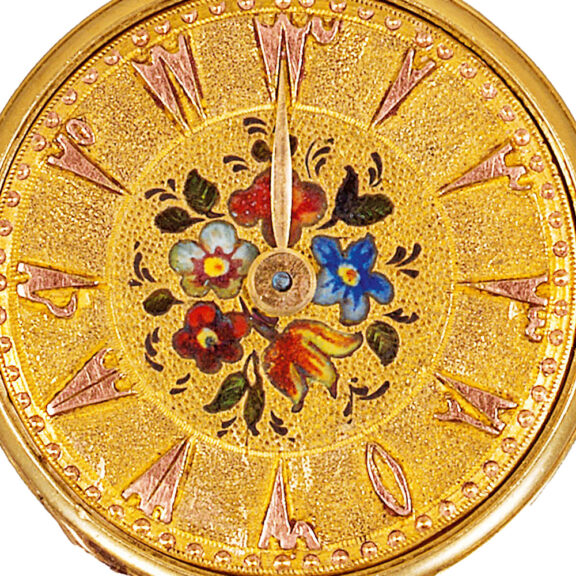
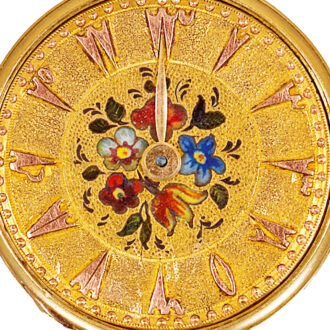
Matte gold dial with radial Islamic numerals, outer minute dots and the centre decorated with painted enamel flowers, hands missing. Signed on the cuvette.
–
Diameter: 14 mm
–
Signed: Auguste Courvoisier & Cie
–
The hour and intermediate wheels are missing.
–
Philippe Auguste Courvoisier was born in 1803 and died in 1873. At times he was associated with Courvoisier & Co and also with Courvoisier Frères, but he also signed clocks and watches in his own name. He was no longer associated with those companies after 1852.
–
The present watch approaches the outer limits of miniaturization and can be considered one of the smallest in the entire world. Only two others are known, one of which was made by Patek Philippe in 185o. It measured 9.02 mm and was shown at the London Universal Exhibition of 1851, figuring in the Official Catalogue of the Exhibition. Long considered the smallest watch in the world, its movement has unfortunately been lost, only the case and dial remain today. The other one, by Charles Oudin, measures the same as this piece, 14 mm.
–
The making of miniature watches has always been a challenge for watchmakers. Many have vied with each other to produce ever smaller mechanisms enabling them to boast of making ‘the world’s smallest watch’. The earliest known surviving example is a tiny gold and enamel clock watch by an unknown German maker dating from circa 1610. This remarkable watch had once belonged to Queen Elizabeth of Bohemia (The Winter Queen). In the 18th Century, one of the smallest watches to be made was by the Viennese maker Philipp Voter of Wien around 1760. Another by J. Thierry, London, circa 1770, containing one of the smallest verge watch movements ever made was sold at Antiquorum, Geneva, 11th & 12th April 1992. Breguet famously made a small number of miniature watches with keyless winding, these watches measuring only 18 mm, were certainly the smallest watches with keyless winding and hand setting produced by any firm before the mid 19th Century. The world’s smallest tourbillon by Fritz-Andre Robert Charrue of Le Locle is dated 1945.
–
A very fine and extremely rare Swiss 18 Carat gold and enamel key-wound miniature watch with a gold cased key made for the Islamic market, circa 1850. Gilt brass bar movement, 8 jewels, cylinder escapement, plain gilt balance with blued steel flat spring, index regulator.
The spring-loaded case back with a polychrome enamel bouquet of flowers within an engraved flower and leaf border, and a reeded band. Hinged gold cuvette.
Matte gold dial with radial Islamic numerals, outer minute dots and the centre decorated with painted enamel flowers, hands missing. Signed on the cuvette.
–
Diameter: 14 mm
–
Signed: Auguste Courvoisier & Cie
–
The hour and intermediate wheels are missing.
–
Philippe Auguste Courvoisier was born in 1803 and died in 1873. At times he was associated with Courvoisier & Co and also with Courvoisier Frères, but he also signed clocks and watches in his own name. He was no longer associated with those companies after 1852.
–
The present watch approaches the outer limits of miniaturization and can be considered one of the smallest in the entire world. Only two others are known, one of which was made by Patek Philippe in 185o. It measured 9.02 mm and was shown at the London Universal Exhibition of 1851, figuring in the Official Catalogue of the Exhibition. Long considered the smallest watch in the world, its movement has unfortunately been lost, only the case and dial remain today. The other one, by Charles Oudin, measures the same as this piece, 14 mm.
–
The making of miniature watches has always been a challenge for watchmakers. Many have vied with each other to produce ever smaller mechanisms enabling them to boast of making ‘the world’s smallest watch’. The earliest known surviving example is a tiny gold and enamel clock watch by an unknown German maker dating from circa 1610. This remarkable watch had once belonged to Queen Elizabeth of Bohemia (The Winter Queen). In the 18th Century, one of the smallest watches to be made was by the Viennese maker Philipp Voter of Wien around 1760. Another by J. Thierry, London, circa 1770, containing one of the smallest verge watch movements ever made was sold at Antiquorum, Geneva, 11th & 12th April 1992. Breguet famously made a small number of miniature watches with keyless winding, these watches measuring only 18 mm, were certainly the smallest watches with keyless winding and hand setting produced by any firm before the mid 19th Century. The world’s smallest tourbillon by Fritz-Andre Robert Charrue of Le Locle is dated 1945.
Signed: Auguste Courvoisier & Cie
Share this page: