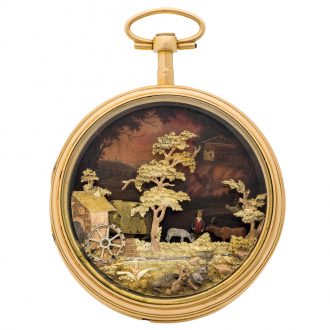
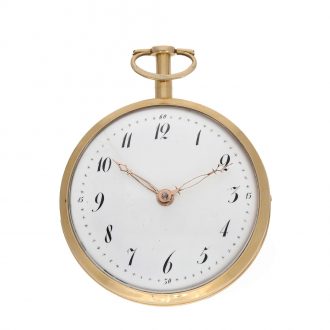
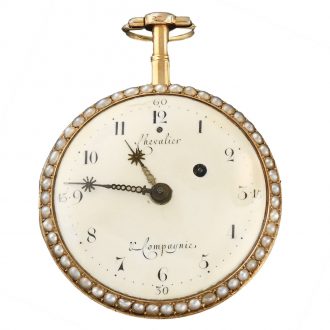
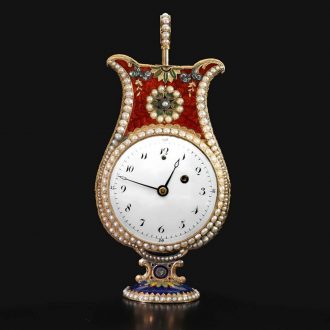
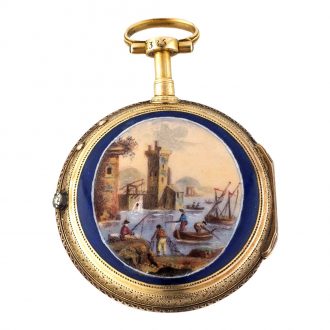
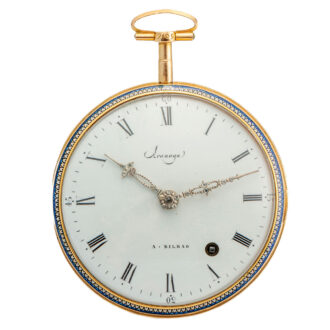
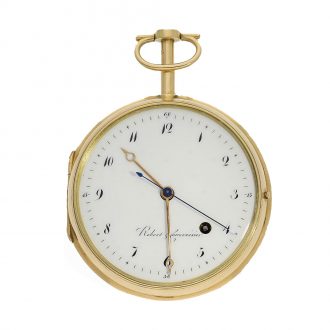
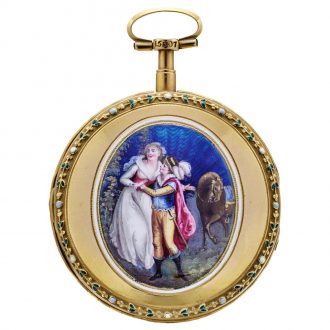
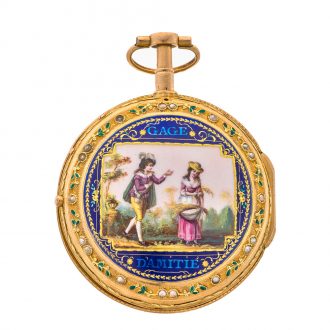
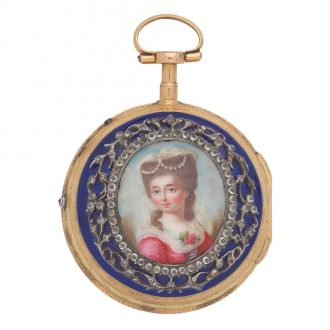
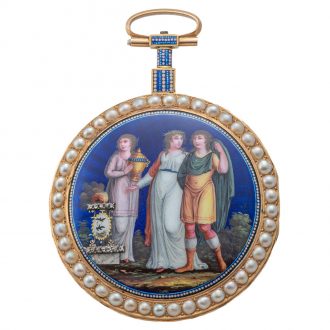
Swiss gold fine and rare gold self winding watch Circa 1790
- Kenmerk
- SA3116
- Diameter
- 52 mm
- Estimate
- € 6.500 - 12.000
- Price sold
- € 9.100
Gold self-winding watch with centre seconds
–
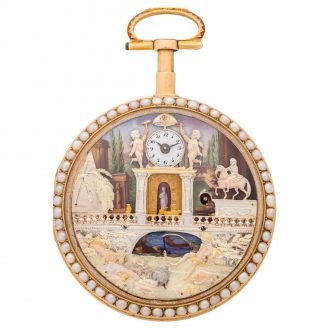
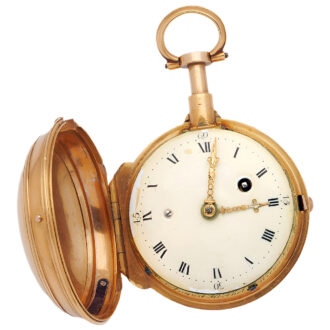
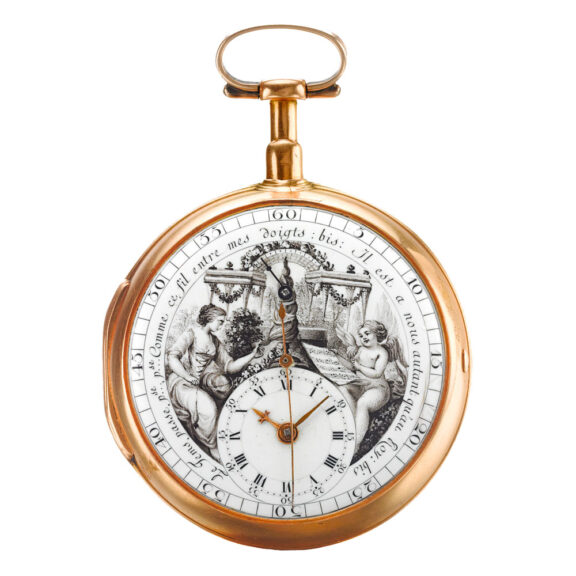
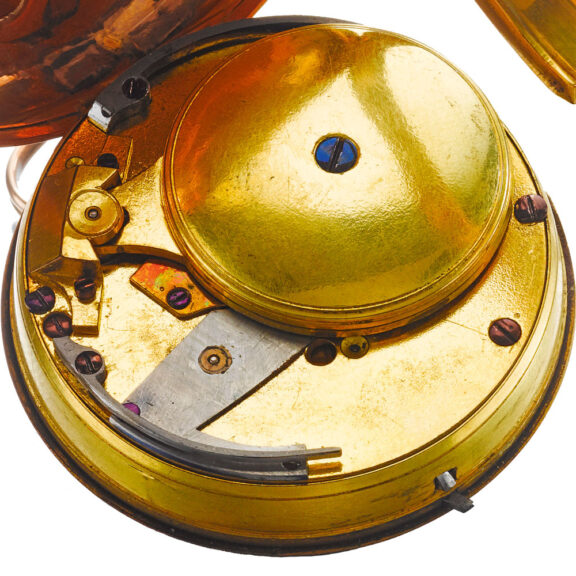
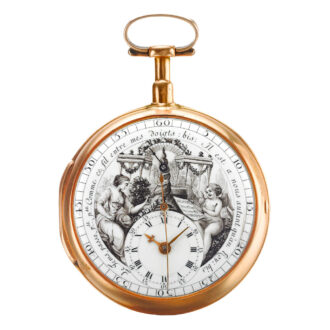
A fine and rare gold self-winding watch with centre seconds and en grisaille dial, circa 1790. Gilt full plate cylinder movement, gilt circular oscillating weight, dust ring.
The dial is painted en grisaille depicting a lady and a putto in a love garden flanking a white enamel meantime dial at 6 o’clock, the regulator at 12 o’clock, the dial further enamelled with the words Le Fems passe pse pse Comme ce fil entre mes doigts: bis: Il est a nous autant qu’au Roy:bis, the outer ring with seconds, monogrammed case.
–
Diameter: 52 mm
–
Signed: No name
–
There has been much debate over the origins of the self-winding watch—the Swiss maker A-L. Perrelet developed the first system in 1770, while the Jaquet Droz developed another around the same period. However, it was through the followers of the Jaquet Droz that the most significant advancement in the commercialization of the self-winding system occurred (see: Jean Claude Sabrier, The Self-Winding Watch pp.117, 161-191.) This watch, though unsigned, can be attributed to one of these followers. For similar examples, see Sabrier.
Another characteristic of the Swiss self-winding watches were their decorative enamel dials with centre seconds and the hours and minutes dial at 6 o’clock. The script on the dial reads:
“Le temps passe passe passe comme ce fil entre mes doigts: bis: il est à nous autant qu’au roi :bis”, translating to “Time passes passes passes like a thread between my fingers, it belongs to us as much as to the king.”
This line comes from a comedy entitled “Les Moissonneurs,” presented for the first time in 1768. It reminds the viewer that time passes equally for everyone, no matter their station at birth.
The development of the self-winding watch was not exclusive to Switzerland. In England in 1780, Louis Recordon patented his design (see: Joseph Flores, Antiquarian Horology, autumn 1995). While in France, Breguet developed his self-winding system around the same time as Recordon and his patent. Indeed, the earliest known self-winding watch signed by Breguet is numbered one and is dated AD 1781.
Share this page: