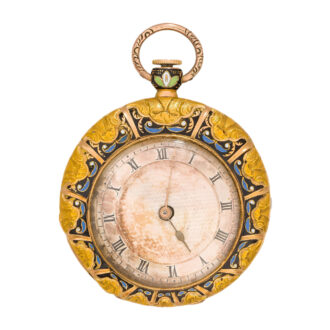
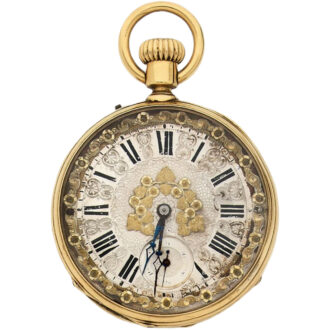
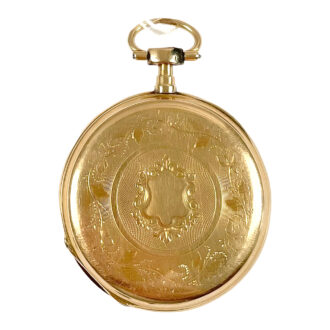
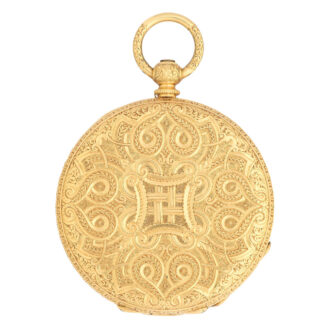
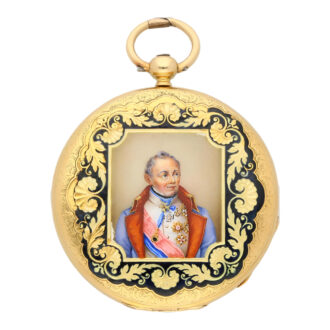
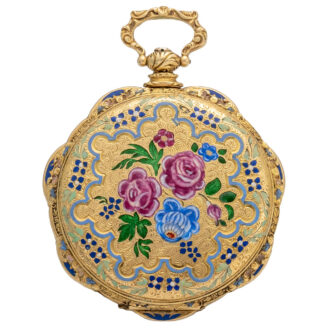
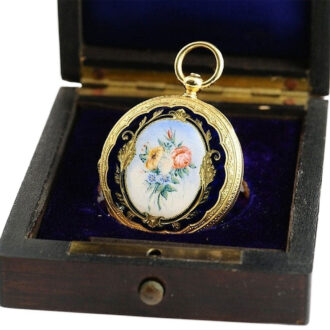
Swiss 18K gold and enamel hunting cased lady’s watch Circa 1850
- Kenmerk
- AD6372
- Diameter
- 36 mm
- Estimate
- € 1.500 - 2.500
- Price sold
- € 1.250
Gold and enamel full hunter by Auguste Leschot
–
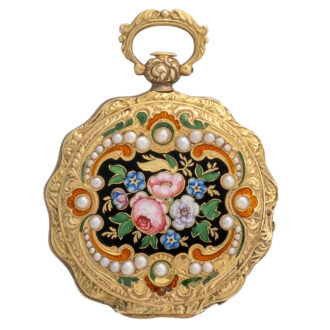
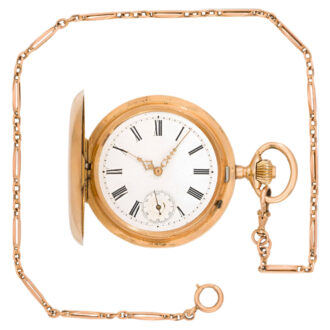
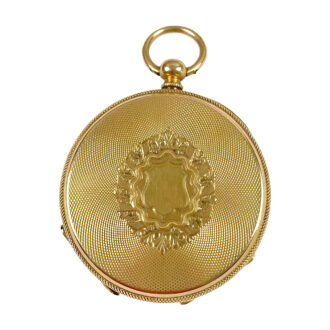
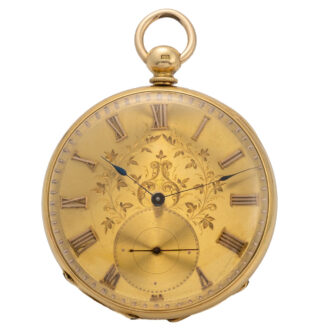
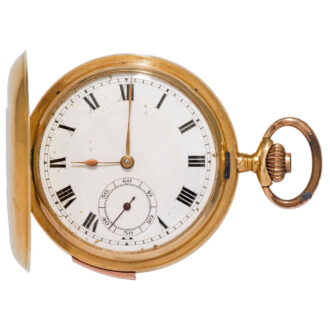
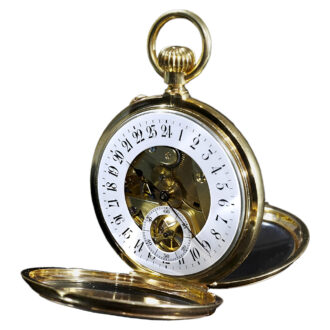
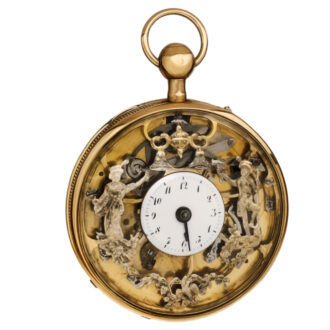
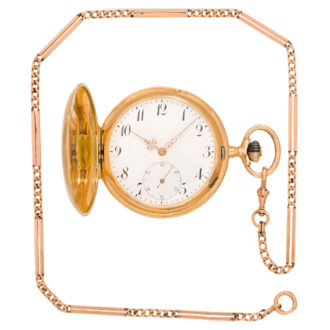
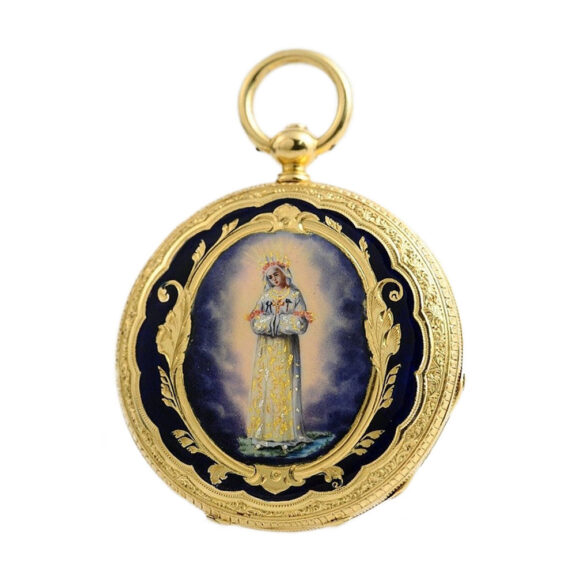
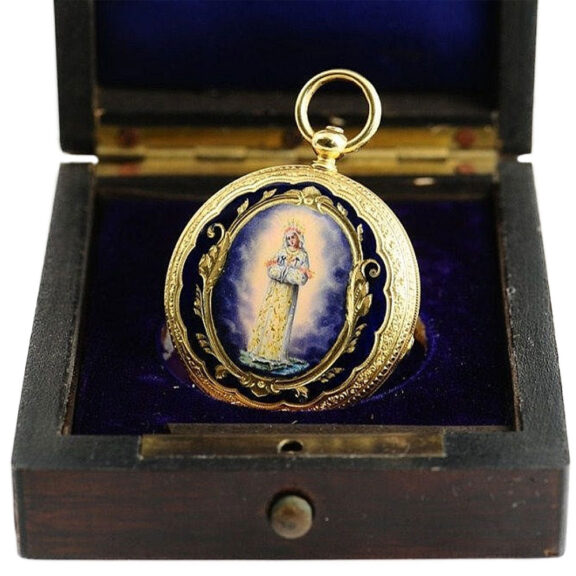
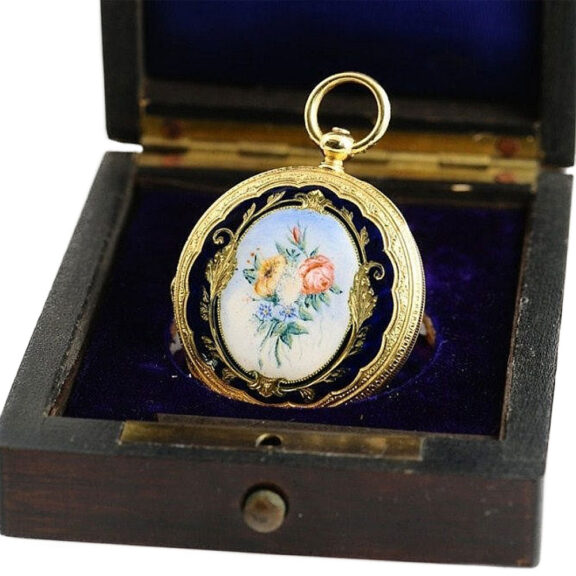
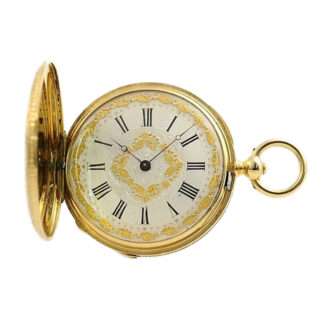
A Swiss decorative 18K gold and enamel hunting cased lady’s pocket watch in the original presentation box, circa 1850.
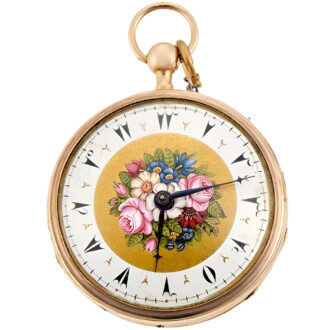
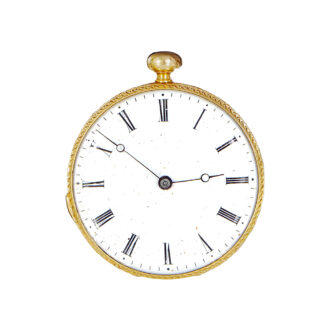
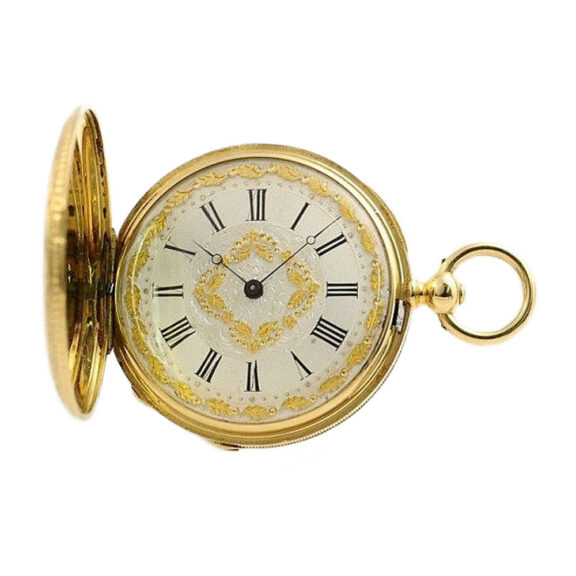
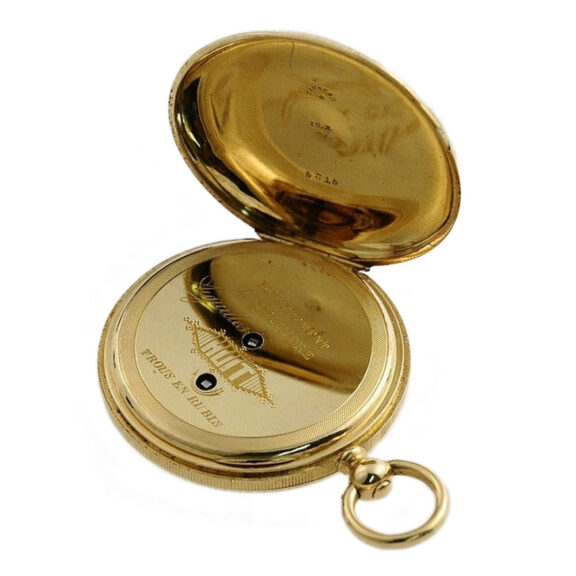
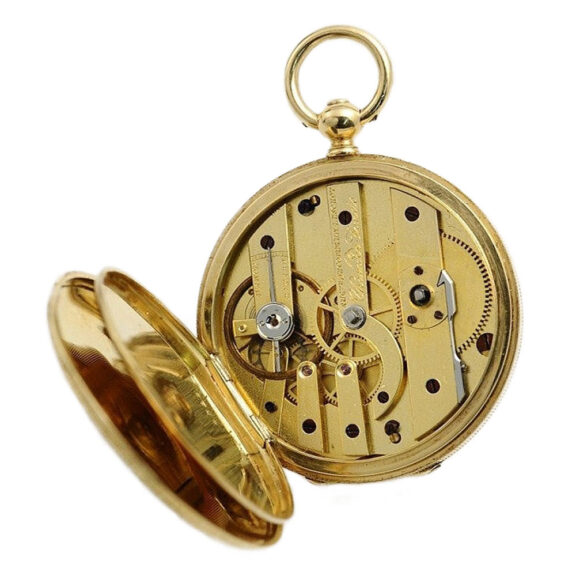
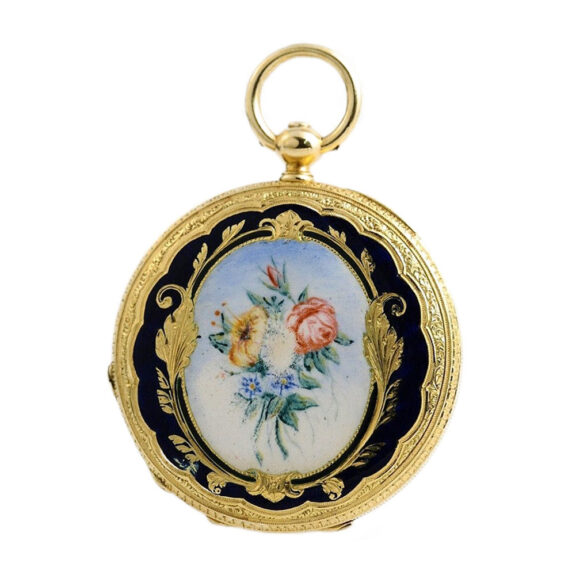
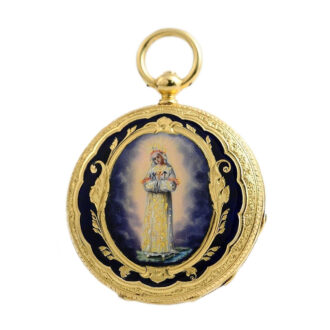
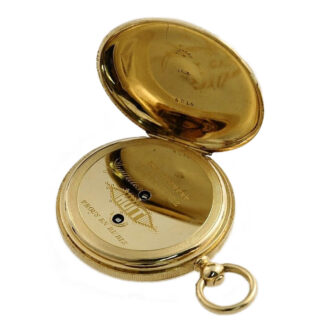
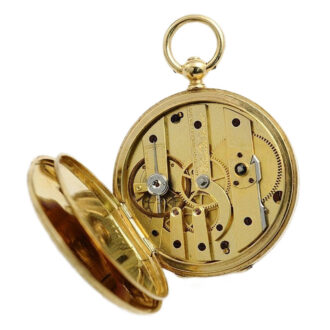
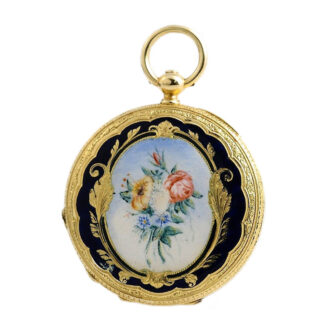
Polychrome enamelled case on both sides, the front with a depiction of the Virgin Mary carrying the distinctive crucifix of La Salette, a cross, hammer and pincers, after Our Lady of La Salette, the back cover with a fine painted on enamel bouquet of flowers, reeded band, case maker’s punch mark Favre & Cie. Gold signed and inscribed dome. Silver engine-turned dial with applied gold floral decoration, radial Roman hours, outer minute track and blued Breguet hands. Frosted gilt bridge movement, keywind, wolf’s teeth winding wheels, cylinder escapement and ring balance, signed.
–
Diameter: 36 mm
–
Weight: 37 g
–
Signed: Auguste Leschot du Commun La Chaux de Fonds
–
Our Lady of La Salette (Notre-Dame de La Salette in French) is a Mary apparition reported by two French children, Maximin Giraud and Mélanie Calvat, to have occurred at La Salette-Fallavaux, a small village in the French Alps, on September 19th, 1846. The Lady carried a cross decorated with a small hammer and pincers.-
Georges-Auguste Leschot was a Swiss industrialist, watchmaker and inventor. Leschot was born on March 24, 1800, in Geneva as the son of Jean-Frédéric Leschot. He attended school in Geneva. In 1812 he came to his uncle, a pastor, in Bévilard, who then continued to teach him. In 1816 he returned to Geneva and learned watchmaking from the watchmaker Chanson and then stonemason from Babault. Immediately after completing his apprenticeship, he started his own business with changing partners, manufacturing and selling watches. Even as an apprentice, he visited the doctor, Dr Alexis Chuit, who made his library available to him. There he acquired theoretical knowledge. In 1829 he married the doctor’s daughter, Charlotte Thérèse Françoise Chuit. Around 1825 he improved the anchor escapement invented by Thomas Mudge by inventing the ‘pull angle’ on the anchor pallets. Thanks to this improvement, the lever escapement replaced almost all other escapements on portable watches in the second half of the 19th century. In 1839 the Geneva watchmaker and mechanic started at Vacheron Constantin as a technical manager and introduced the series production of watch movements with the machine tools he had invented, which considerably improved the precision and quality of pocket watches. In 1840 he designed one on behalf of Vacheron-Constantin Pantograph for watchmaking that allowed the simple duplication of the same parts in different sizes. Leschot attached great importance to the interchangeability of components, which led to cost reductions and more economical production. He was also involved in setting up a watch factory in Cluses (Haute-Savoie), where he promoted vocational training for girls. He also invented the diamond drill for tunnel construction. Georges-Auguste Leschot died on February 4, 1884, at the age of 83 in Plainpalais, today the municipality of Geneva.
Signed: Auguste Leschot du Commun La Chaux de Fonds
Share this page: