Swiss gold complicated keyless lever pocket watch Circa 1904
- Kenmerk
- SA0595
- Diameter
- 55 mm
- Estimate
- € 200.000 - 400.000
- Price sold
- € 223.600
Gold gentlemen’s pocket watch
–
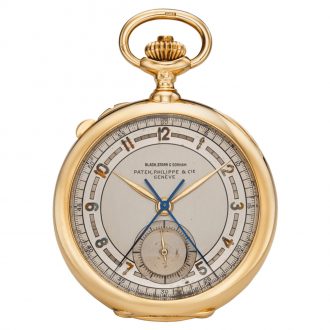
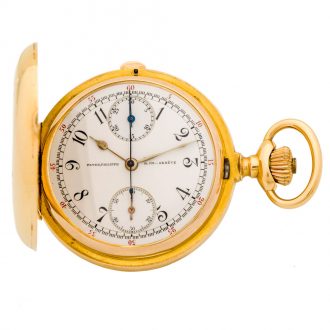
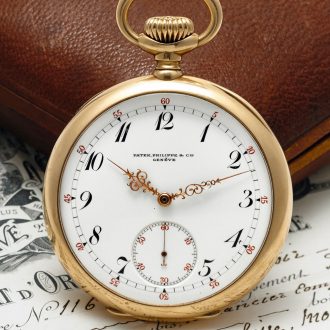
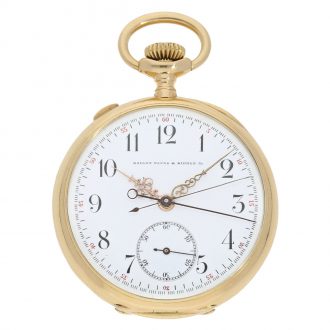
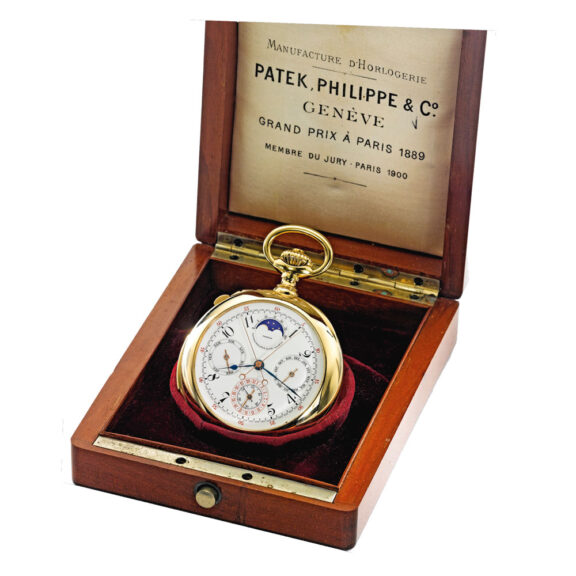
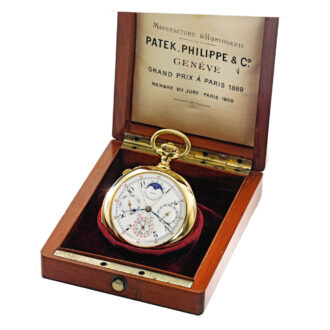
An important Swiss 18k yellow gold open-faced minute-repeating split-seconds chronograph pocket watch with perpetual calendar and moon phases, made by Patek Philippe in Geneva, circa 1904.
–
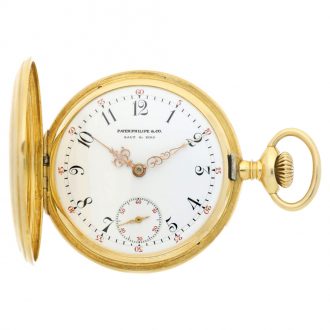
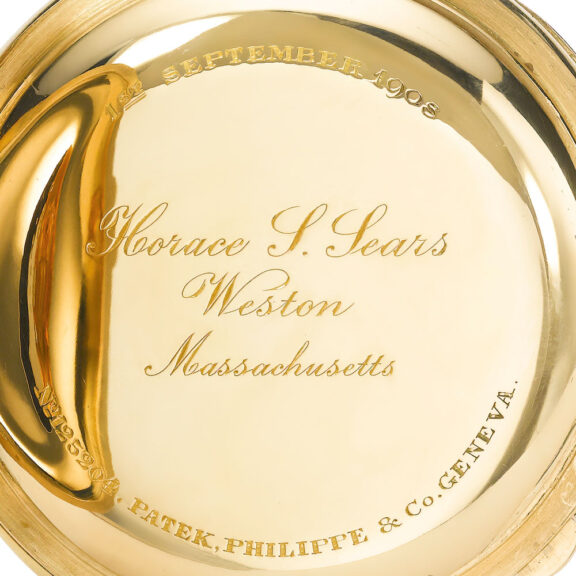
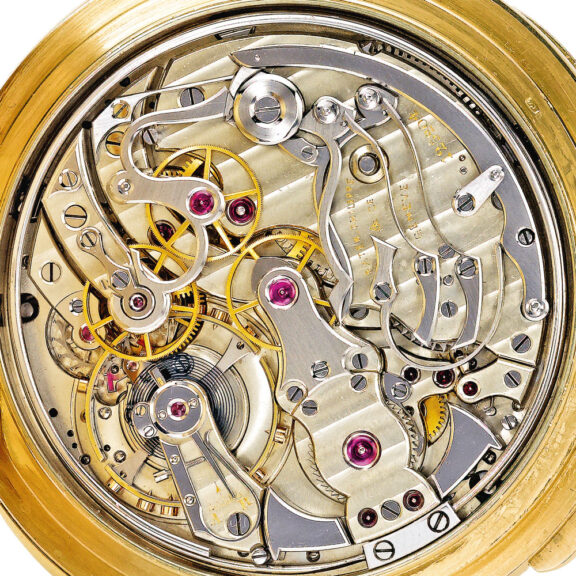
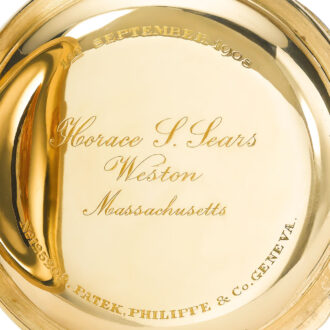
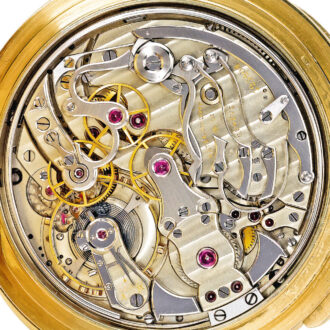
The nickel lever movement has 40 jewels and a bimetallic balance, and the repeater strikes on two gongs. The hinged cuvette is engraved “1st September 1908 Horace S. Sears Weston Massachusetts”.
–
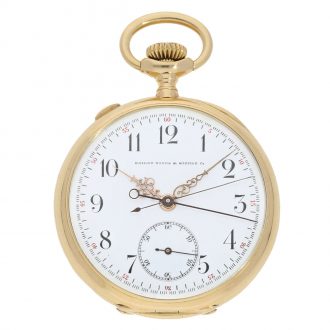
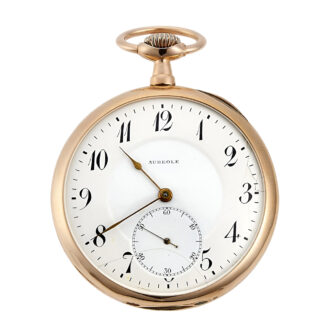
The white enamel dial has black Arabic hour numerals and an outer minute track. The track is divided into fifths of a second and has red Arabic numerals every five minutes.
–
The subdials are arranged as follows:
6 o’clock: small seconds with the date around it
9 o’clock: day of the week
12 o’clock: moon phases
3 o’clock: month
–
The hands are blued steel spade hands, with gold chronograph hands.
–
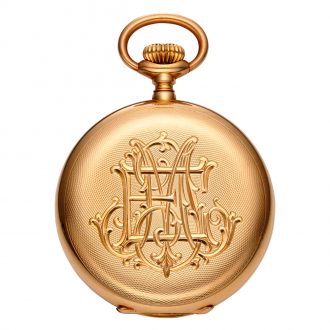
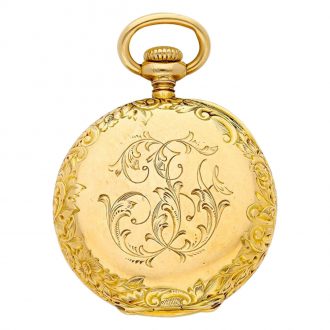
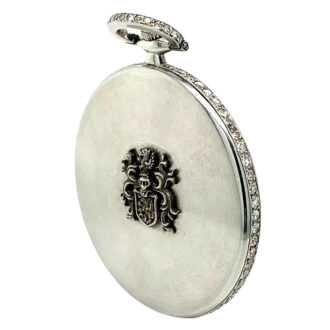
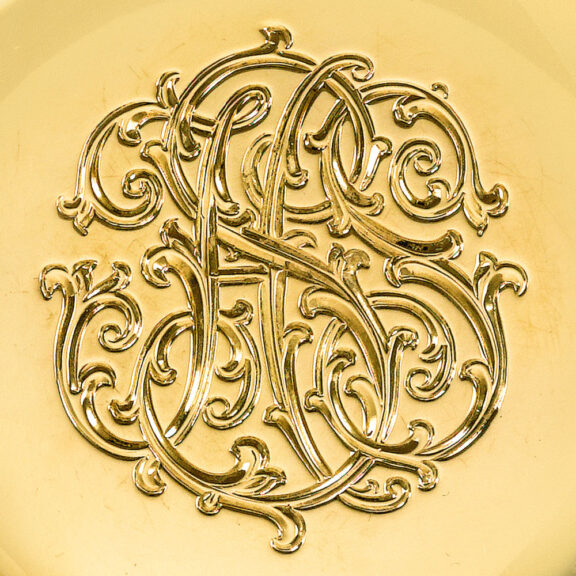
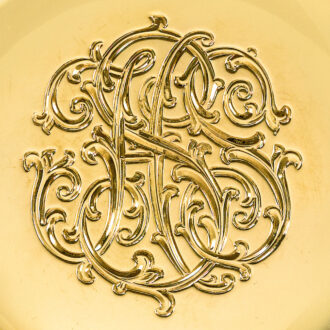
The plain case has the monogram “HSS” on the back. On the band are a slide for the minute repeater and a slide that locks the crown. The split-seconds button sits at 10 o’clock, and the chronograph button is built into the crown.
–
The dial, case, cuvette and movement are signed. The cuvette and movement are numbered.
–
–
An important Swiss 18k yellow gold open-faced minute-repeating split-seconds chronograph pocket watch with perpetual calendar and moon phases, made by Patek Philippe in Geneva, circa 1904.
–
The nickel lever movement has 40 jewels and a bimetallic balance, and the repeater strikes on two gongs. The hinged cuvette is engraved “1st September 1908 Horace S. Sears Weston Massachusetts”.
–
The white enamel dial has black Arabic hour numerals and an outer minute track. The track is divided into fifths of a second and has red Arabic numerals every five minutes.
–
The subdials are arranged as follows:
6 o’clock: small seconds with the date around it
9 o’clock: day of the week
12 o’clock: moon phases
3 o’clock: month
–
The hands are blued steel spade hands, with gold chronograph hands.
–
The plain case has the monogram “HSS” on the back. On the band are a slide for the minute repeater and a slide that locks the crown. The split-seconds button sits at 10 o’clock, and the chronograph button is built into the crown.
–
The dial, case, cuvette and movement are signed. The cuvette and movement are numbered.
–
Diameter: 55 mm
–
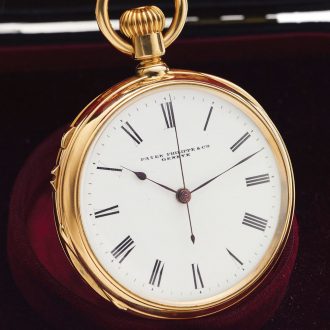
Signed: Patek, Philippe & Co Geneva
–
It has an Extract from the Archives confirming its sale on September 24th, 1908 and engraved monogram H.S.S. on the back cover.
–
–
Signed: Patek, Philippe & Co Geneva
–
It has an Extract from the Archives confirming its sale on September 24th, 1908 and engraved monogram H.S.S. on the back cover.
–
Horace Scudder Sears 1855-1923
He was the son of the Reverend Dr Edmund Hamilton Sears and grew up in the town of Weston, Massachusetts, a small town outside Boston.
–
Sears started out as a clerk for a Boston ship chandler, selling canvas for sails, and he rose quickly. He soon co-founded the textile firm Wellington, Sears & Co., which made his fortune. He was also a generous philanthropist.
–
In 1898 Sears began building Haleiwa, a grand estate in his home town of Weston. Like many Gilded Age magnates, he hired the best designers and builders, and the house was built in the Renaissance Revival style. The famous Olmsted Brothers designed the grounds. Arthur Shurcliff later added Italianate features such as fountains, terraces and balustrades. The estate was finished in 1901. The mansion included a 200-seat theatre for performances by the Friendly Society, a theatre group that raised money for the First Parish Church. The theatre meant a great deal to Sears, who was president of the First Parish Friendly Society.
–
Sears was a leading figure in Weston and gave much of his wealth to improving the town. He was the driving force behind the Village Improvement Plan, which created the Town Green. In 1917 he made a generous donation towards the town hall, and Sears Hall was named after him.
–
A watch like this one was fitting for a man of Sears’s standing. It combines a perpetual calendar, a split-seconds chronograph and a minute repeater, and it represents the height of the watchmaker’s art. The earliest known watch of this kind dates from 1887, and scholars estimate that no more than two were made each year.
–
Within a few years of this watch’s sale in 1908, Patek Philippe began receiving commissions from James Ward Packard and Henry Graves Jr., two patrons who are now famous among collectors. In buying this masterpiece, Sears was one of the first of the American turn-of-the-century magnates whose wealth and discerning taste led them to Patek Philippe.
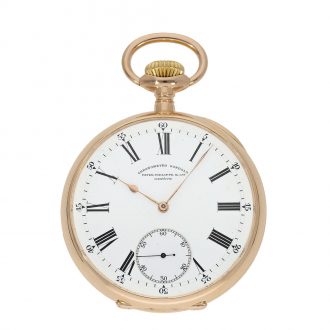
Signed: Patek Philippe and Cie Geneve
Share this page: