Swiss unique gold watch with musical movement Circa 1790
- Kenmerk
- AC0184
- Diameter
- 59 mm
- Estimate
- € 40.000 - 80.000
- Price sold
- € 49.600
Gold enamel watch with musical movement, probably by Du Bois et Fils
–
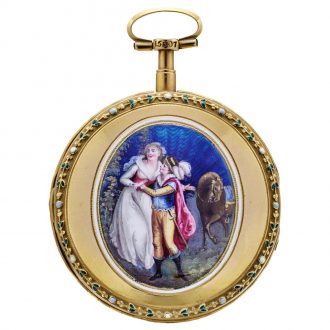
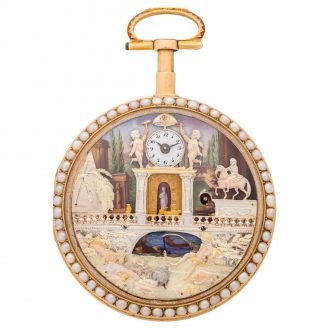
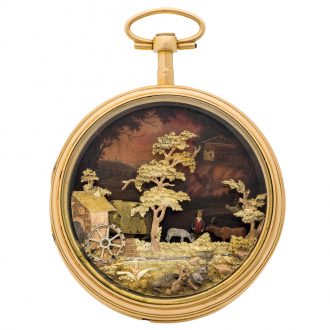
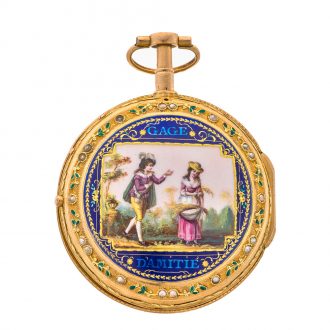
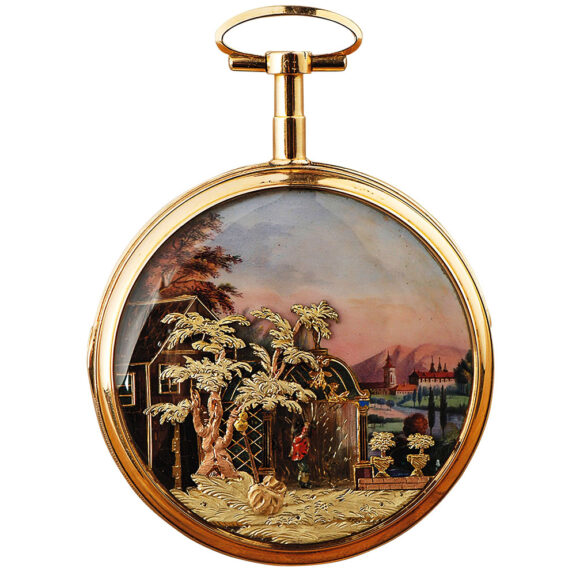
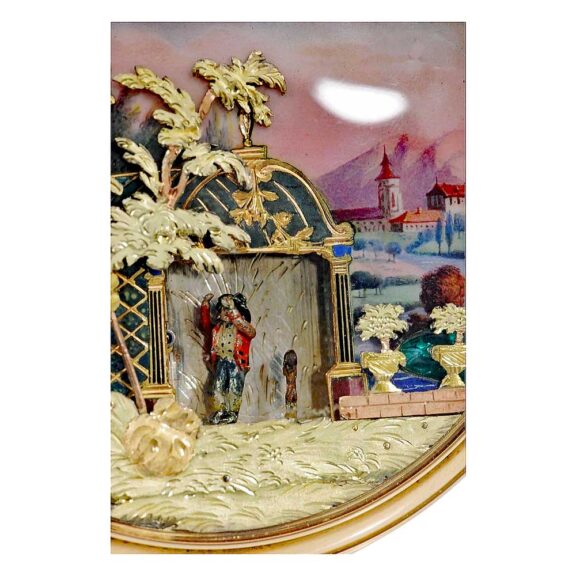
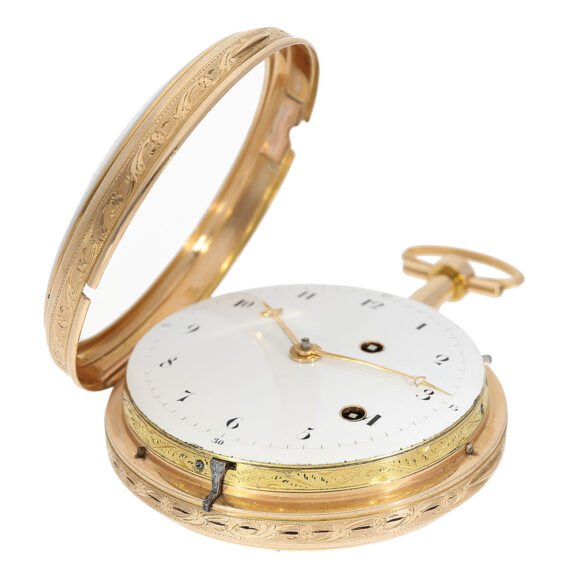
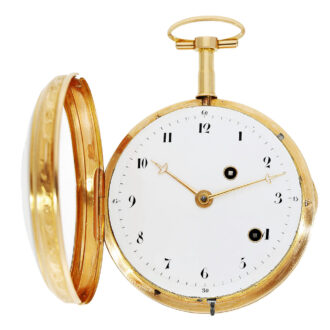
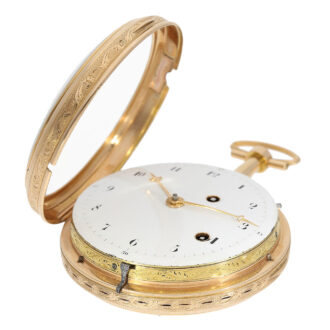
A unique Swiss double-sided gold and enamel pocket watch of museum quality, with musical movement and two automatons, produced for the Chinese market: The Traveller and his Dancing Dog, circa 1790.
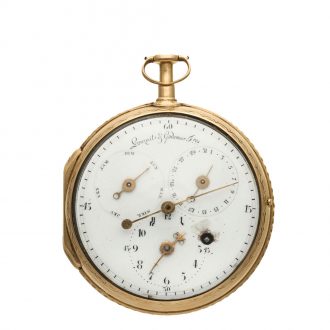
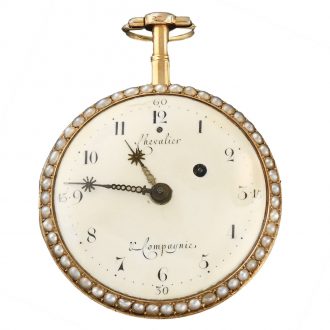
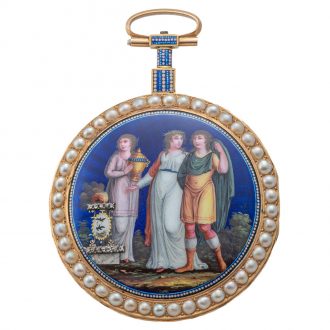
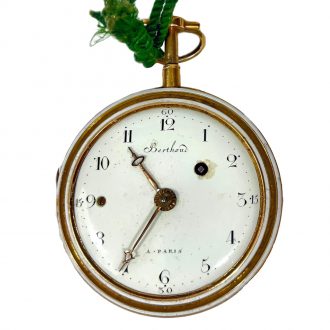
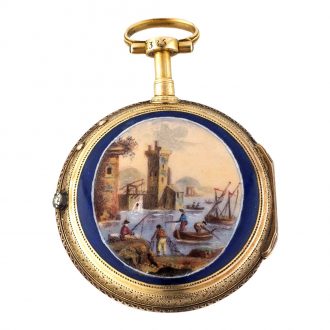
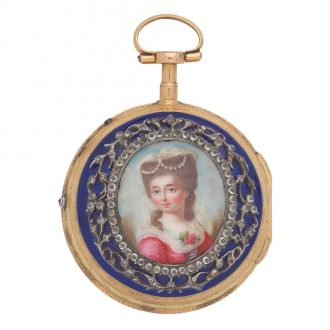
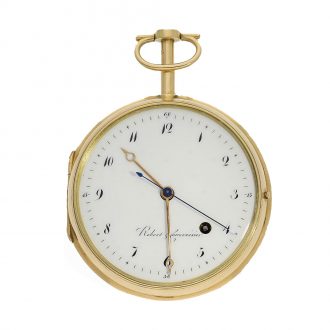
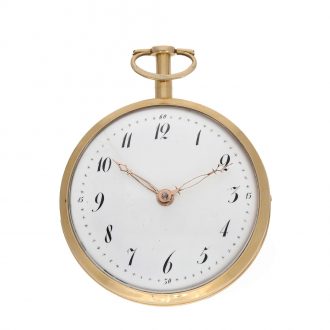
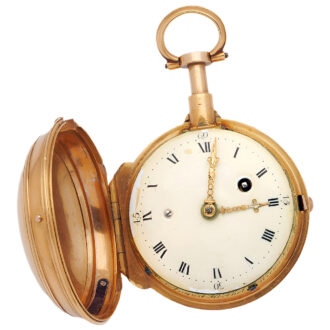
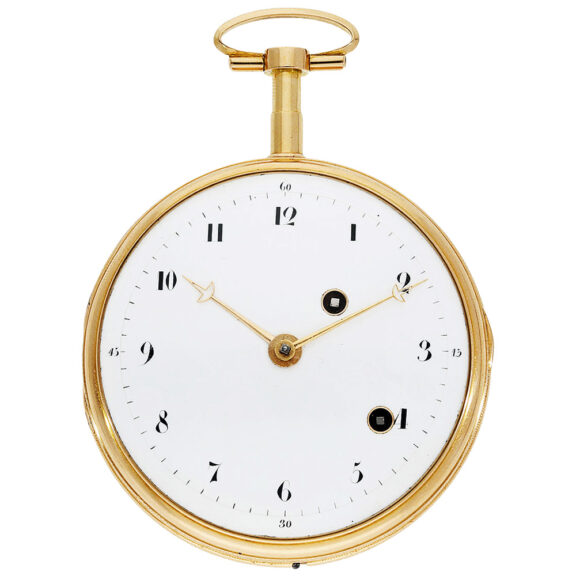
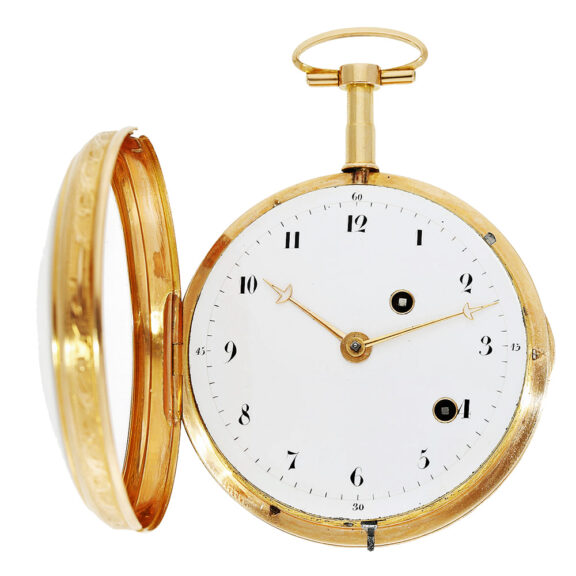
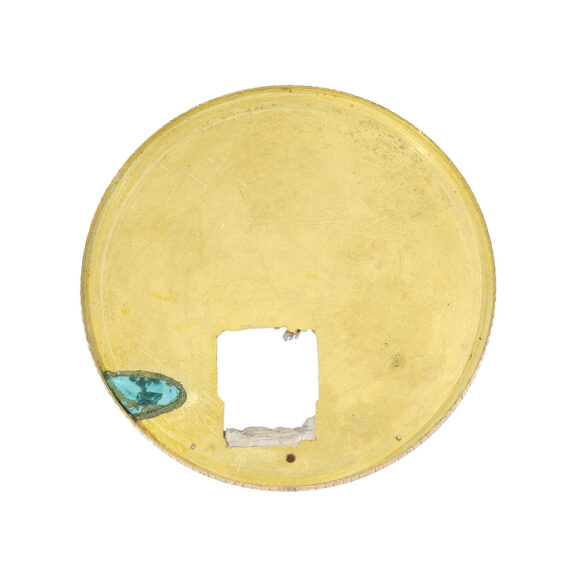
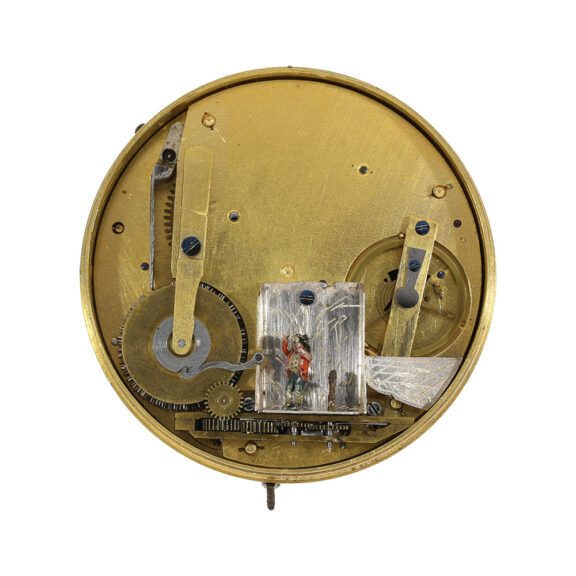
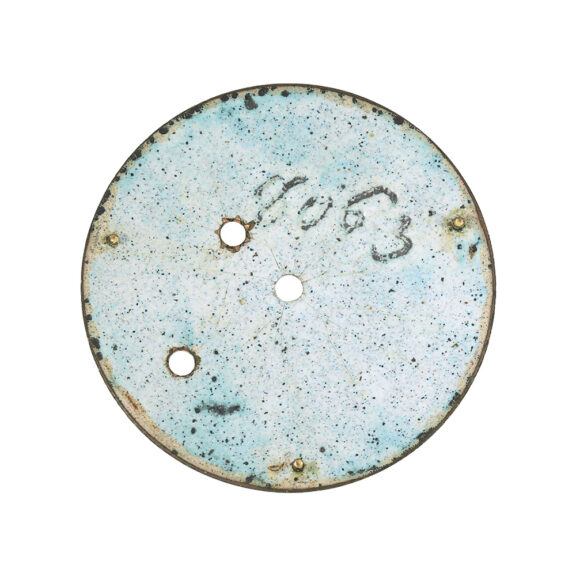
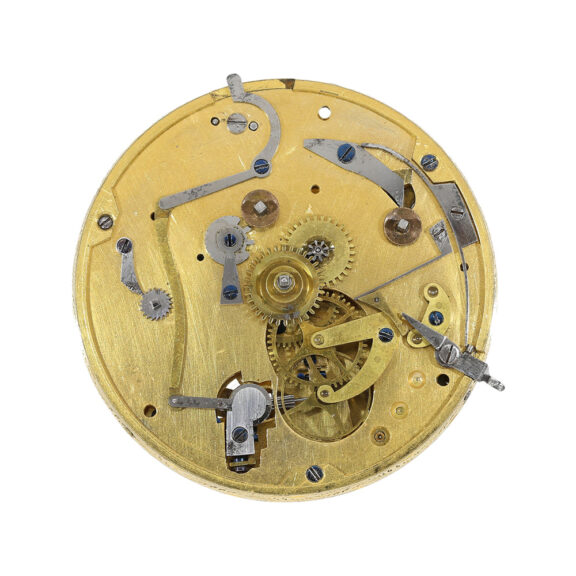
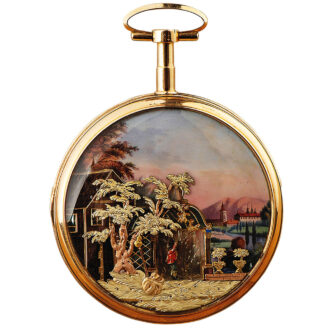
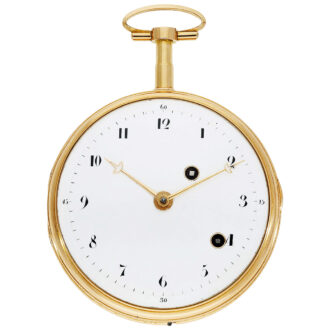
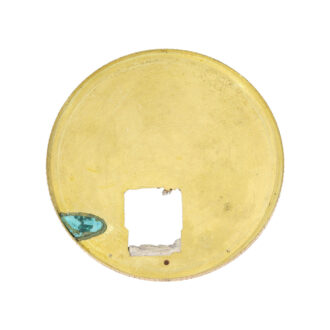
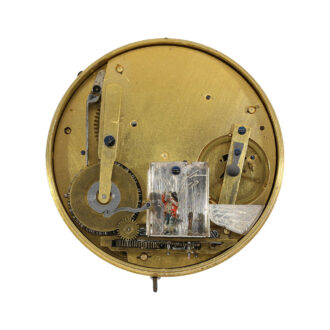
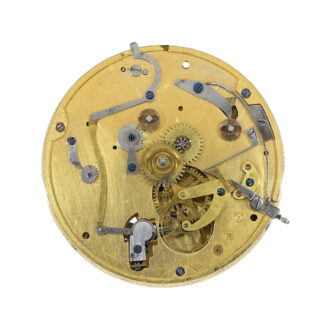
18-carat rosé gold case, front and back with glass panels, partly open-worked band engraved with flowers and tendrils. The background shows an exquisite polychrome enamel painting of a monastery on a riverside – most likely the former Benedictine monastery at Beinwil in the canton of Solothurn in Switzerland. White, enamel dial with Arabic radial hours, outer minutes track with Arabic five-minute numerals, winding arbours at two o’clock for the watch and at four o’clock for the musical movement and the automatons. Full plate movement with cylindrical pillars, barrel, chain/fusee, verge escapement, three-arm brass balance, blued balance spring, musical movement with a barrel with pins, nine vibrating blades, and a planetary gearing set under the platform commanding the dancers’ rotation.
–
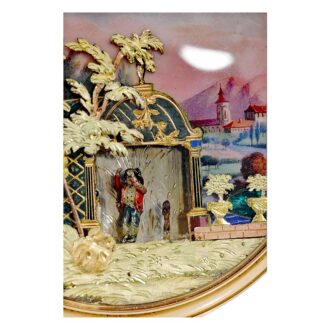
The automaton scene is about a traveller and his dog moving to the music in a finely decorated gazebo raised on columns. The man wears a blue and red costume and a wide-brimmed hat. The dog balances its hind legs and moves up and down in tune with its dancing master. The man’s staff and knapsack are resting under a three-colour gold oak tree, and a house is visible behind it on the left. In the front is grass with a pair of potted plants on the right.
–
Diameter: 59 mm
–
Weight: 143 g
–
Signed: No name
–
The Traveller and his Dancing Dog is a unique and striking automaton scene – we know of no other like it ever used for a watch.
Except for the watch from the Gélis collection, they are all based on similar ebauches – which strongly suggests that they were all created by the same maker.
The movement of this watch is consistent with the high-quality creations of the makers in the Neuchâtel area. We know similar movements from other automaton watches, particularly those signed by Du Bois et Fils; from that, we may conclude that they were either made by him or that he was associated with the workshop that produced them. Some Duchêne et Fils watches and watches by other makers are also fitted with those movements.
Duchêne et Fils and Du Bois et Fils are famous for having created some of the most extravagant automaton watches of all time. There are, for example, the “Tightrope Dancer” from the Sandberg Watch Collection, as well as “Moses” and, of course, the “Theatre”.
–
Du Bois et Fils
The company Philippe Du Bois (1738-1808) established became famous for being one of the most important companies in the Neuchâtel area for over two centuries.
–
The Art of the Automaton in Geneva
During the 1780s, Geneva opened a most intriguing chapter of horological history. The city developed, with great flair, the art of automatons: machines designed to imitate the movements of live beings or creatures. They ranged from the simplest forms, where a figure’s moving arms could point to the time, to complex, full-scale productions, such as pastoral scenes, theatre pieces or concerts. Automata were soon being used to animate a wide variety of objects, such as scent bottles, amphorae, mirrors or snuffboxes; their use as timepieces was often merely a pretext for possessing these exquisite creations. And since where there is life, there is sound; the automata were fitted with a musical mechanism. The acknowledged masters of this marriage between ornamental watches and automata included Pierre Morand, Henry Capt, Isaac Daniel Piguet and Philippe Samuel Meylan, as well as the Jaquet Droz workshop in Geneva, with colleagues and successors Jean-Frédéric Leschot and Jacob Frisard. All were the brilliant creators of musical watches, first with chiming bells and later with a cylinder or pin drum that caused a comb made up of blades to vibrate. These watches were especially prized in the East, and during trade with Turkey and China, they acquired a subtle local touch, a discreetly exotic charm that makes them easy to distinguish today. In the hands of the Rochat family and the Bruguier workshop, this tradition continued until 1850.
Share this page: