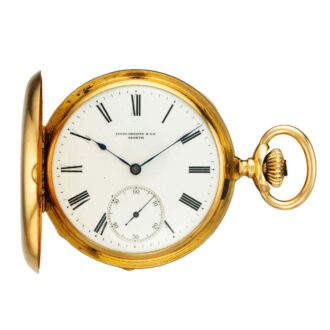
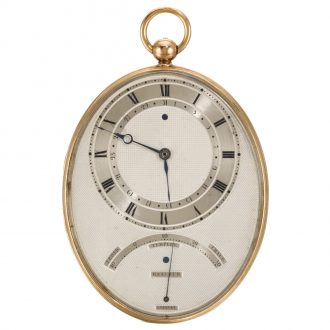
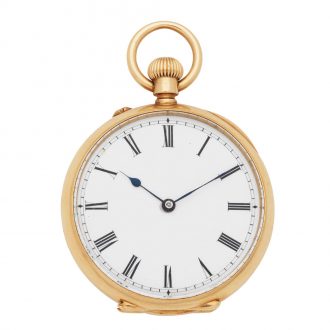
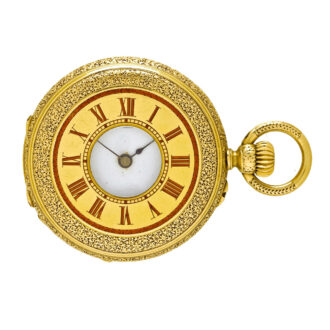
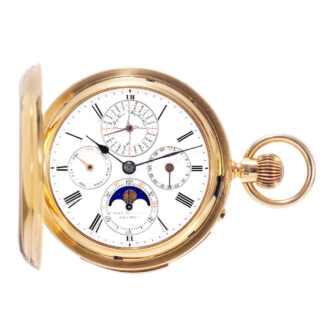
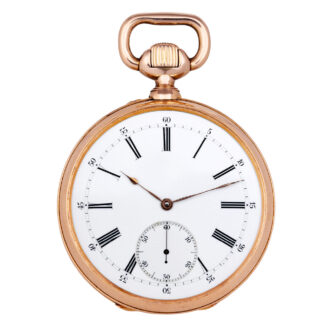
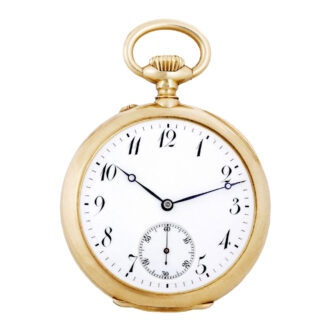
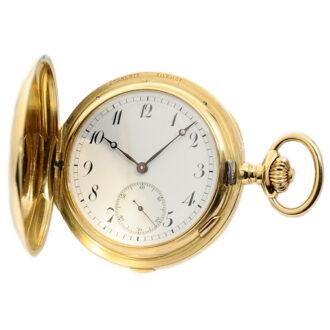
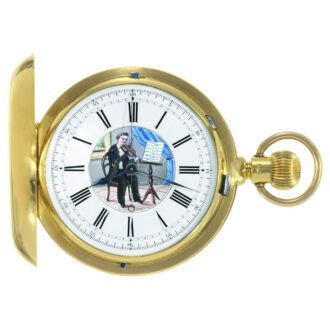
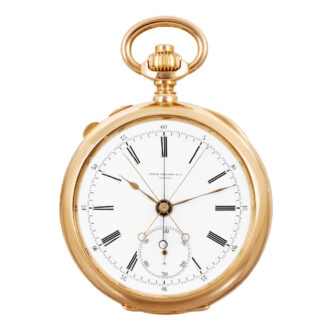
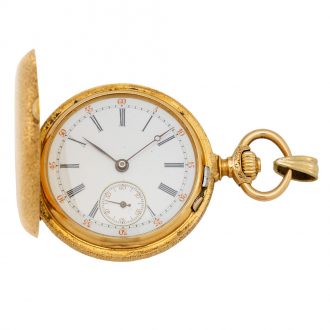
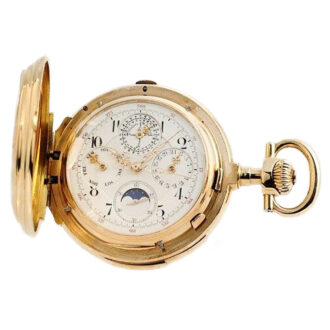
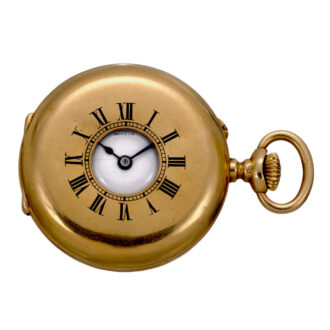
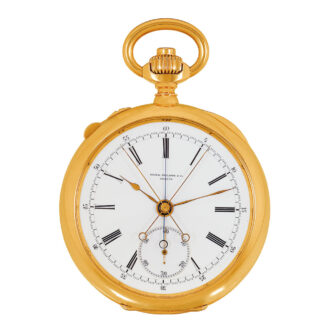
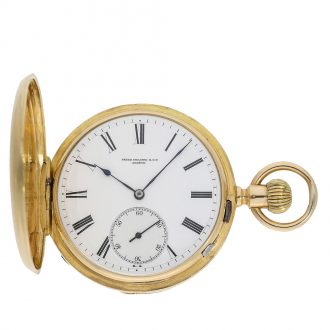
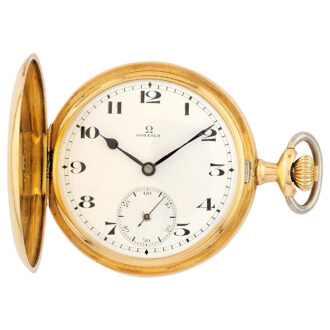
Repeating full hunter chronometer with register Circa 1884
- Kenmerk
- EB0014
- Diameter
- 55 mm
- Estimate
- € 5.000 - 9.000
- Price sold
- € 8.500
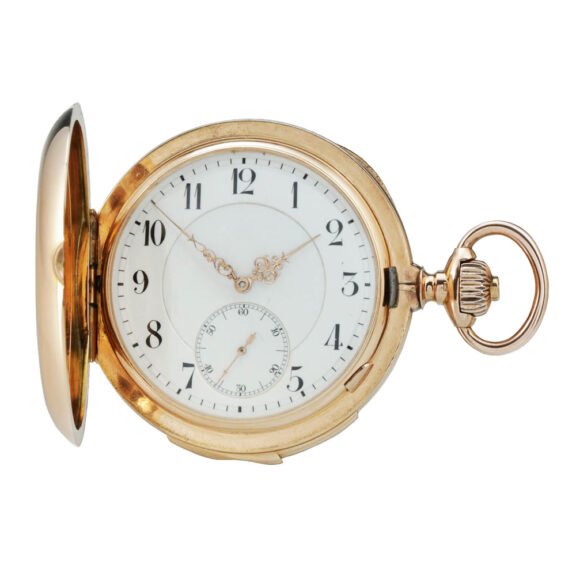
Rose gold hunting cased minute repeating watch with register by Audemars
–
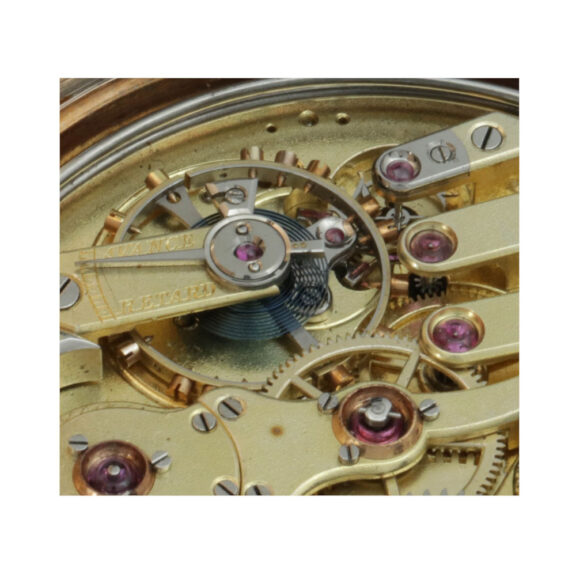
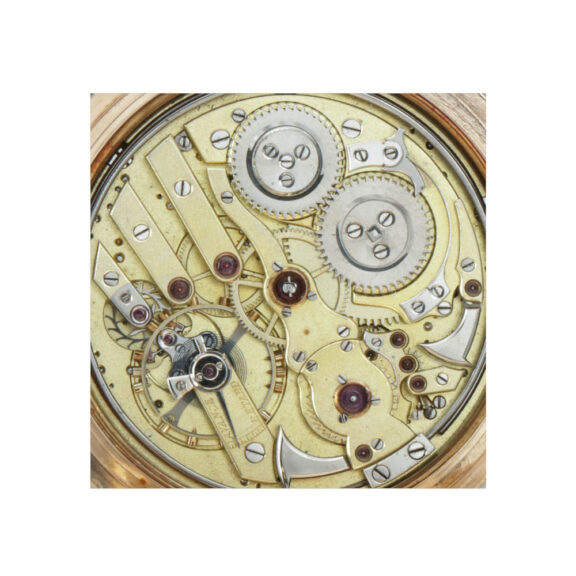
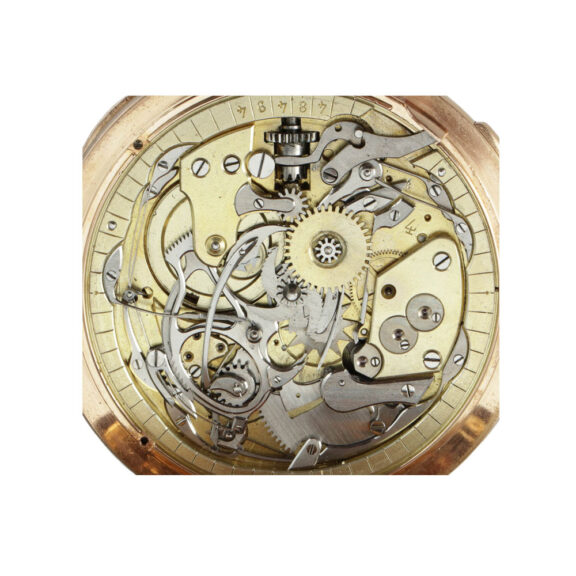
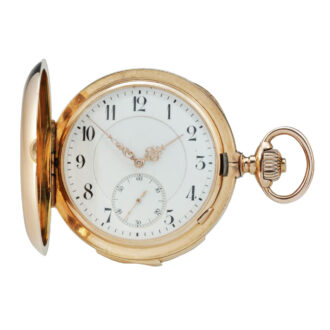
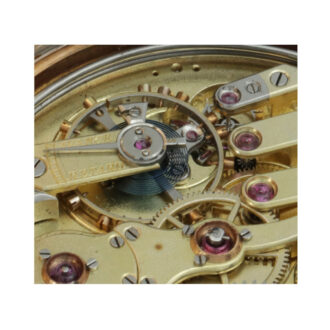
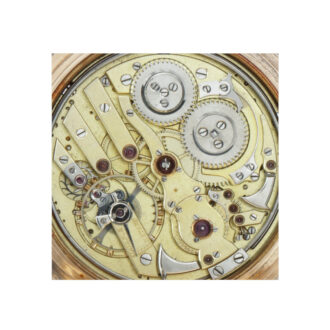
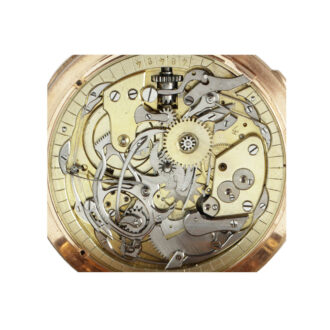
A heavy Swiss 14 carat rose gold hunting cased minute repeating chronometer with register, circa 1884. Sold to Dürrstein & Co., Dresden. Complex anker chronometer movement, bridge grained and gilded, golden wheels, steel lever escapement with compensation balance, index regulation, wolf toothed mechanism, blued Breguet spring with end curve. White enamel dial, sunken center, black Arabic numerals, outer minute ring, small decentralized seconds at 6 and gold Louis XV hands. Plain case. Smooth gold cuvette.
–
Diameter: 55
–
Height: 15 mm
–
Weight: 146
–
Signed: Louis Audemars
–
Louis-Benjamin Audemars was born on May 24, 1782 in Le Brassus. He completed an apprenticeship with his future brother-in-law Philippe Samuel Meylan, whose company he took over in 1811. After completing his apprenticeship, he worked for two years with Abraham-Louis Breguet in Paris, where he became a master student. Inspired by the ingenuity of Breguet, Louis-Benjamin Audemars became one of the pioneers of watchmaking. Audemars first made hereditary and complicated mechanisms, later also complete, mostly complicated watches of outstanding quality.
–
The house of Louis Audemars has for many decades supplied complicated movements to Breguet and other luxury manufacturers. For example to Le Roy in Paris, A. Lange & Söhne or Dürrstein in Glashütte. Louis-Benjamin Audemars became one of the most important watchmakers of his time in Switzerland by producing these complex calibres.
–
Louis-Benjamin Audemars married twice and got a total of 12 children. François Élisée and Auguste Audemars were trained as watchmakers. Louis-Benjamin died on May 21, 1833 in Le Brassus. In the same year, the sons decided to continue their father’s business under the name of Louis Audemars & Fils under the technical management of their eldest sons. The brothers Henri Hector, Eugène François and Charles Henri were probably trained as watchmaker in their own company. Warehouses were founded worldwide, 1835 in Geneva, 1835 and 1849 in London and Paris, then 1858 in New York and the warehouse in Vienna (1865) also served the Russian market. From 1880, Pavel Buhre took over the representation of Louis Audemars in Russia. Representations in Prague, China and Hong Kong followed. The company made all the necessary parts and machines by hand, it was believed that with trained homeworkers, who in turn passed on their knowledge to their children, a consistently high quality could be guaranteed. Due to the advancing mechanical production of other manufacturers, the hand made watches became too expensive and the company got problems to sell their products in the market. In 1870, the watch l`Universelle was introduced and in 1873 one was delivered to Le Roy in Paris, with the following complications: 2 independent mechanisms, 2 dials, minute repetition, perpetual calendar, grande & petite sonnerie, jumping independent seconds, split seconds with hour and minute counters, 1/5 seconds and two time zones, moon phase and age, thermometer, crown lift. To the back an additional dial with the world time for 43 cities. In 1885 the company went bankrupt and was closed. The brothers founded their own companies, which used the estate and sold the movements and already produced watches under its own name.
–
The company has won many prizes and awards worldwide, including: a. Med. 1st Class London 1851, Bronze Medal New York 1853, Medal of Honor 1st Class France 1856 and 1863, Paris 1855, London 1862, Vienna 1873, Philadelphia 1876, Gold in Paris 1878, Sidney 1879. In addition, Audemars became the royal court supplier of the Russian Tsar.
–
At the beginning of his career Johannes Dürrstein worked together with the wholesaler Ludwig & Fries. In 1874, however, together with his brother Friedrich, he founded his own company, which traded as Dürrstein & Co. in Glashütte and traded in Swiss watches and watches by A. Lange & Söhne. Almost 20 years later, Dürrstein founded the ‘Uhrenfabrik Union’ in 1893. The watches made there were of excellent quality and could be ordered with high quality complications. The range included pocket chronometers, tourbillons and perpetual calendars and usually came with a certificate from the Hamburg Observatory. Dürrstein always tried to meet the needs for high quality timepieces of its customers and therefore mostly used first class Swiss movements in their watches. Louis Audemars, as well as Audemars Piguet were certainly the most important suppliers of raw materials to Dürrstein.
–
Literature: a nearly identical clock is described and illustrated in the book about Louis Benjamin Audemars by Hartmut Zantke: His life and his work. According to the table for production numbers, the clock was made around 1884. This watch has been sold in the original Swiss case.
Signed: Louis Audemars
Share this page: