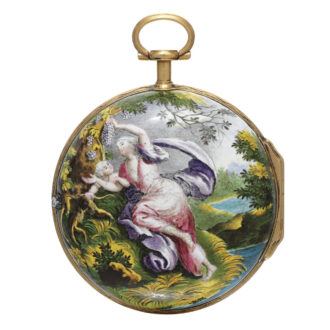
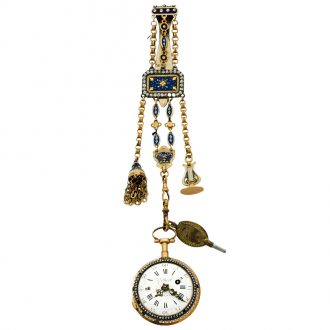
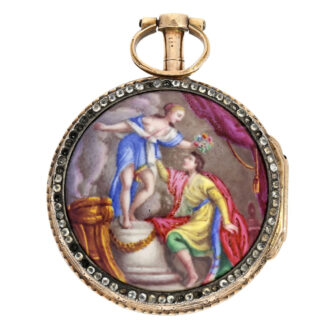
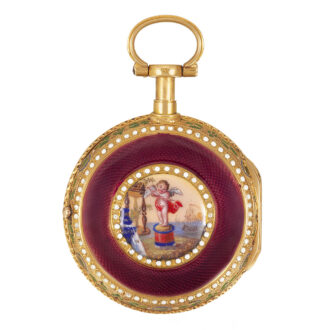
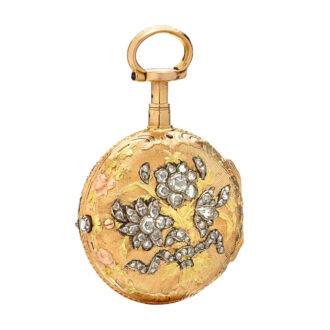
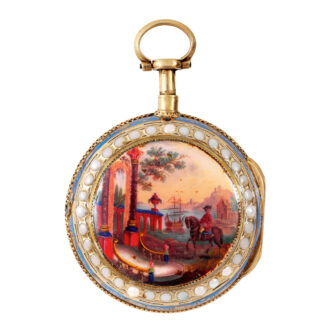
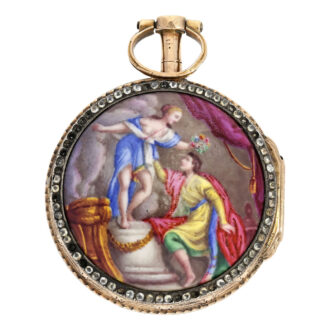
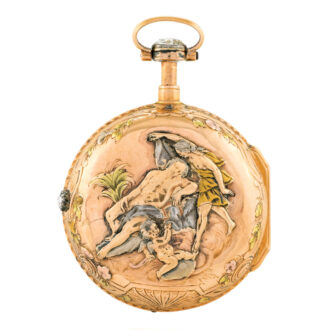
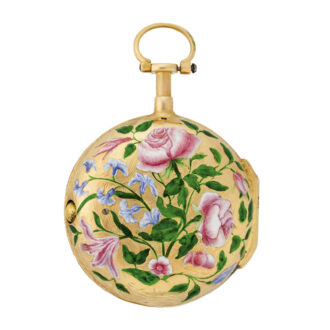
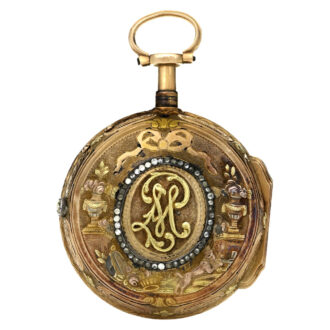
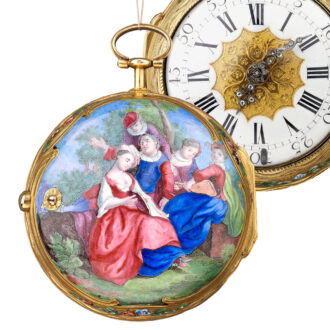
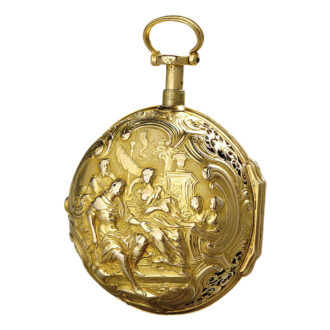
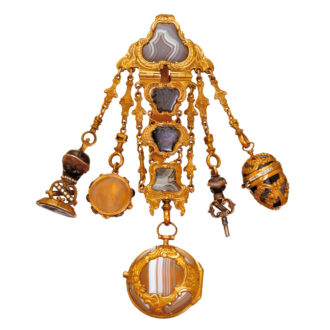
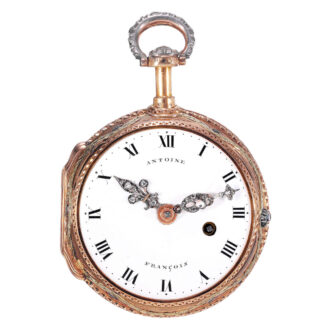
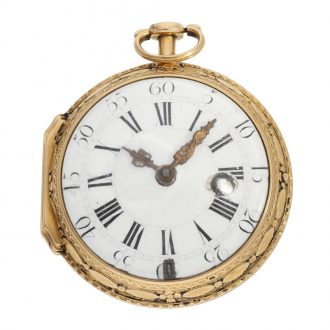
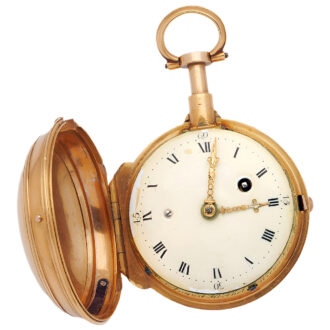
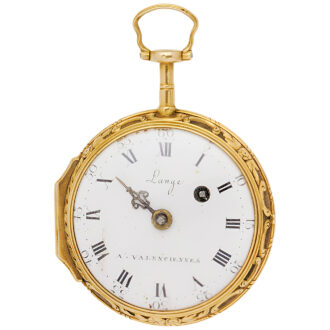
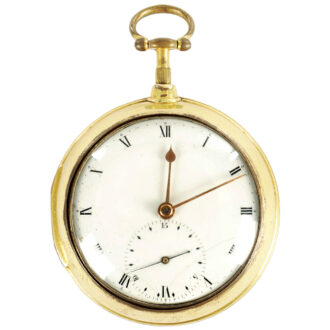
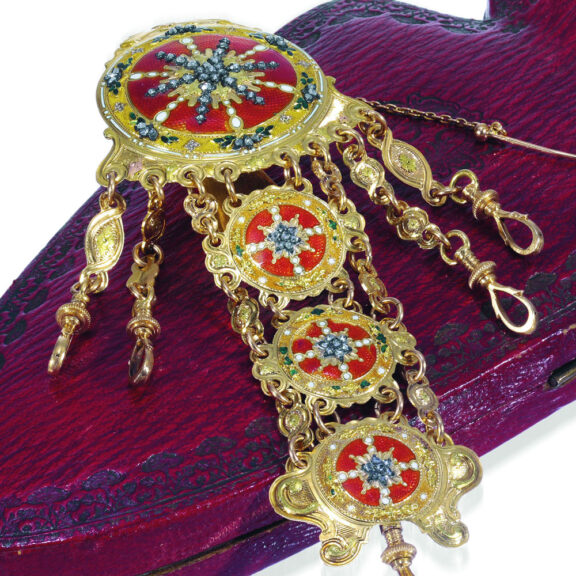
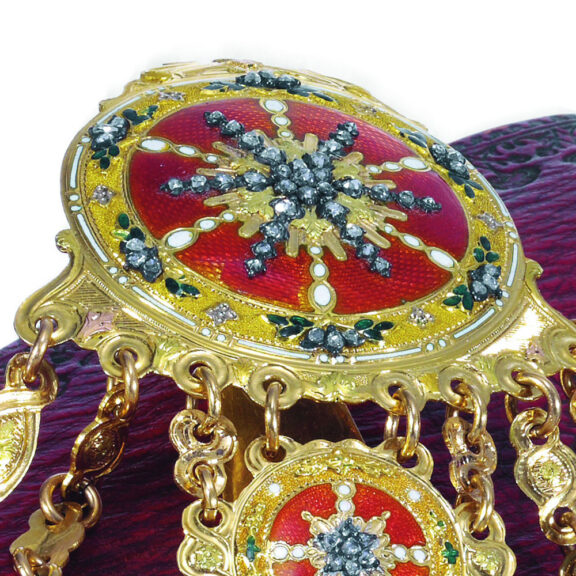
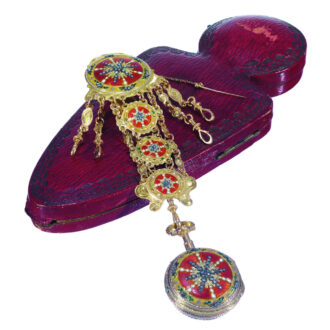
French 20k gold repeating verge with chatelaine Circa 1765
- Kenmerk
- BA0476
- Diameter
- 38 mm
- Estimate
- € 12.000 - 25.000
- Price sold
- € 10.100
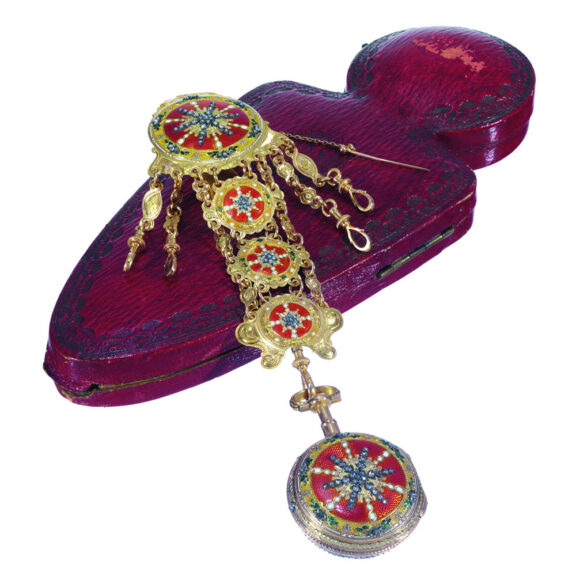
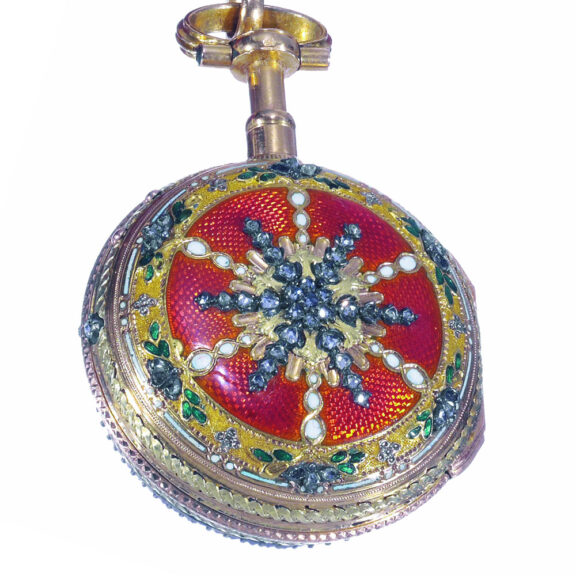
Gold, enamel and diamond set quarter repeater à tact by Lépine
–
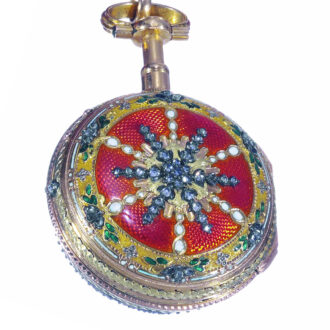
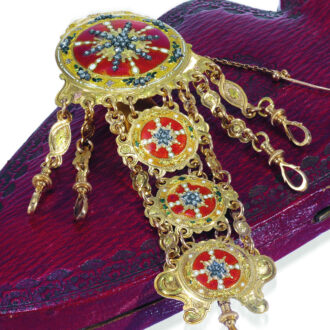
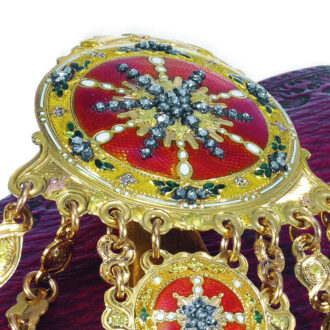
A very fine and very rare French 20 carat gold, enamel and rose cut diamond set quarter repeating verge pendant watch with à tact option and original matching 20 carat gold, enamel and rose cut diamond set chatelaine, made in the 1760s. Frosted gilt full plate movement, conical pillars, fusee with chain, verge escapement with three armed brass balance and flat balance spring, continental pierced foliate balance cock with steel endplate, silver regulator dial, repeating on a bell in the back of the case, levers under the bezel for a tact or bell strike option and silence. White enamel dial with Roman numerals intersected by rose cut diamond set half hour indexes, outer dot minute divisions and Arabic five minute numerals and rose cut diamond set silver Louis XV hands. Louis XV case, chased bezel and border with a repeated pattern, bezel set with rose cut diamonds, the back decorated with translucent red guilloché enamel and white enamel star pattern, the centre with an applied rose cut diamond set star, chased border with green enamel leaves and rose cut diamond set flowers, rose cut diamond set thumb piece. Dial and movement signed, chatelaine with French gold marks. Accompanied by the original fitted red morocco case.
–
Diameter: 38 mm
–
Signed: L’Epine Hger du Roy à Paris
–
Jean-Antoine Lépine (1720-1814) was born at Challex, a small village a few kilometers north of Geneva. He went to Paris in 1744. A workman for André Charles Caron, the King’s Clockmaker, he married his employer’s daughter in 1756 and was received Master in 1765. He was made ‘Horloger du Roi’ (watchmaker to the King) about 1765. In 1766 he succeeded Caron. In 1772, Lépine established himself in the Place Dauphine, in 1778-1779, Quai de l’Horloge du Palais, then in the rue des Fossés Saint Germain l’Auxerrois near the Louvre in 1781, and finally at 12 Place des Victoires in 1789. In 1782, his daughter Pauline married Claude-Pierre Raguet, with whom he formed a partnership in 1792. In 1763 he invented a repeating mechanism for watches, which was published in the Mémoires de l’Académie des Sciences in 1766. His revolutionary new caliber, in which the rear plate by was replaced by bridges, was invented circa 1770. The use of a dead beat escapement allowed him to eliminate the fusee. Lépine also invented the virgule escapement, a simplification of the double virgule escapement invented by his father-in-law and used by his brother-in-law Pierre Augustin Caron (who became famous under the name of Beaumarchais). He developed a new type of case with concealed hinges and a fixed bezel. Lépine went often to the Gex countryside, particularly to Ferney where Voltaire had set up a watch manufactory in 1770. Though his exact role in the Ferney manufactory is not known, it is certain that he gave commissions to the workshops there until 1792. After his retirement in about 1793, although he had lost his sight, Lépine continued to be active in the firm managed by his son-in-law and this until his death on 31 May 1814, at the age of 93.
Signed: Lépine Hger du Roy à Paris
Share this page: