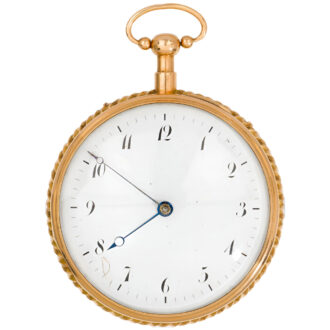
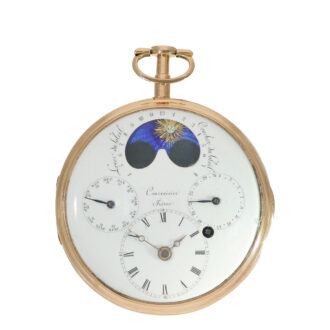
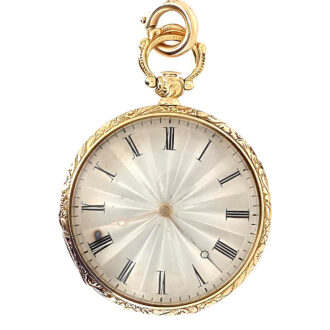
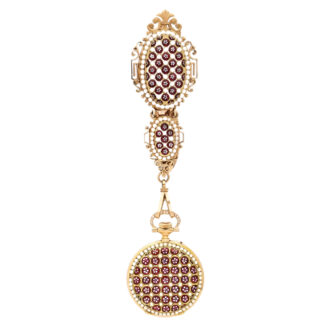
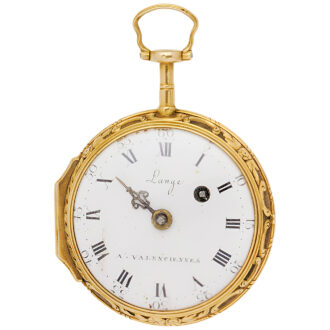
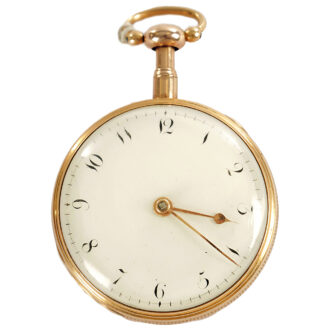
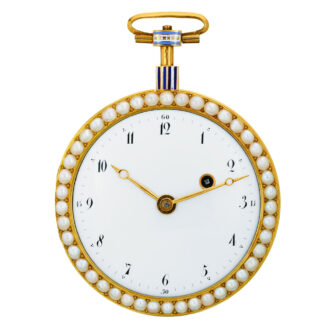
Decorated Swiss verge for the Spanish market Circa 1800

- Kenmerk
- BA0492
- Diameter
- 56 mm
- Estimate
- € 22.500 - 35.000
- Price sold
- € 28.800
Gold, enamel and pearl-set watch attributed to Jean-Louis Richter
–
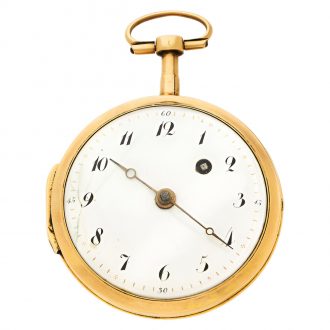
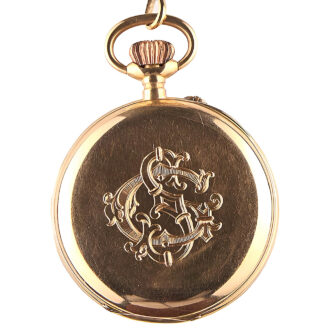
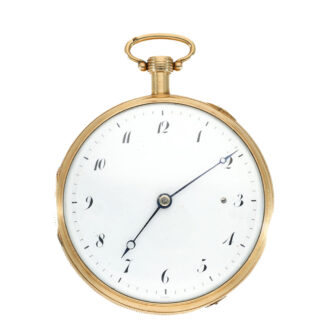
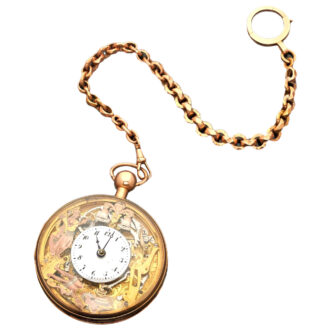
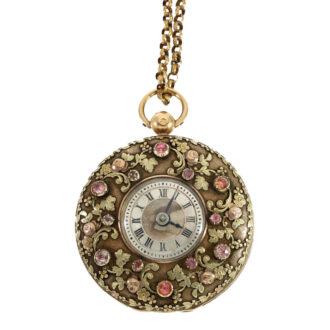
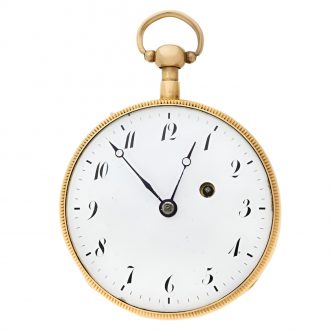
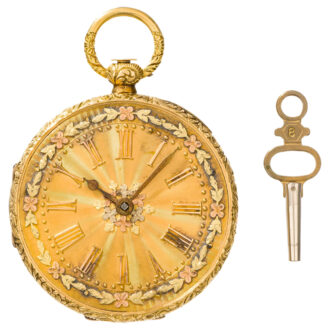
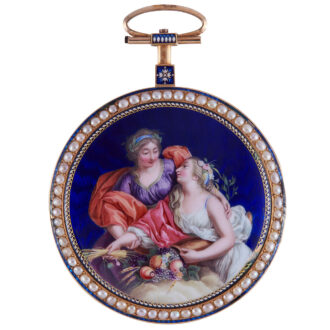
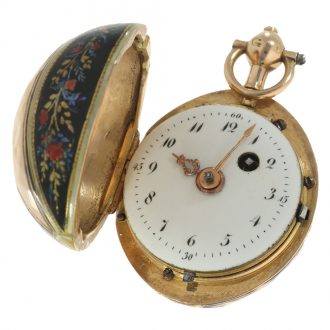
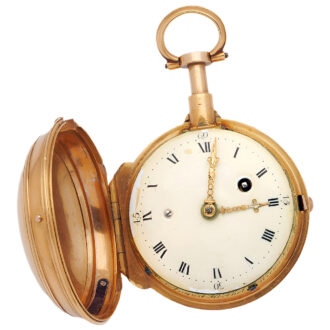
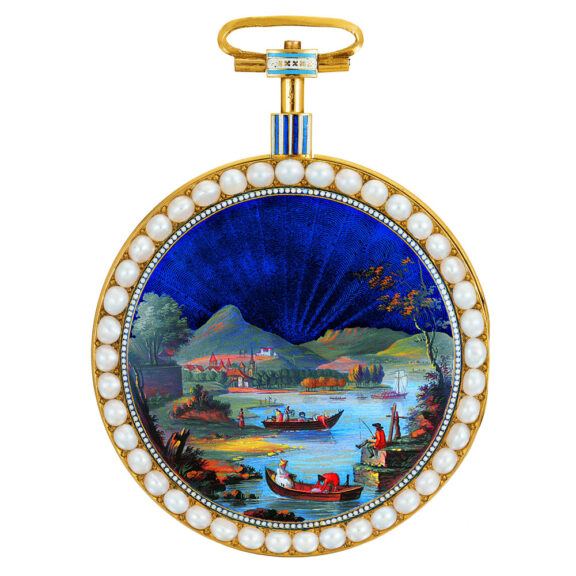
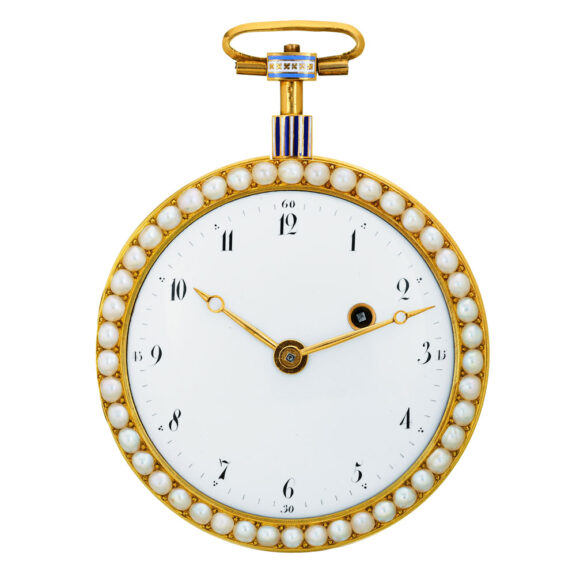
A fine, rare and large Swiss 18 carat gold, enamel and pearl-set open faced verge pocket watch made for the Spanish market, circa 1800. Frosted gilt full plate movement, cylindrical pillars, fusee and chain, verge escapement, three armed brass balance, blued steel flat balance spring, continental type balance cock, silvered regulation dial. White enamel dial with Arabic hours, outer minute indexes and Arabic quarter hour numerals, original gold Breguet hands. Case with pearl-set bezels, enamelled pendant and bow, the back with a fine painted on enamel lake and mountain scene with a dark blue guilloché enamel sky.
–
Diameter: 56 mm
–
Signed: No name
–
Jean-Louis Richter (1766-1841) was a painter active in Geneva’s ‘Fabrique’ from the 1780s to the 1830s. His work often unsigned, is clearly recognizable. He was the son of Jean Jost Richter who died in 1792, an engraver and ‘bourgeois’ of Frankfort on the Main, who became an habitant of Geneva on February 7, 1766. In 1778, at the age of 12, Richter began a six-year apprenticeship with the Roux brothers, who specialized in the decoration of watches and jewellery. In January 1793, ‘Rifter’ (sic) is listed among the citizens of Geneva who are to elect the new National Assembly, he is described as a painter. In 1820, Richter was elected to the Conseil of the city of Geneva, and in 1830, he was elected again. In addition to his painting on enamel, Richter also practised another genre, imported from Berlin and Brunswick: a painting on objects made of cardboard and of sheet iron. In 1826, Richter is recorded in the Almanach des adresses du canton de Genève as working “en l’Isle, No. 243”. Around 1815 he became associated with Aimé-Julien Troll (1781-1852). In 1828 they are listed as executing paintings “on enamel and in oils, landscapes, portraits, flowers, and all types of jewellery, Quai de l’Isle, 243”. The association between Troll and Richter had been dissolved by 1840. Jean-Louis Richter died in Geneva on July 21, 1841, at the age of nearly 75. Dr Hans Boeckh has shown that the work of Richter may be divided into three periods: in the earliest of them, the English influence is predominant, with subjects coming from the engravings of artists such as William Hamilton (1751-1801) and Peltro William Tomkins (1760-1840), although the influence of other artists can be perceived as well, contemporaries such as Johann Ludwig Aberli (1723-1786), Francesco Bartolozzi (1727-1815), Angelica Kauffmann (1741-1807) or painters from earlier times such as Guido Reni (1575-1642) and Eustache Lesueur (1616-1655). Richter’s second period was dominated by Italian landscapes, real or imaginary, in the style of Claude-Joseph Vernet (1714-1789). In his third period, Richter favoured Swiss landscapes, often after the work of Pierre-Louis De la Rive.
Share this page: