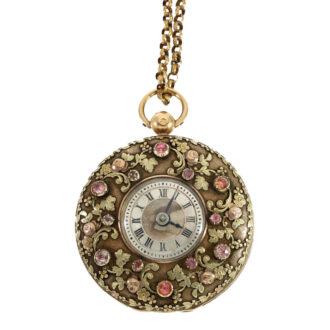
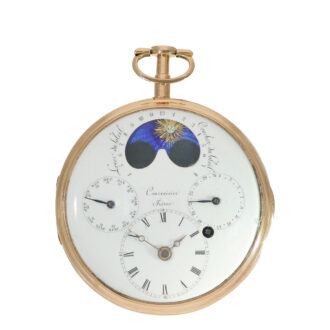
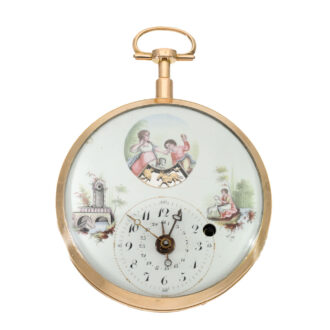
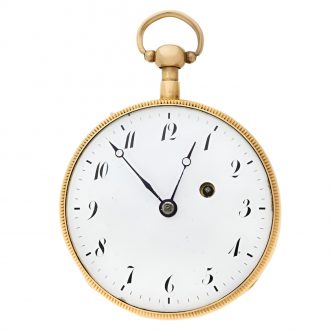
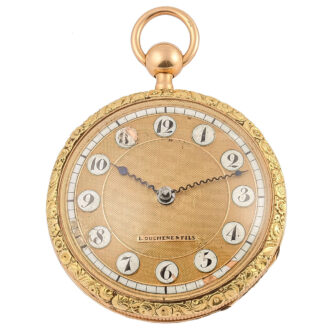
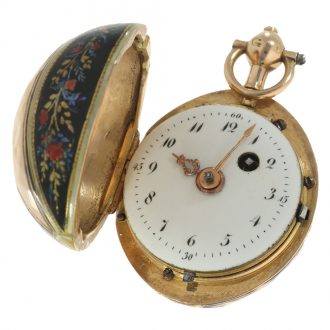
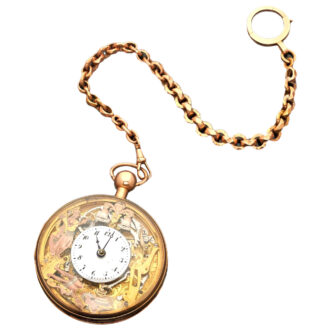
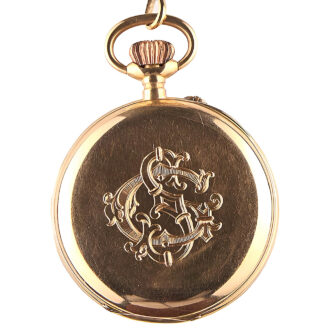
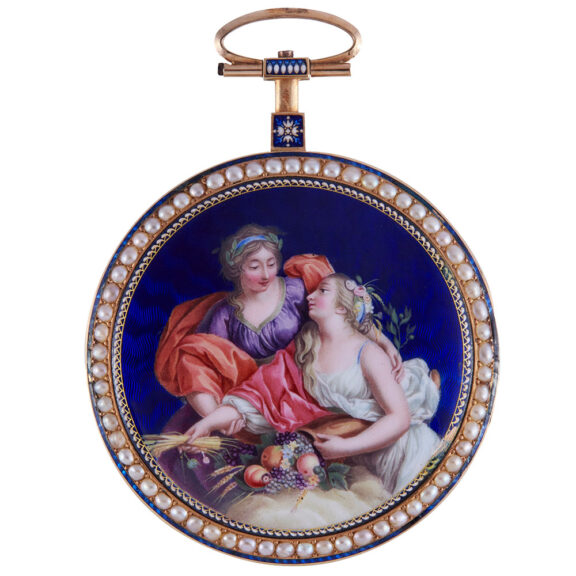
Fine Swiss gold, enamel and pearl pocket watch Circa 1800
- Kenmerk
- TA5404
- Diameter
- 53 mm
- Estimate
- € 7.500 - 15.000
- Price sold
- -
Gold open faced verge pocket watch
–
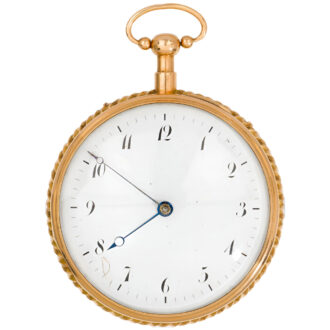
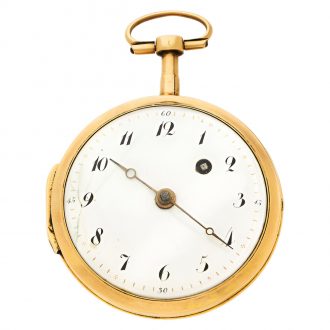
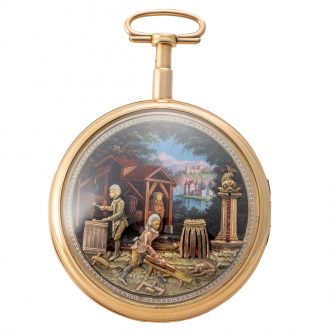
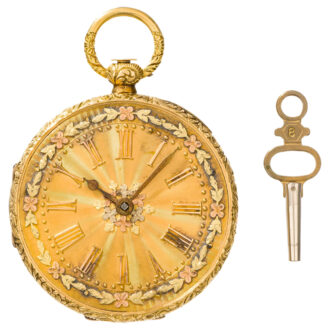
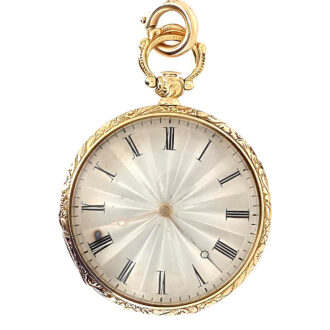
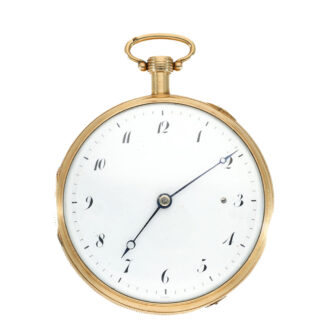
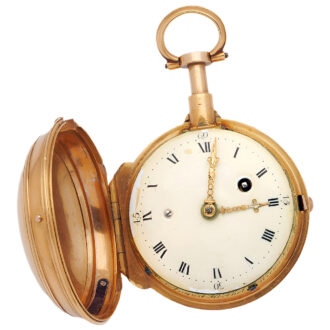
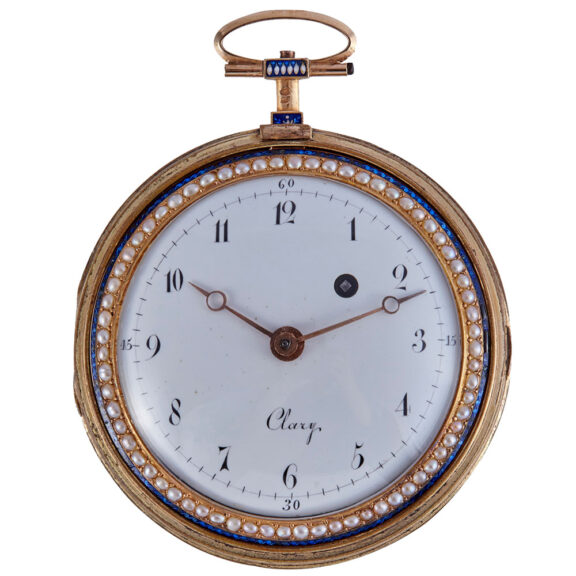
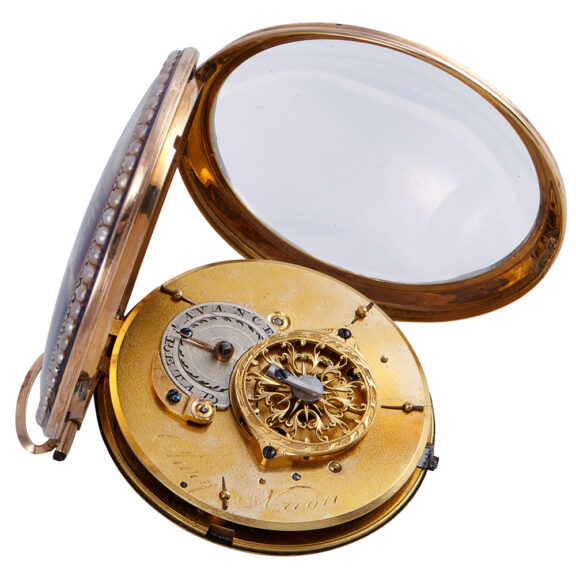
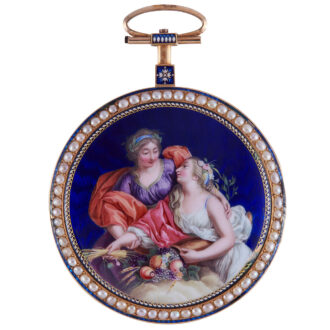
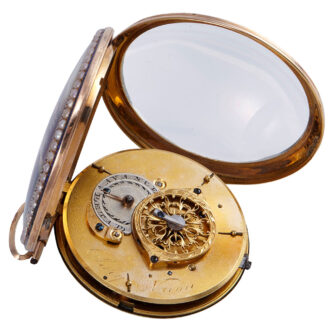
An excellent Swiss 18 carat gold, enamel and pearls open faced keywinding pocket watch, made by Clary in Geneva, circa 1800.The case back with an allegorical scene showing Peace Bringing Back Abundance or The Allegory of Fertility, after a painting of Elisabeth Vigée-Lebrun (1755-1842). The painting on enamel on gold is attributable to Jean-Louis Richter (1766-1841) or Jean-Abraham Lissignol (1749-1819). The case back and front bezel are set with one row of half-pearls. The pendant and bow are decorated with a décor of gold paillons. White enamel dial with suspended Arabic numerals and yellow gold Breguet hands. A full plate, gilded brass movement, fusee and chain, verge escapement, monometallic balance and blued steel flat hairspring, pierced and engraved gilded continental cock. Signature on the dial and movement.
–
Diameter: 53 mm
–
Weight: 77 g
–
Signed: Clary, Geneva
–
Accompanied by an outer gilded protective case, with one glazed side.
–
Clary
Several excellent quality Genevan watches, dating from the very end of the 18th century or the beginning of the 19th century, with a gold case, enamel painting, some set with half pearls and/or diamonds, signed Clary, are known. Nothing is known about this watchmaker, who was most probably active in Geneva at the time, where several people bearing the surname Clary or Claris are listed.
–
Iconography
In the past, the subject represented on this watch has been given as Apollo pursuing a nymph or Demeter and Core or Demeter and Persephone or Vertumnus and Pomona. It is, in fact, Peace Bringing Back Abundance, titled also The Allegory of Fertility, a painting by Elisabeth Vigée-Lebrun (1755-1842), executed in 1780. (now in the Louvre Museum in Paris). The Geneva enamel painter probably interpreted it from a contemporary engraving.
–
Richter, Jean-Louis (1766-1841)
Learned his art in Geneva under David-Etienne Roux and Philippe-Samuel-Théodore Roux, becoming a most renowned enamel painter. His speciality was the painting of landscapes and particularly lake-side scenes and marine-scapes, often representing ships in a harbour or battles with fighting Men-of-War, but, on occasion, also portraits and hunting scenes. He did not often sign his work, but it is clearly recognised as being in his hand from the style and quality of the painting. He applied his art principally to watch cases and snuff boxes, and these were largely destined for the Chinese, Turkish, British and Italian markets. In 1828, he was in partnership with Aimé-Julien Troll (1781-1852), and one can find work signed “Richter et Troll”. Richter, like other great enamel painters of the time, often found inspiration for his work from paintings or engravings by the artists then in fashion, particularly Claude Vernet or the romanticised English and Irish rural life.
Signed: Clary, Geneva
Share this page: