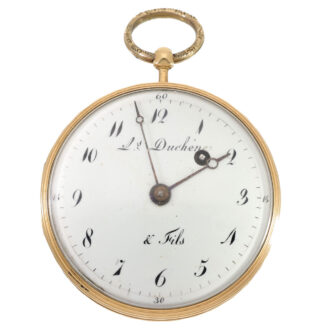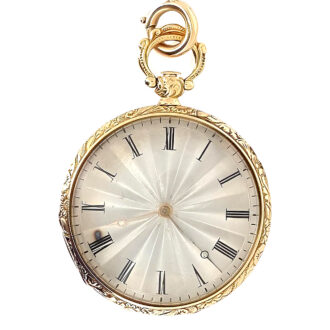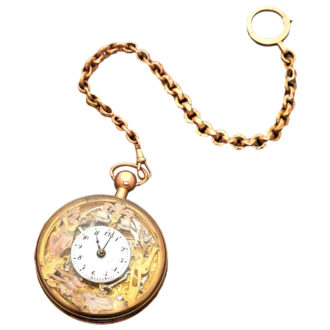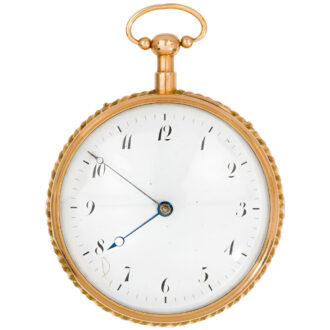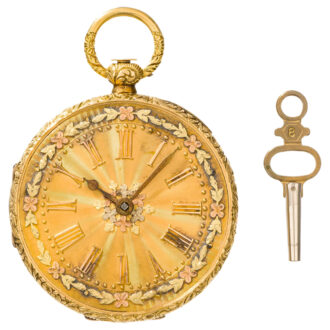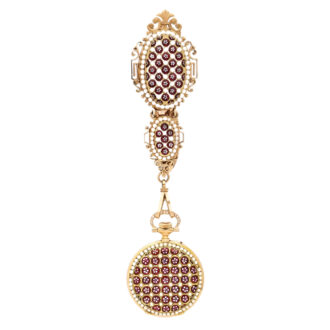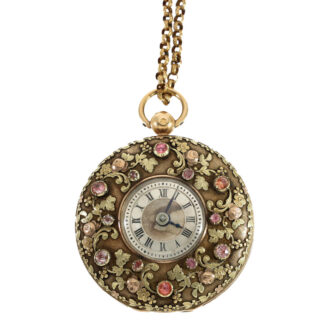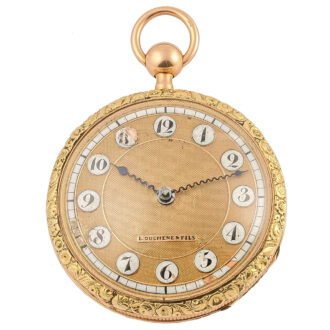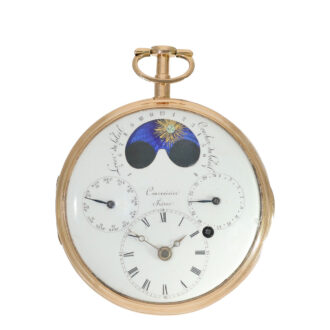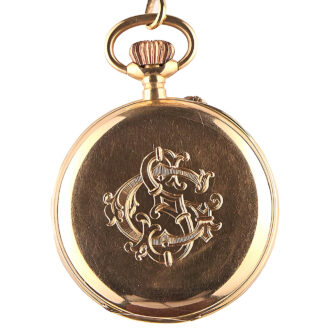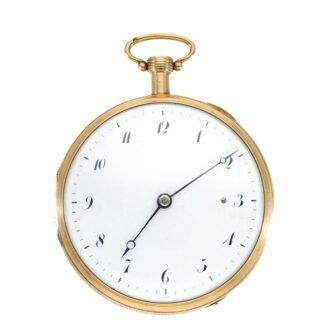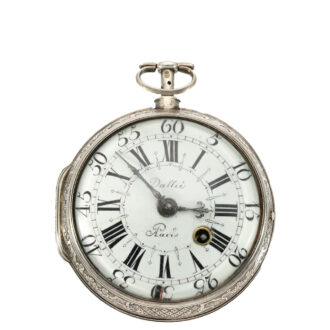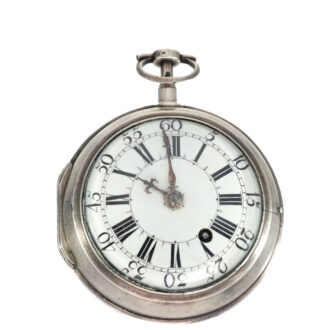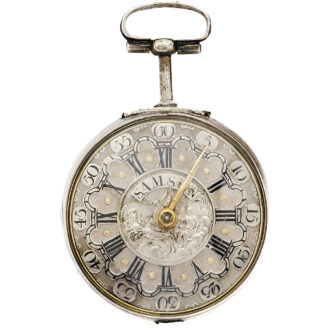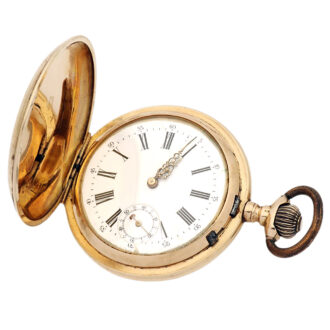
Swiss musical watch made for the Chinese market Circa 1800
- Kenmerk
- CH1443
- Diameter
- 62 mm
- Estimate
- € 300.000 - 600.000
- Price sold
- € 412.000
Highly important gold, enamel and pearl set musical watch
–
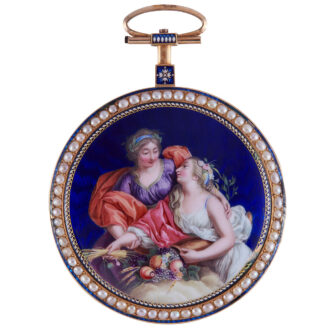
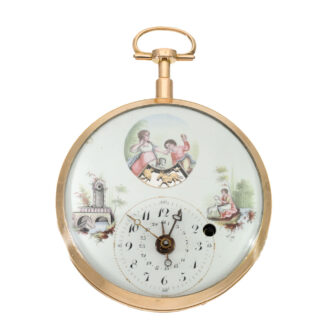
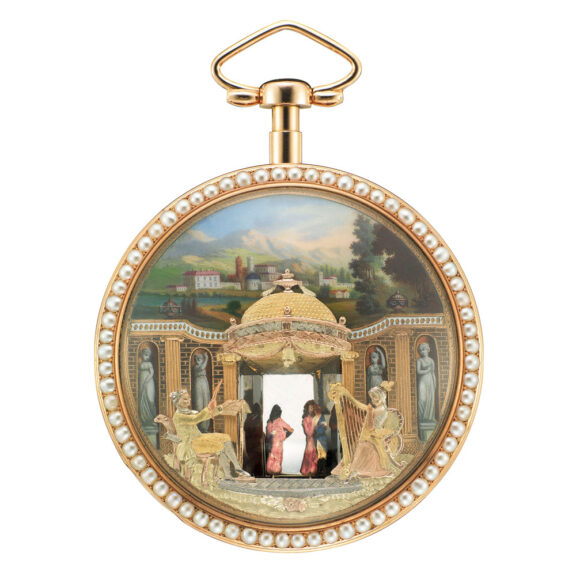
An exceptionally rare and highly important Swiss key-wound musical watch with automata, in 18-carat gold, enamel and pearls, made for the Chinese market around 1800. It is attributed to Du Bois et Fils and known as “The Theatre”.
–
Movement
Key-wound gilt full-plate movement with a cylinder escapement and a plain three-arm brass balance.
–
Dial
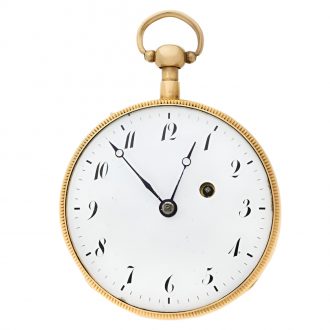
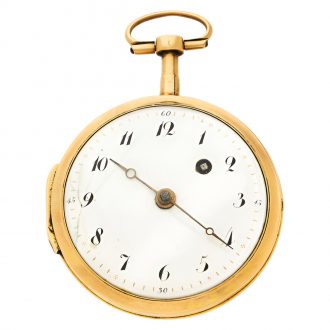
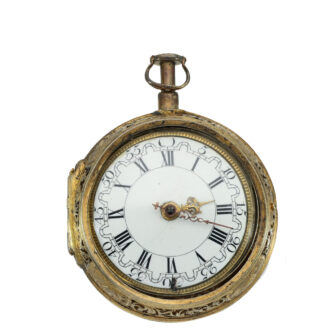
White enamel dial with Roman numerals. There are two winding holes: one between VIII and IX for the time, and one at IV for the music and automata.
–
Case
A large case with pearl-set bezels. The band is finely decorated with rectangular panels of translucent royal-blue enamel over an engine-turned ground, framed by patterned gold borders. A lever in the band starts the music and automata.
–
Back and automaton
The back is finely painted in polychrome enamel with a view of the Jura mountains, showing a lakeside castle and the village around it. At its centre is a pagoda-like theatre of chased gold in several colours, decorated with figures of women in neoclassical dress painted in grisaille enamel. On either side are moving musicians in multi-coloured gold: a lady playing the harp on the right and a gentleman beating time on the left. On a revolving stage with mirrored walls and a multi-coloured ceiling, four brightly enamelled dancers move in time to the music. They come together towards the centre and then draw apart again to the corners of the stage.
–
Diameter: 62 mm
–
Signed: Attributed to the firm of Du Bois et Fils
–
Background
To meet demand from China, master goldsmiths, enamellers and watchmakers from England, France and Switzerland worked together to make ever more lavish and whimsical timepieces and fantasy objects of every kind. This watch combines around 1800 Swiss automaton engineering with exquisite craftsmanship. It shows how inventive European watchmakers were in meeting the growing demand for clocks and automata, from the Chinese Imperial court and its courtiers and from European aristocrats and royal families, especially in the 18th and 19th centuries.
–
Automaton watches first appeared in Geneva in the late 18th century. These small technical marvels imitated the movements of living creatures. They ranged from simple bras en l’air figures, whose arms pointed to the time, to very complex pastoral scenes, theatres like this one, and other tableaux. Some also had repeating or musical mechanisms. They were highly prized works of art, not only in Europe but also among Chinese and Ottoman dignitaries.
–
The “Theatre” automaton
The “Theatre”, or ballroom, automaton is perhaps one of the rarest automata ever made. Fewer than eight are thought to have been produced. This example can be attributed to Du Bois et Fils of Neuchâtel, Switzerland, who also made other automaton masterpieces such as the “Tightrope Dancer” and “Moses”. All known Theatre watches use similar ébauches, which suggests they came from the same maker, although each is decorated slightly differently.
–
A very similar watch without pearls sold in Geneva in 1996 for CHF 366,500. It is now on display in the Patek Philippe Museum in Geneva.
Signed: Dubois & fils
Share this page: