English rare miniature gold pocket chronometer Circa 1861
- Kenmerk
- SA0465
- Diameter
- 26 mm
- Estimate
- € 20.000 - 40.000
- Price sold
- € 66.500
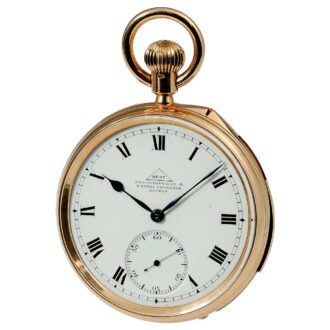
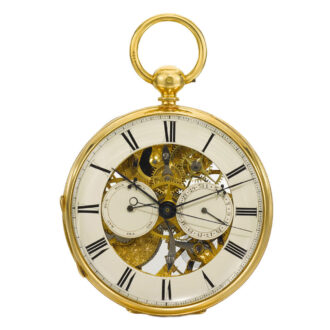
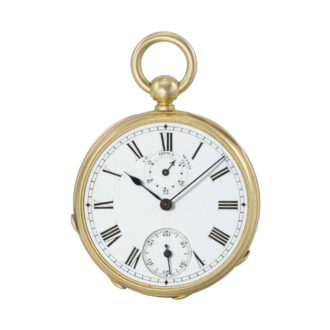
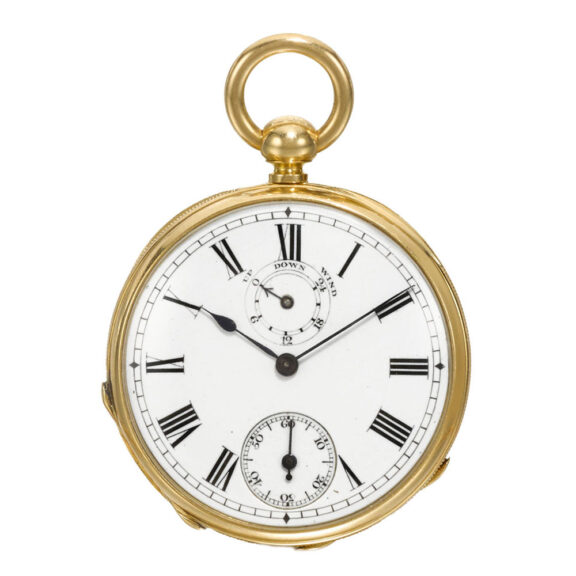
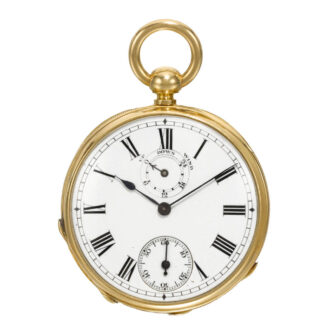
Exceptionally rare miniature gold pocket chronometer with power reserve indication
–
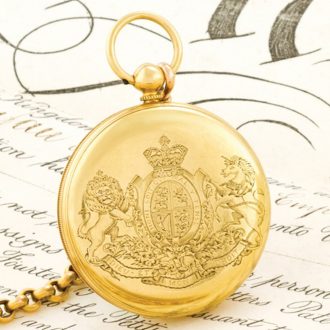
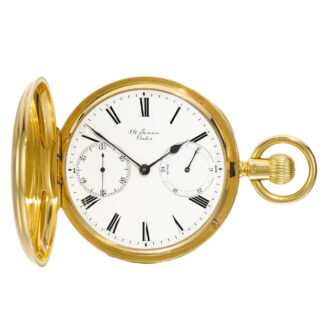
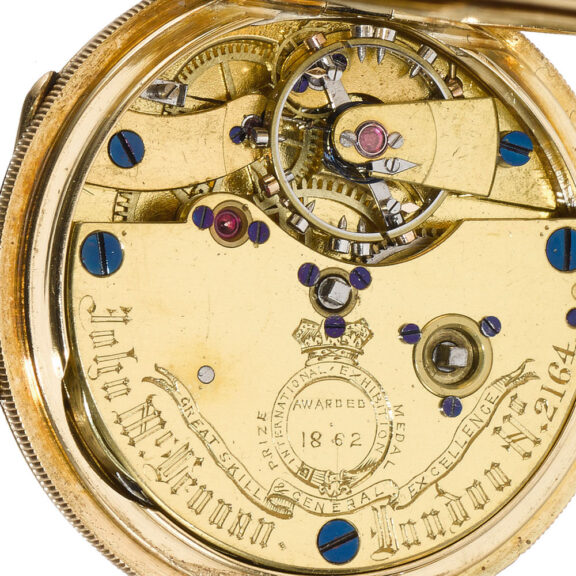
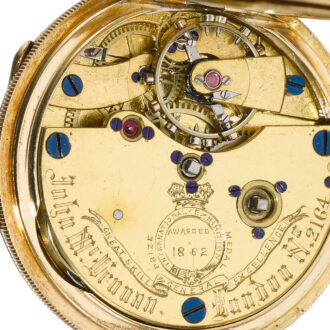
An English exceptionally rare and very fine miniature gold open-faced pocket chronometer with power reserve indication, circa 1861, gilded three-quarter plate movement, spring detent escapement, bimetallic compensation balance, blued steel duo-in-uno spring, ruby endstone, signed John McLennan, London, the backplate further engraved Prize Medal International Exhibition awarded 1862, Great Skill and General Excellence.
White enamel dial, Roman numerals, outer minute ring, two subsidiary dials for up-and-down indication and subsidiary seconds with Arabic numerals.
Gold case, engine-turned bezel and case back, plain gold polished cuvette with apertures for winding and hand-set, with maker’s mark RR in oval cartouche for Robert Rowlands, with a fine gold chain.
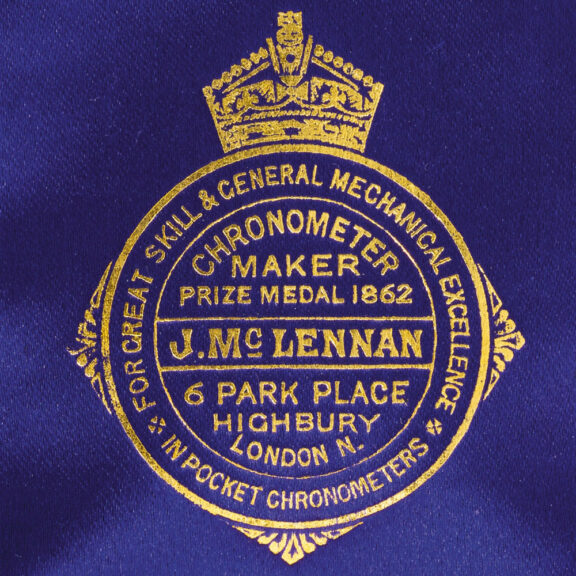
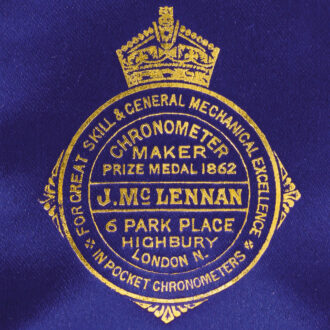
With an associated John McLennan presentation box.
Diameter: 26 mm
–
Signed: John McLennan London
–
An astonishingly small pocket chronometer, this is believed to be the smallest English pocket chronometer with a spring detent escapement and up-and-down power reserve indication ever made. A slightly smaller pocket chronometer, but without up-and-down, measuring 25.7mm was formerly in the collection of the Time Museum and sold at Sotheby’s New York. The latter watch was made by Alexander Watkins and exhibited at the Great Exhibition at Crystal Palace in 1851. Anthony Randall, in his book The Time Museum Catalogue of Chromometers,notes “the difficulties of making such a [small] watch were, at the time, really formidable, and the detent escapement must be about at the practical limit for reduction in size.”
John Osbourne McLennan (1814-1886) was born in Dingwall, north of Inverness, Scotland. A highly accomplished maker, he worked for James McCabe junior and Charles Frodsham. He is reputed to have invented the duo-in-uno balance spring which was challenged by A.P. Walsh, however, as Tony Mercer notes in his book Chronometer Markers of the World, “W. B. Crisp suggests that A.P. Walsh saw them at an exhibition of 1862 went home and copied them, then immediately had them displayed in his own showcase”. The 1862 International Exhibition mentioned on the present watch’s movement was held in South Kensington, London, on a site that now houses the Natural History and Science museums. Given the hallmark date and extreme rarity of this watch, it would seem certain that this is the same chronometer shown at the exhibition by McLennan and which A.P. Walsh must have seen. Following the exhibition, McLennan would have arranged to retrospectively engrave the backplate of his movement to commemorate his achievement.
In a letter to Antiquarian Horology (December 1984), it was stated that McLennan’s miniature chronometer watch, made for the 1862 Exhibition, was sold to Alexander Baird of Urie Castle for 265 Guineas in 1862. At the time of its auction at Christie’s in 2011, it was noted that this watch had remained in one family for three generations.
The Horological Journal of January 1887 gave a short obituary of John McLennan as follows: “To complete the horological obituary for 1886 must be recorded the death of probably the best all-round watchmaker of our times, Mr. John McLennan, who, at the age of 72, succumbed to a complication of internal disorders at the end of November, was engaged for many years on the finest class of work for McCabe, Charles Frodsham and other famous houses. He exhibited in the 1862 Exhibition, as the production of his own hands throughout, certainly the smallest pocket chronometer ever made, the movement being the size of a shilling; the balance spring was a duo in uno – a form in which the bottom of the spring is a volute, rising from the outer end of which is a helix. Mr. McLennan claimed to be the inventor of the duo in uno, but the originality of this conception was challenged, we believe, by both Mr. Walsh and Mr. Hammersley. However, the style of Mr. McLennan’s work, the clean handling and the superb finish, but induced a spirit of emulation that did much to advance the character of English watchmaking.”
Signed: John McLennan London
Share this page: