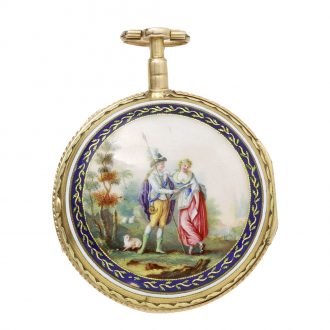
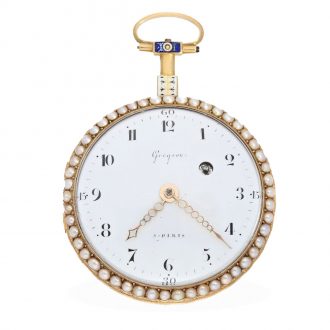
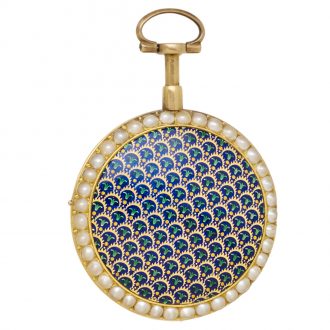
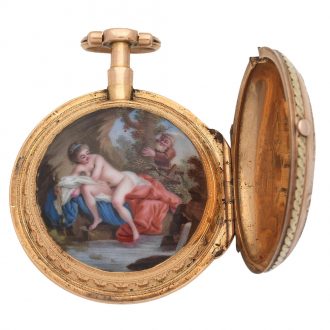
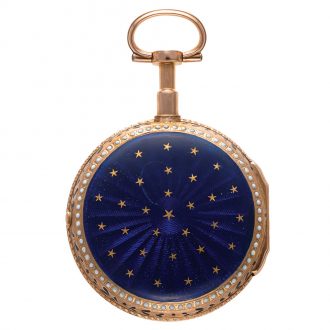
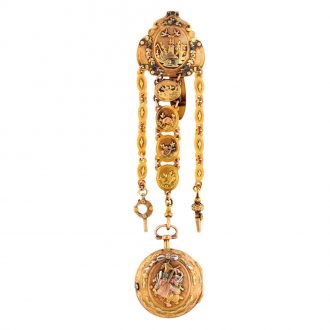
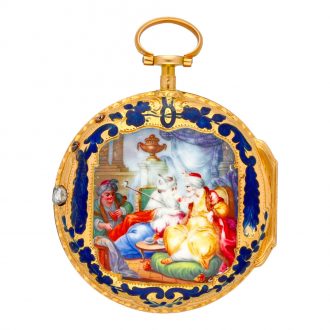
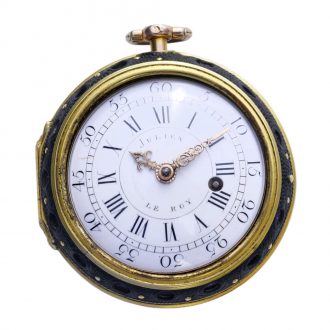
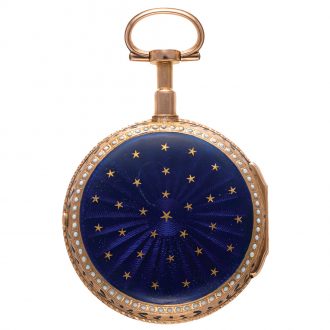
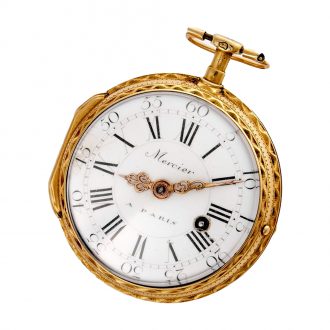
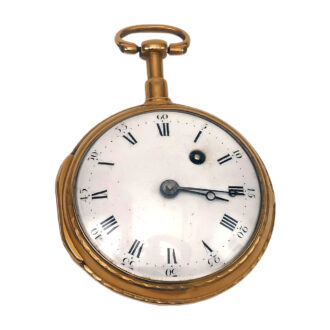
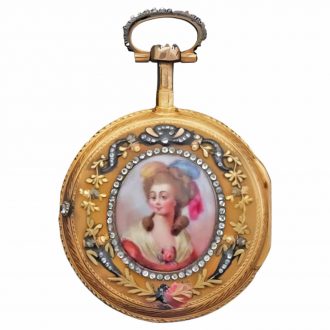
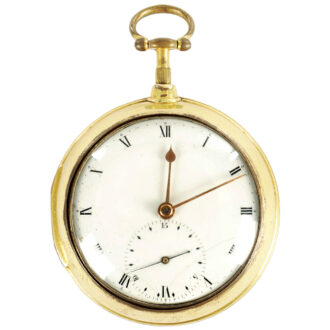
French 18K gold and painted enamel pocket watch Circa 1775
- Kenmerk
- AL3483
- Diameter
- 42 mm
- Estimate
- € 6.000 - 12.000
- Price sold
- € 17.000
Gold open faced key winding double comma watch
–
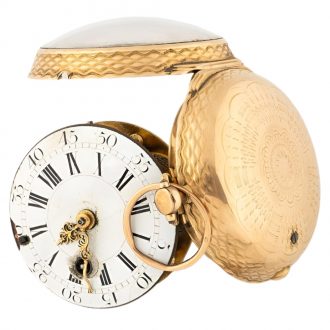
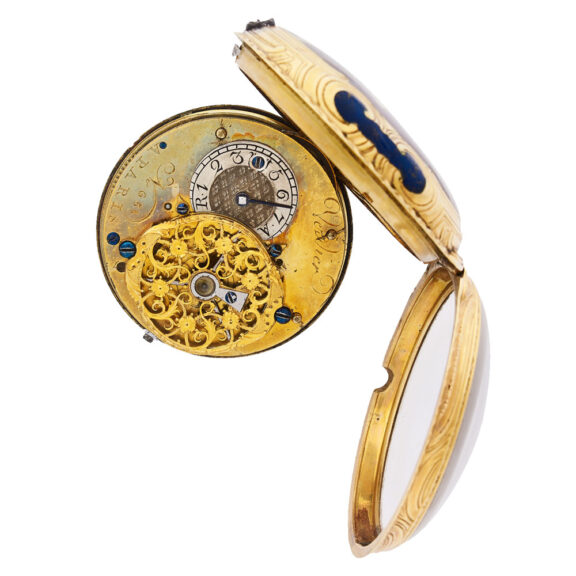
A magnificent and historically significant French 18 carat gold open faced pocket watch featuring a rare double comma (virgule) escapement and a painted enamel scene attributed to Hamelin, made by the celebrated master watchmaker Verdier in Paris, circa 1775. This watch has a mechanical key winding fusee and chain movement with a complex virgule escapement, a spiral balance, an advance/retard adjustment disc, and stylized pillars between the two plates. It features an intricately chased and pierced continental balance cock, signed on the backplate Verdier à Paris.
–
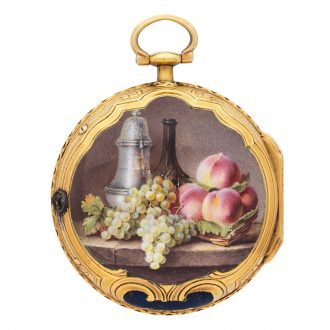
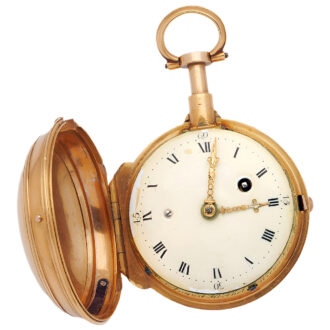
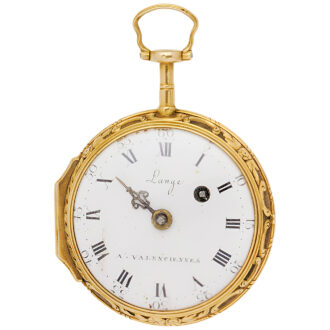
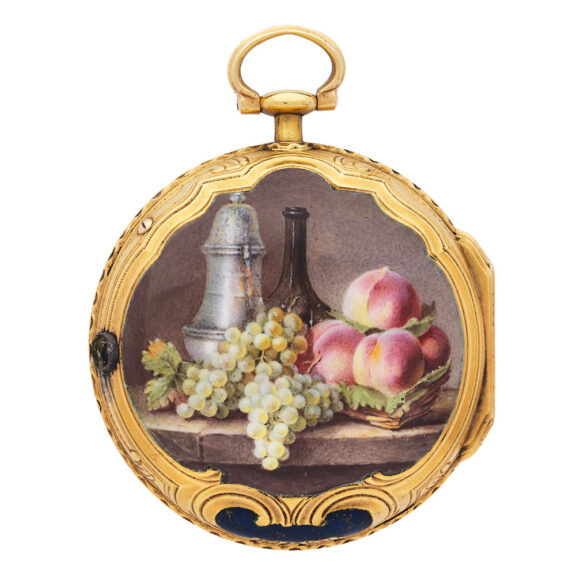
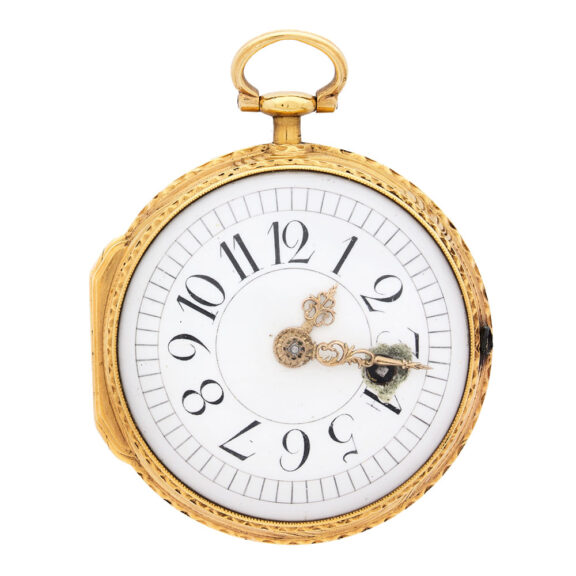
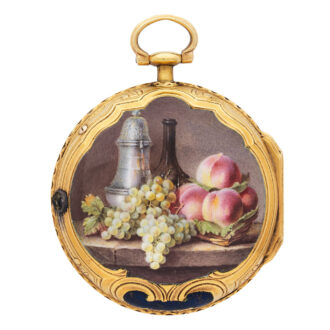
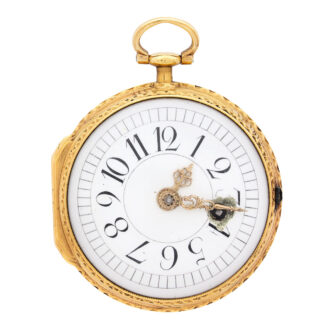
The white enamel dial shows large black Arabic numerals for the hours, an outer railway minute track, ornate gold hands, and a winding aperture near 4 o’clock. The timepiece is housed in an exceptionally fine hinged round 18 carat solid gold case. The front has a bezel chased with delicate scrollwork, while the caseband is embellished with rich royal blue enamel cartouches. The reverse back cover is finished with a vibrant polychrome enamel miniature painting in the Dutch still life tradition, depicting an abundant arrangement of grapes and peaches alongside a classic pewter pitcher and bottle on a dark table ledge.
–
Diameter: 41.5 mm
–
Weight: 62.90 g
–
Signed: Verdier à Paris
–
The maker of this outstanding timepiece, Jean-Jacques-Baptiste Verdier, became a Parisian master clockmaker in 1737. He established his workshop on the Rue des Marais in 1739 and rose to the prestigious rank of Juré in 1773.
–
The breathtaking unsigned miniature enamel painting on the case back is attributed to Hamelin, widely revered as one of the premier French enamel painters of the 18th century. His signed works are so rare that only four snuff boxes are recorded worldwide, including examples in the Wallace Collection and the Taft Museum.
–
Beyond its artistic brilliance, this timepiece is a mechanical landmark due to its virgule escapement, also known as the double comma. This escapement was the centre of one of the greatest watchmaking scandals in 18th century France. In 1753, the royal clockmaker Jean-André Le Paute published a description claiming this new escapement as his own. However, a 21-year old Pierre-Augustin Caron, the future celebrated playwright Beaumarchais, publicly accused Le Paute of intellectual theft. The Royal Academy of Sciences intervened, ruling in Caron’s favour in 1754 while also crediting Jean Romilly with a simultaneous variation. Although the virgule escapement provided excellent accuracy, its manufacturing was notoriously complex and fragile, so very few were produced. Surviving examples of this calibre are an extraordinary rarity for connoisseurs of horological history.
Signed: Verdier à Paris
Share this page: