Impressive Swiss gold and enamel cylinder watch Circa 1800
- Kenmerk
- DT0100
- Diameter
- 65 mm
- Estimate
- € 200.000 - 400.000
- Price sold
- -
Gold repeating watch with three automatons
–
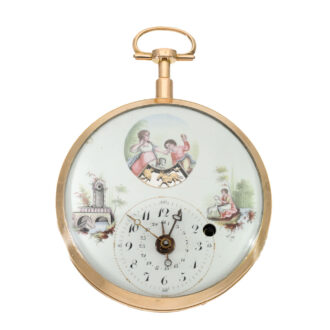
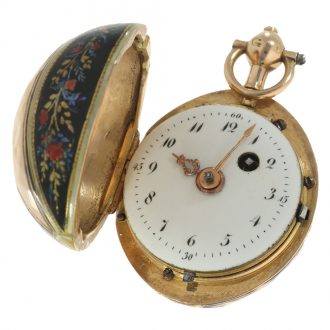
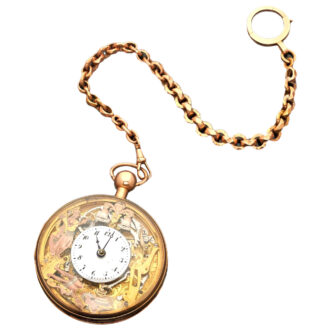
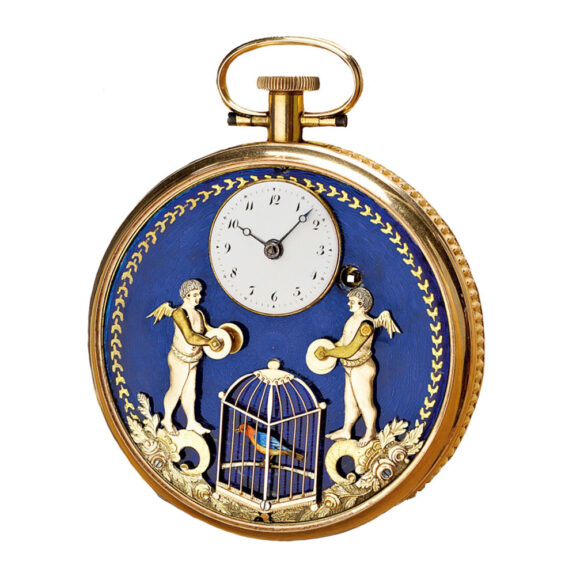
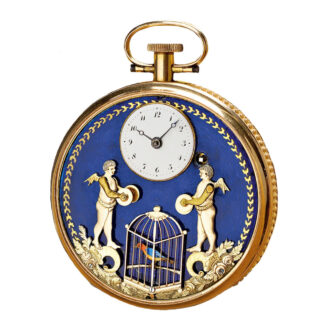
A gold and enamel singing bird watch of museum quality and historic significance, quarter repeater with two flutes, three automatons, circa 1800.
There are only two other examples of this kind held in important museums.
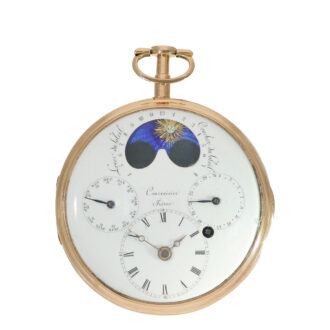
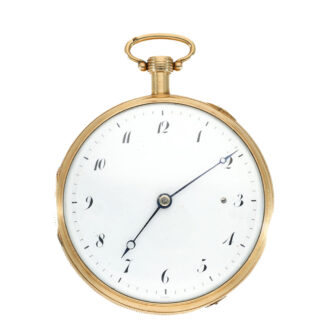
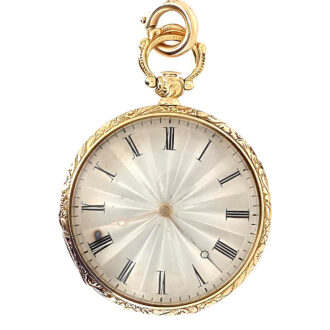
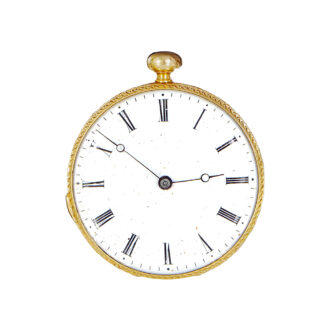
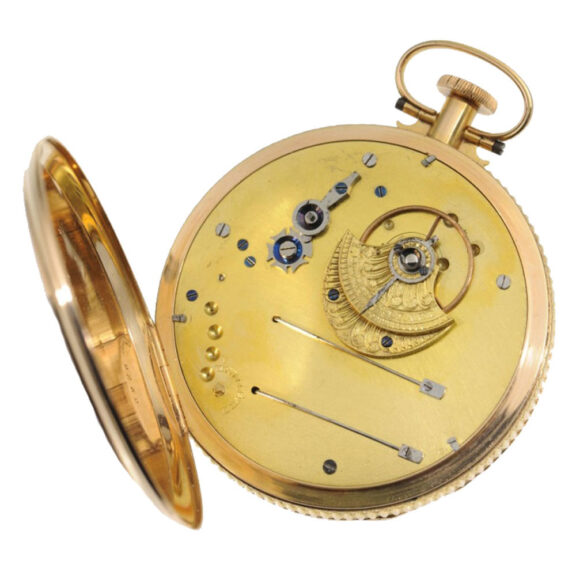
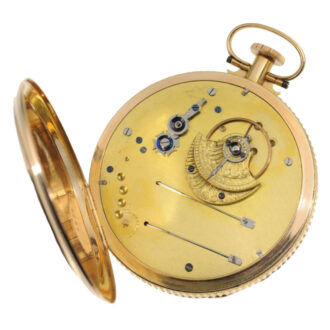
An 18k gold, case maker’s punch mark “OQ”, enamel and gold dial, full plate movement, keywind, chain/fusee, cylinder escapement, three-arm ring balance, two flutes, two gongs.
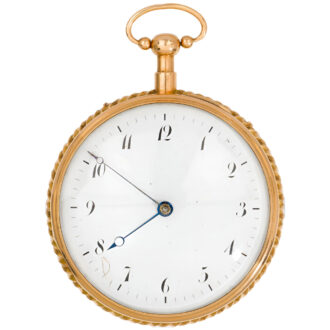
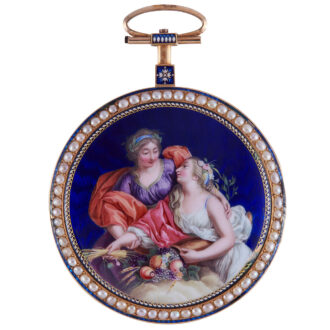
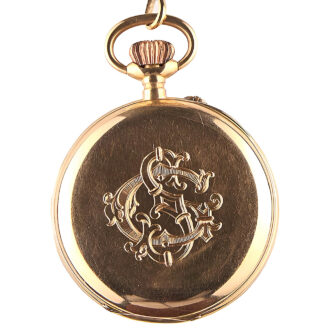
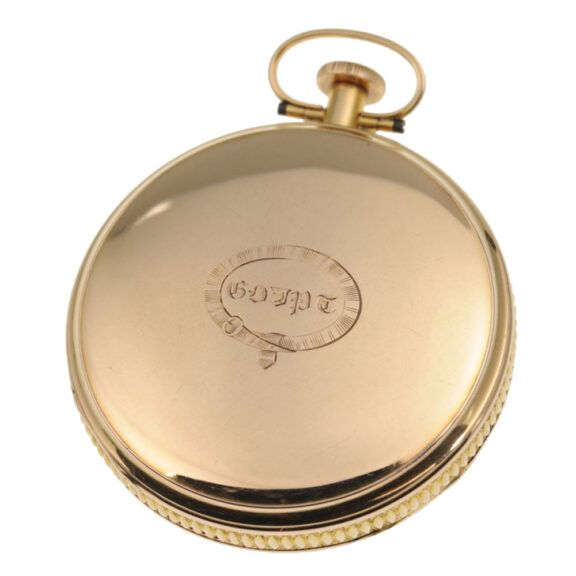
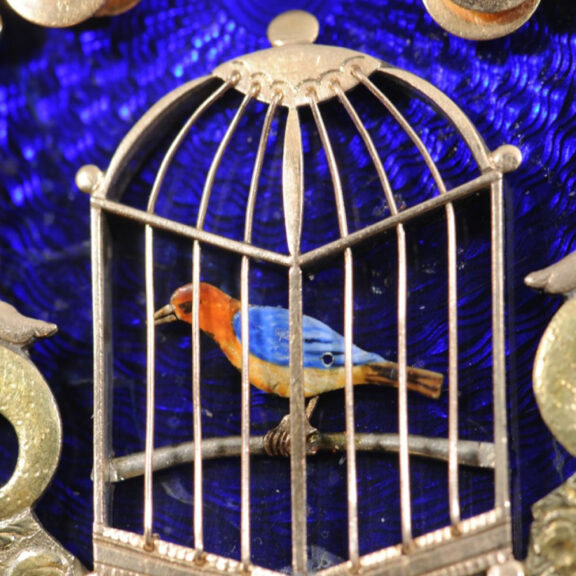
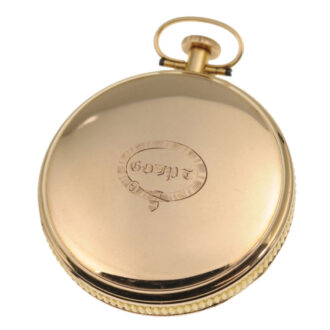
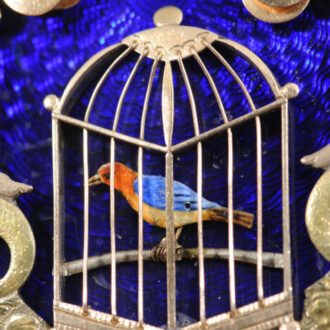
Two three colour gold, winged putti stand on flower filled cornucopia against a background of basketweave engine turned pattern and translucent cobalt blue enamel. The putti are facing each other and play the cymbals. On the floor between them sits a birdcage with a perched colourful, chirping bird. Above is a small white enamel dial with Arabic hours and blued hands. A graceful gold border of stylised leaves frames the scene. On the back the engraved initials “GD PT” are surrounded by a buckled band. The pendant must be turned to activate the repeater mechanism a typical feature in watches by Philippe DuBois’.
–
Diameter: 65 mm
–
Weight: 176 g
–
Signed: Philippe DuBois Le Locle
–
This watch is illustrated and described in “Flights of Fancy” by Sharon and Christian Bailly, 2001.
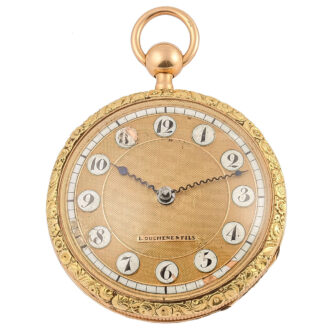
A nearly identical piece is illustrated and described in “La Montre Suisse” by Eugene Jaquet et Alfred Chapuis, Basel 1945, illus. 101, Collection G. Du Bois à Peseux. Also in “Les Automates” by Alfred Chapuis and Edmond Droz, Neuchatel 1949. There is another similar watch in the Patek Philippe Museum in Geneva, which has two monkeys playing the cymbals. Illustrated and described in the exhibition catalogue. In 1785 Philippe DuBois (1738-1808) and his sons founded the DuBois & Fils 1785 watch company at the family seat in Le Locle. DuBois had already established extensive business connections all over Europe and America as a cloth merchant, which made things much easier for the start-up watch company. During the 19th century DuBois & Fils opened branches in Germany, the Netherlands, Spain and the United States and business boomed. Due to its proximity to the trade fairs the German Frankfurt branch was particularly important. DuBois was one of the first makers to produce self-winding watches.
Signed: Philippe DuBois Le Locle
Share this page: