Swiss extraordinary half pearl set ring watch with seconds Circa 1800
- Kenmerk
- AD6135
- Diameter
- -
- Estimate
- € 6.000 - 12.000
- Price sold
- -
Gold navette shaped ring watch attributed to Antoine Rojard
–
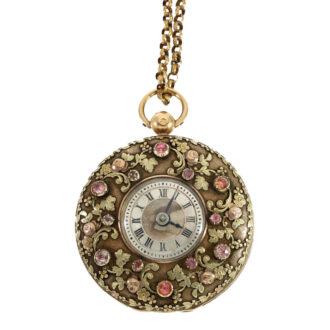
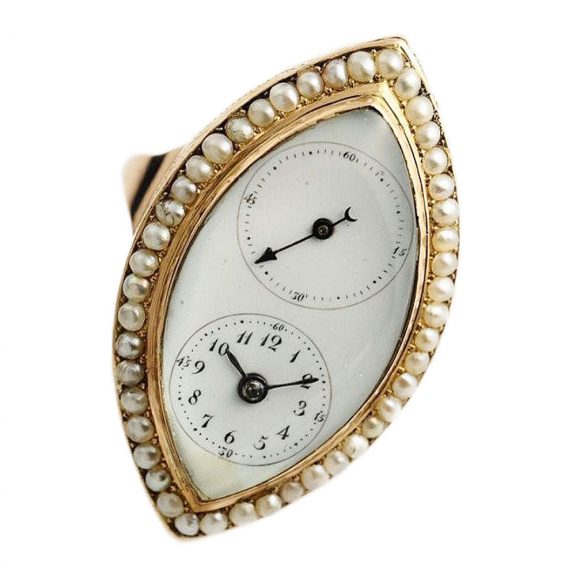
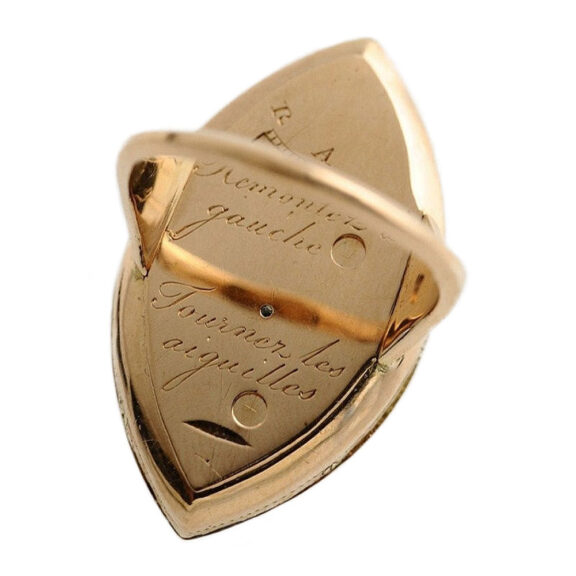
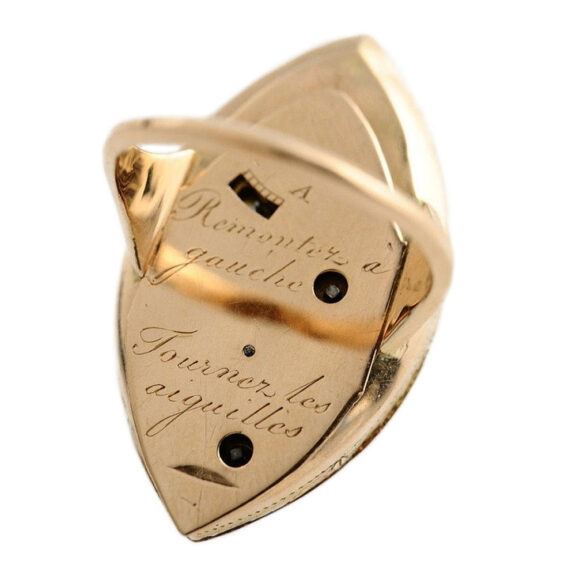
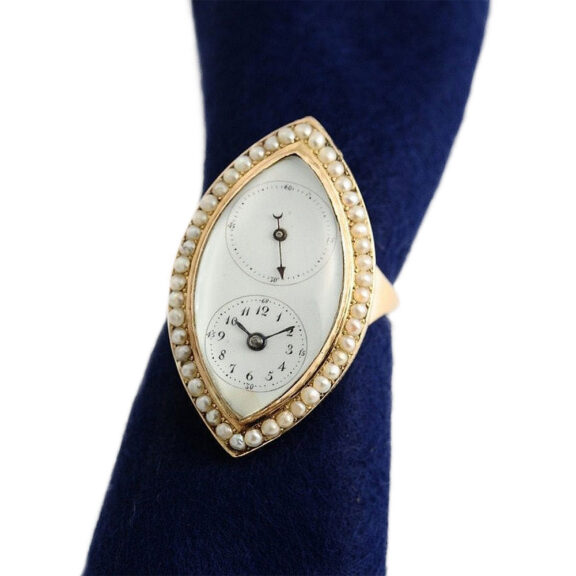
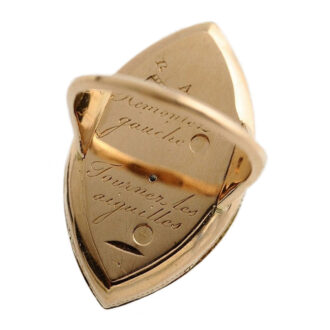
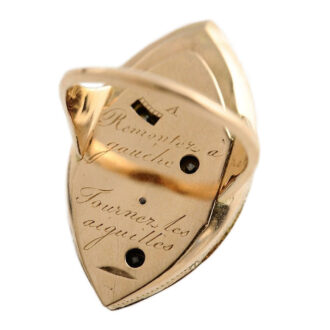
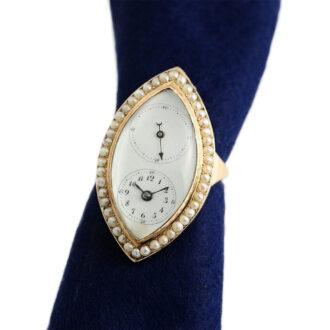
An extraordinary Swiss 18 Carat rose gold navette shaped half pearl set ring watch with seconds, circa 1800. Frosted gilt navette shaped movement with cylinder escapement.
The case with a florally engraved rim, half pearl set bezel, winding, setting and regulating apertures on the back, inscribed Remontez a gauche and Tournez les aiguilles. White enamel dial with in the lower part an eccentric chapter ring with Arabic numerals for the indication of hours and minutes, in the upper part an eccentric chapter ring with Arabic seconds and blued hands.
–
Diameter: 37 x 21 x 11 mm
–
Weight: 17 g
–
Signed: No name
–
Very few makers were capable of making ring watches, considered marvels of watchmaking. Around 1800 only Piguet et Capt, Antoine Rojard and Pierre Simon Gounouilhou are known to make them. Only sixty ring watches from that period are recorded and only three are signed or rather scratched (by Piguet et Capt). The present piece is in the style of Antoine Rojard whose claim to fame comes from his ring watch worn, according to the tradition, by Napoleon Bonaparte. Rojard and Humbert were practically the only competitors to Jaquet-Droz and his circle. In a letter to Frisard, Leschot writes about a certain worker “I think it best to treat him with tact…. He could harm us by going over to Humbert or Rojard”. Miniaturization in horology began in the 14th century. By the early 17th century, miniaturization was in full bloom. A German maker produced a small stack freed watch with a movement measuring only 10 mm, less than 4 ½”’! As early as the 1580s, watchmakers were fascinated with the idea of fitting a watch into a ring. Only a few succeeded. In the early days, successful attempts ended up on the finger of a King, Prince or prelate. In the Metropolitan Museum of Art, there is a very early ring watch, dating from about 1560 and signed I.W. The Mantua archives contain a letter from James Widman to the Duke of Mantua concerning three ring watches and it is quite possible that one of them is the one in the Metropolitan Museum. In 1764, the young John Arnold presented an extraordinary ring watch to King George III of England. It was a half-quarter repeater, less than 2 centimetres in diameter and it had 120 parts. The watch brought fame to Arnold and established him as a very capable watchmaker. Czar Paul I of Russia offered Arnold double what George III had paid – already a small fortune of £500, but Arnold refused.
Share this page: