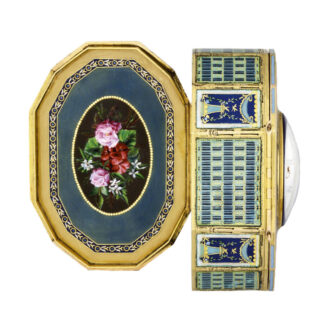
Magnificent Swiss gold and enamel musical snuff box Circa 1785
- Kenmerk
- TA3113
- Diameter
- -
- Estimate
- € 80.000 - 125.000
- Price sold
- € 100.450
Gold and enamel musical snuff box attributed to Jaquet-Droz
–
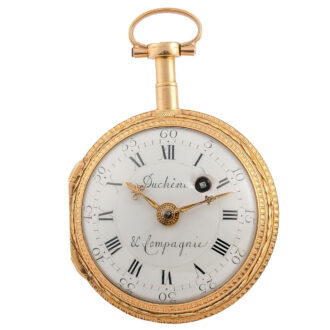
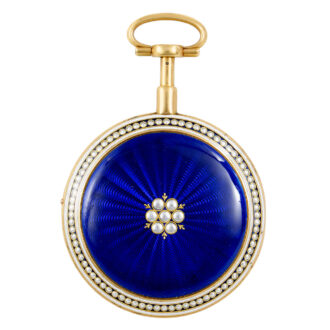
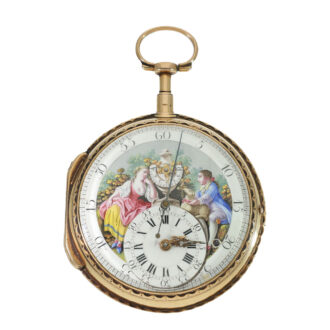
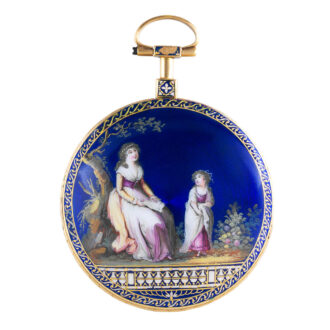
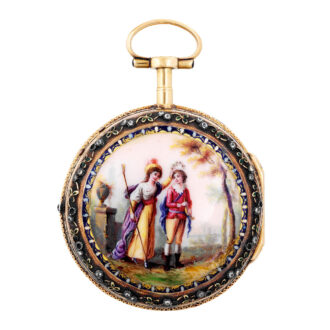
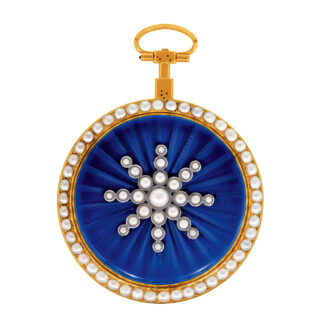
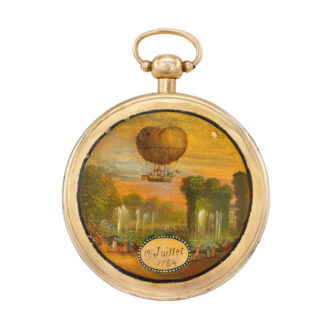
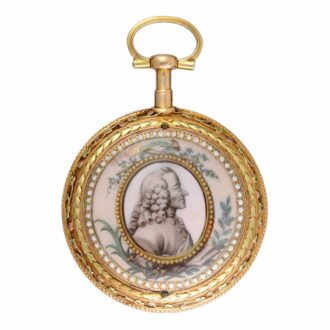
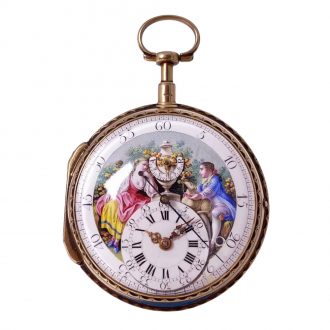
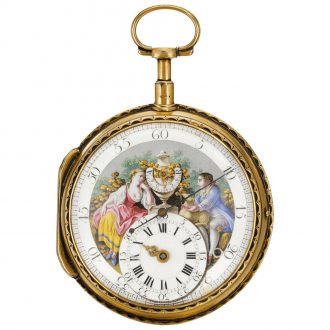
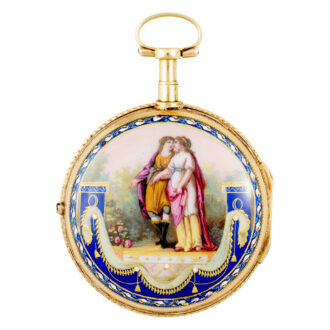
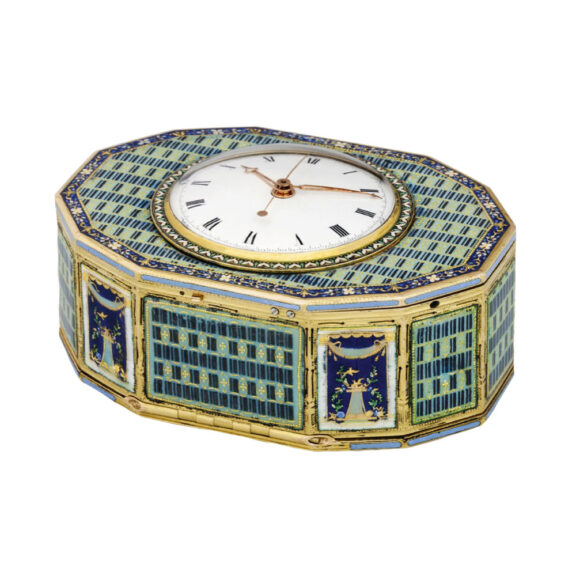
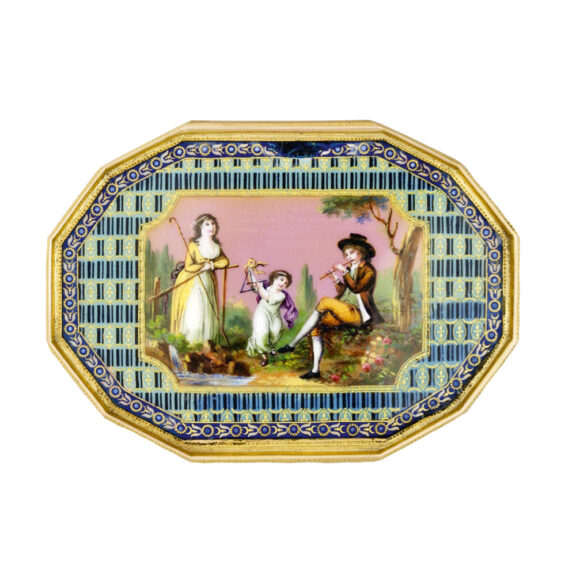
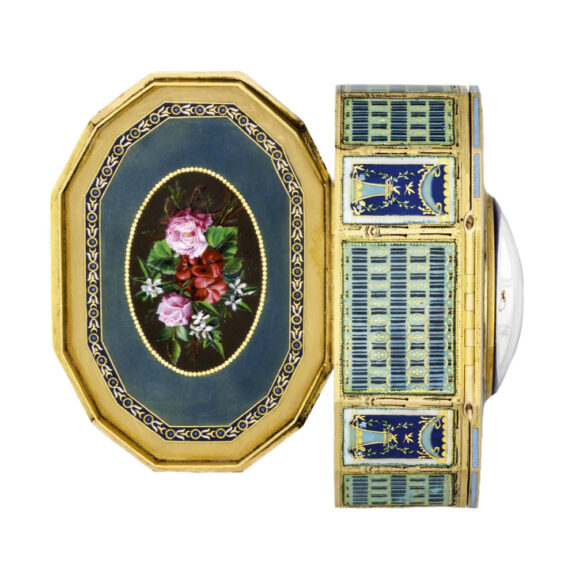
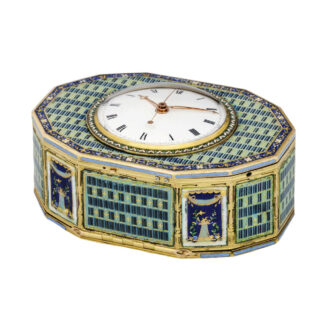
Magnificent and extremely fine Swiss 18 Carat gold and enamel musical snuff box with a centre second watch made for the Imperial Chinese Court, circa 1785. Retailed by Recordon & Dupont, London. A fully enamelled box with powder blue and paillon formal decoration in a striped pattern, the borders with paillon floral garlands over a blue ground, the twelve sided band including four panels of blue enamel within white frames decorated with paillon altars and doves symbolising Love and Fidelity, the bottom panel is centred with a painted on enamel pastoral scene depicting a young musician assisted by Cupid charming a maiden and opening to reveal a shallow snuff compartment enamelled with a bouquet of summer flowers on a brown ground within grey and papillon decorated border.
–
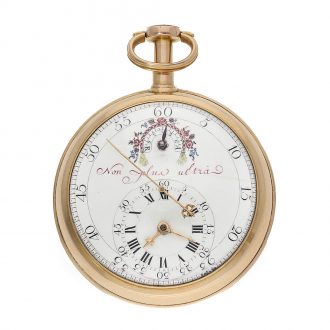
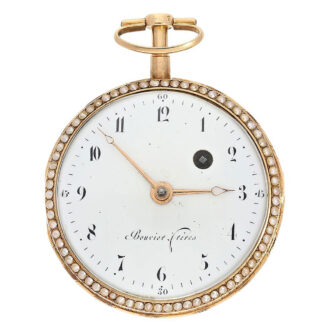
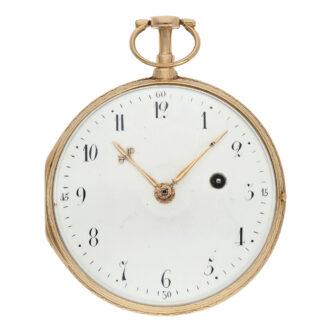
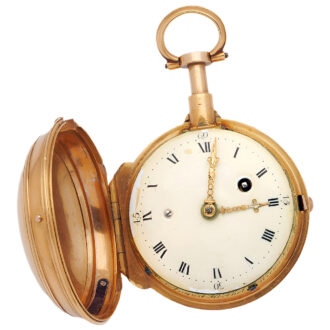
The gold panel with French-style prestige marks, engraved Taken from the Summer Palace Pekin 8th October 1860 N.S. The watch is inset on the lid with a pallone decorated bezel and a hinged gilt brass cuvette. White enamel dial with radial Roman numerals, outer minutes and seconds divisions and gold pierced hands. Gilt brass movement, drawn from the Lépine calibre with free standing barrels engraved with scrolled foliage, cylinder escapement, plain gold three arm balance, flat balance spring with index regulator. The shaped and skeletonized musical movement is also gilt brass, fusee with chain, a pin drum with five hammers playing on five stacked bells.
–
Dimensions: 84 x 60 x 32 mm
–
Signed: No name
–
Slightly restored soft enamel and the dial is slightly chipped.
–
Originating from an old family of Sainte-Croix watchmakers, later working in Geneva, Louis Recordon established his company in London in 1778 where he succeeded Emery in Cockspur Street. In partnership with Charles Dupont, also from Geneva, they settled in Tottenham Court Road and specialized in watches and clocks for the Chinese Market. In 1782 he began to trade with Jaquet-Droz and Henry Maillardet who was in charge of his workshop in London. Although the cuvette is signed Recordon & Dupont, the layout of the movement and the carillon allow the attribution of this box to the workshop of Jaquet-Droz, the leading specialist in such pieces at the time.
Pierre Jaquet-Droz was born on July 28, 1721, on a small farm (La Ferme de Sur Le Pont) in La Chaux-de-Fonds, Switzerland, as the son of a farmer who was an occasional clockmaker as well. He studied humanities and philosophy in Basel from 1738 to 1739. He became interested in clockmaking and precision mechanics under the tutelage of older relatives from the Brandt-dit-Grieurin, Sandoz and Robert families. On October 25, 1750, Jaquet-Droz married Marianne Sandoz, the daughter of Civil Lieutenant Abraham Louis Sandoz. Soon after the birth of his two children, Julie in 1751 and Henri-Louis in 1752, at the age of 34, Pierre lost his wife, followed by his daughter in 1755. He never remarried. In 1758, Pierre made the long and difficult journey to Spain, to present his works to King Ferdinand VI. When he returned to La Chaux-de-Fonds in 1759, the sum of money he brought back from Spain enabled him to concentrate on making watches, clocks and automata. Jaquet-Droz worked together with his son and a neighbour’s son, Jean-Frédéric Leschot, whom he had taken in after the death of the boy’s mother and thought of as his adoptive son. From 1773 onwards, Jaquet-Droz and Leschot perfected and marketed increasingly sophisticated automata. Their work culminated with the three humanoid automata: The Writer, The Draughtsman and The Musician, presented in La Chaux- de-Fonds in 1774. Encouraged by this success, the Jaquet-Droz family took to the road to exhibit their products. From La Chaux- de-Fonds they travelled to Geneva, Paris, London, Holland, Flanders, Spain, Russia and beyond. Pierre decided to set up a workshop in London, under the management of his son, Henri-Louis. Exhausted by his travels, the latter delegated some of his responsibilities to Jean-Frédéric Leschot. Leschot was tasked in particular with overseeing the business relationship with the prominent trading company James Cox in London, whose agents in Canton opened up the Far Eastern market for the Jaquet-Droz Company and for many years represented it in China, India and Japan. They also set up a branch in Neuchâtel, Switzerland. For ten years, the company continued to expand. It sold clocks, automata, watches and singing birds all over the world, primarily in China. In 1784, Jaquet-Droz decided to move to Geneva, Jean-Frédéric Leschot soon joined him and they decided to open the city’s first clockmaking manufacture, simultaneously introducing the production of timepieces featuring complications. In 1788, the success and prosperity of Jaquet Droz & Leschot peaked, but only for a short time. In 1790, drafts made on their principal correspondent in China came back unpaid and their main client in London failed, putting the company in the red. These misfortunes darkened Pierre Jaquet-Droz’s final years. He left Geneva to live in Bienne, Switzerland, where he died in 1790. This in combination with the death of his son Henri-Louis in 1791 at the age of 39, the French Revolution in 1789 and the Napoleonic Wars meant the end of a period of great creativity and prosperity for Jaquet-Droz & Leschot. The Jaquet- Droz brand joined the Swatch Group in 2000. In 2010, the company moved its atelier to La Chaux-de-Fonds.
–
The lack of pearls on the case, the early style of enamelling making dramatic use of paillons and the unusual shape, all point to an early date. This is further supported by the prestige French marks frequently found on Swiss boxes from the last quarter of the 18th century. The inscription inside the box refers to the sacking of the Emperor’s Summer Palace on 8th October 1860, during the second China War. Despite the conclusion of the treaty of Tientsin, with the ascent of the Emperor in 1859, the delegation proceeding to Peking to ratify the agreement was fired upon from the Taku Forts at the mouth of the Peiho River. Hostilities were renewed and the convention was finally concluded following the defeat of the Tartar troops and the sacking of the Palace. This box, along with other portable treasures, was evidently taken at the time, although the identity of the acquirer N.S. is not known.
Share this page: