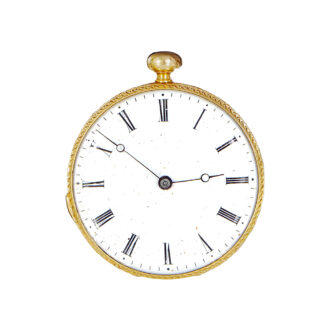
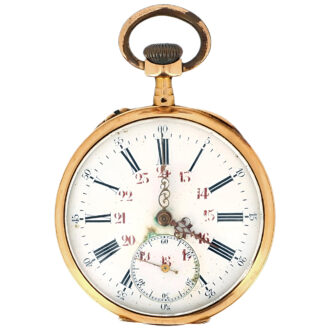
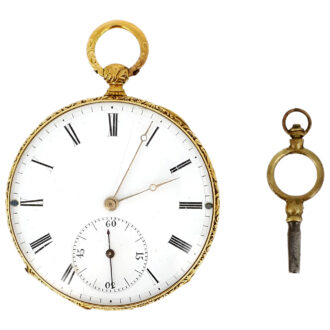
Historically Swiss gold watch with seven complications Circa 1885
- Kenmerk
- TA4308
- Diameter
- 57 mm
- Estimate
- € 30.000 - 60.000
- Price sold
- -
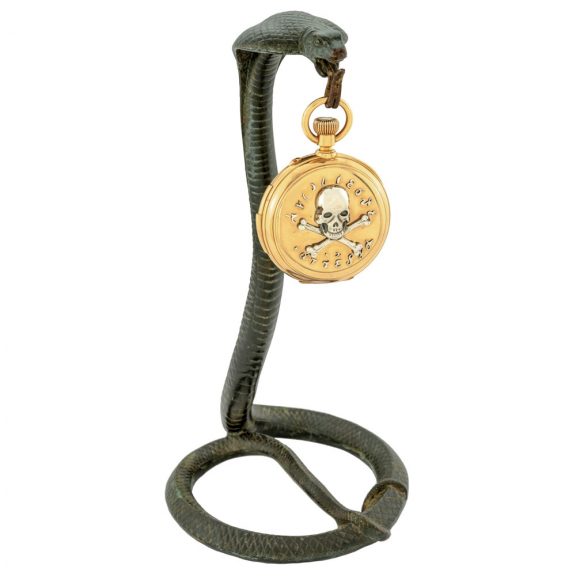
Gold watch accompanied by bronze serpent stand
–
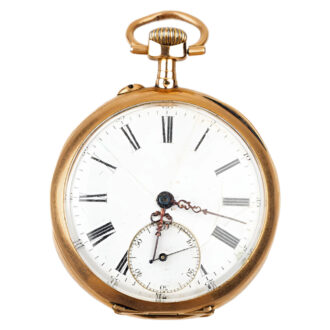
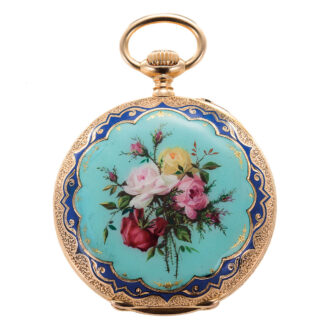
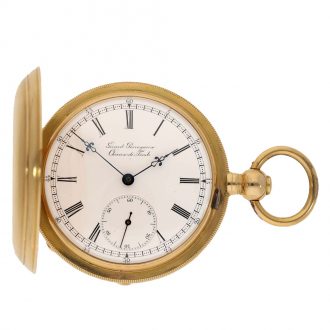
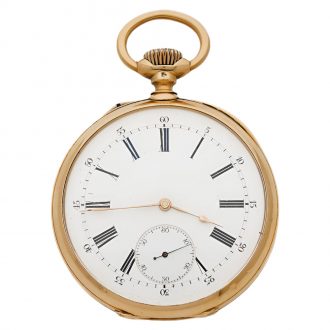
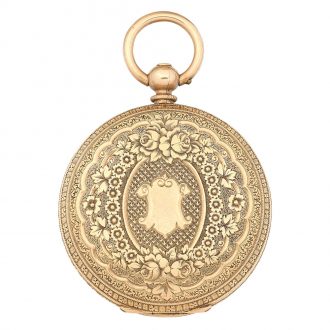
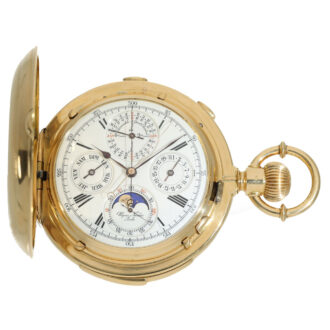
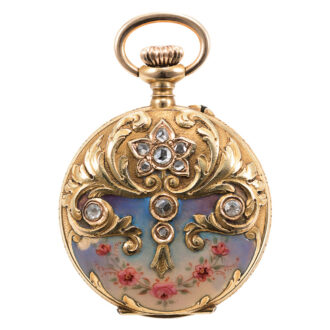
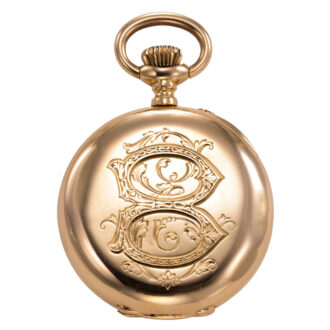
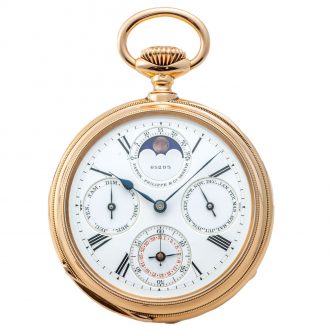
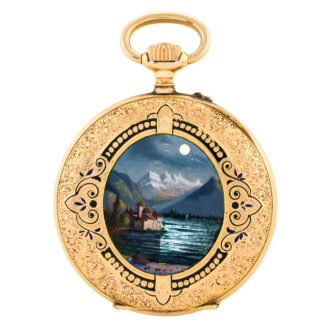
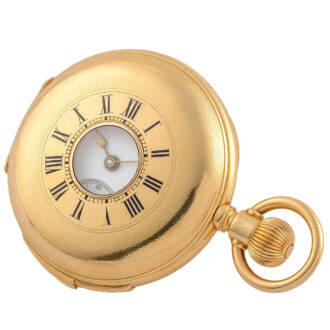
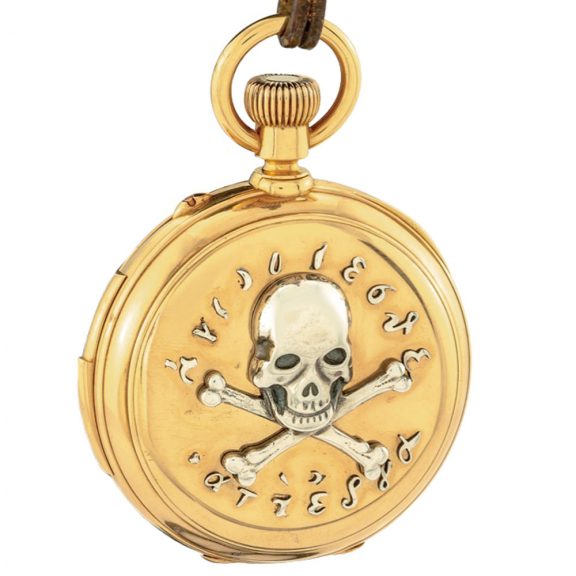
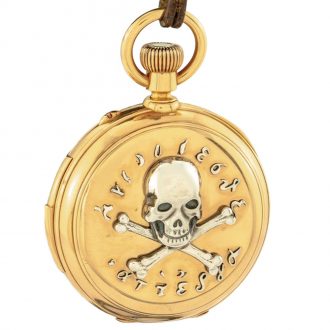
A unique, historically 18 carat gold and silver-mounted hunting cased keyless pocket watch, circa 1885. With seven complications: minute repeating, perpetual calendar, phases of the moon and lunar calendar. A massive, polished case and a hinged gold cuvette. The front cover with a large applied silver foliate monogram KM, and engraved dedication around the border. The back cover with a largely applied silver skull and crossbones in high-relief, applied silver Masonic/Illuminati inscription above and below.
–
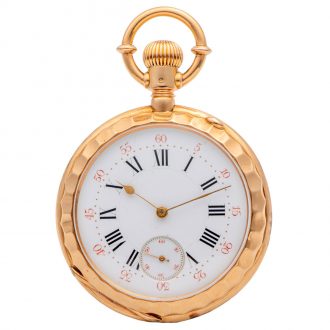
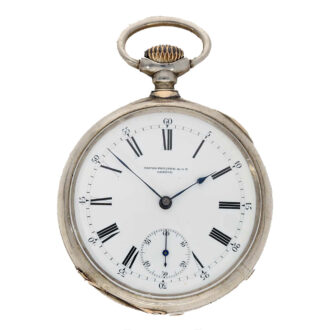
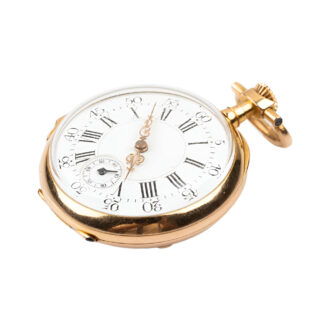
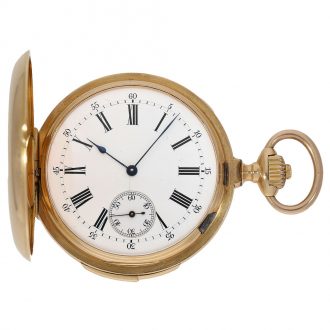
White enamel with radial Roman numerals, outer minute track, subsidiary dials for the date, days of the week, months and 4-year cycle, and seconds. Aperture for the moon phases with a lunar calendar at the edge and gold spade hands. Rhodium-plated movement, 29 jewels, counterpoised straight-line lever escapement, cut bimetallic compensation balance with gold timing screws, blued steel Breguet balance spring with overcoil, index regulator, repeating on gongs activated by a slide on the band. Dial signed, cuvette and movement signed in Cyrillic, case numbered.
–
Diameter: 57 mm
–
Signed: Paul Buhre Swiss
–
Pavel Buhre was a Swiss watchmaker and one of the Russian Tsar’s Court Watchmakers. This watch is undoubtedly one of the most valuable and complicated watches he ever delivered to Russia. The dial is made in Switzerland and carries the German signature Paul Buhre St. Petersburg! Provenience: The watch comes from the heritage of its owner Konstantin Mitrofanovich Mazurin. The mysterious case design speaks for membership in a student association at the Tsarist elite school “Katkovo-Lyzeum”, which he attended from 1880-1886. The inscription 6 March 1886 could indicate the end of this period. Mazurin – a dynasty of merchants and entrepreneurs in the Russian Empire. Almost the entire business activity of the Mazurians took place in Moscow and St. Petersburg. Konstantin Mitrofanovich Mazurin (born 1866, Moscow) was a Russian musical scientist and son of the wealthy industrialist Mitrofan Sergeevich Mazurin (1834-1880) and the Italian ballerina Laura Yakovlevna Guerre.
–
The Mazurin family owned the village of Reutovo and the paper spinning mill there. Konstantin Mitrofanovich Mazurin graduated from the Imperial School between 1880 and 1886. The Moscow Imperial School in memory of Tsesarevich Nikolai (unofficially: the Katkovo Lyceum) in Moscow on the Ostozhenka was a privileged closed university for children of noble families, which existed from 1868 to 1917. The Lyceum was opened on 13 January 1868 and was named in honour of Alexander II’s eldest son, “Moscow Lyceum of Zarevich Nikolai”, who died early. Konstantin Mitrofanovich Mazurin is listed as one of the most important students of the lyceum alongside famous Russian personalities from politics and the military.
–
After this education, he entered the Faculty of Physics and Mathematics of Moscow University as his father’s last wish (1886). He moved soon to the Faculty of History and Philology there. In 1893 he was awarded two silver medals of the University of Moscow for art historical works. He studied singing and music and published several books. Later, he also graduated from the Medical Faculty of Moscow University (1904-1909). Despite extensive research with the help of several linguists, among others at the University of Prague, we could not decipher the secret inscription. The conclusion is that several old Russian languages were probably used and formed a secret code!
Signed: Paul Buhre Swiss
Share this page: