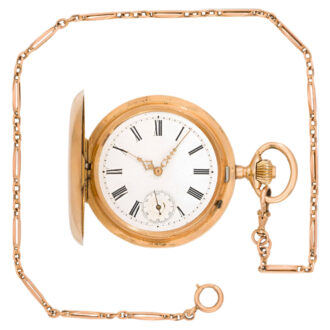
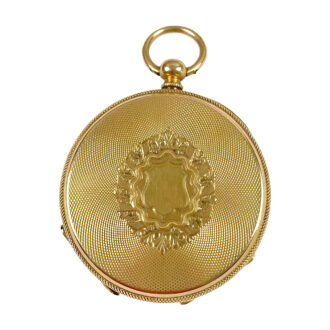
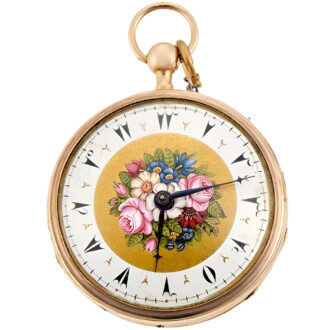
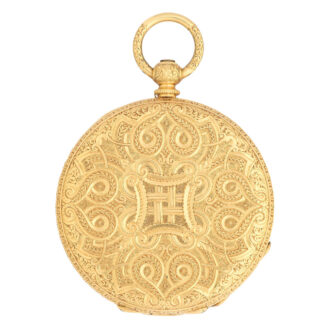
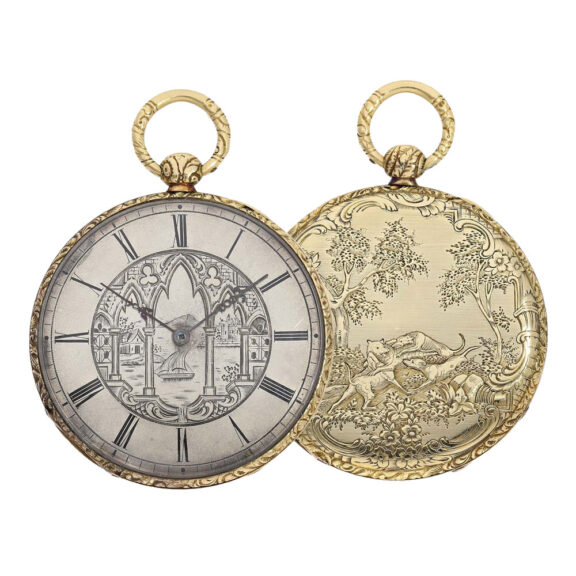
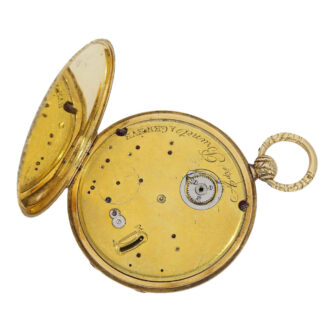
Fine Swiss 18 carat gold Bagnolet caliber pocket watch Circa 1850
- Kenmerk
- CT2013
- Diameter
- 46 mm
- Estimate
- € 1.250 - 2.500
- Price sold
- € 1.250
Gold open faced cylinder watch
–
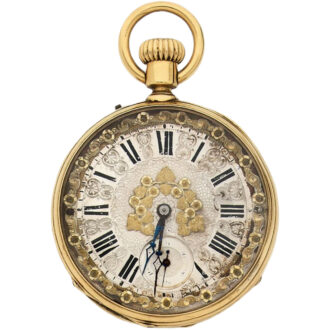
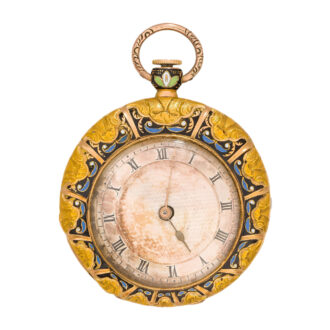
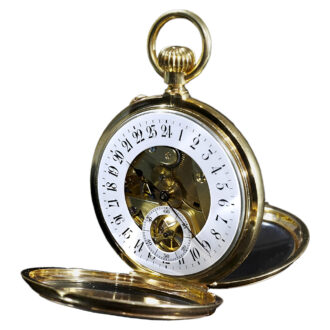
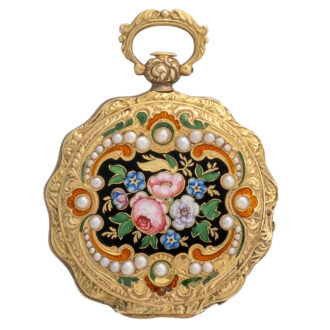
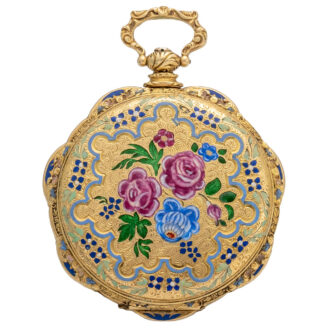
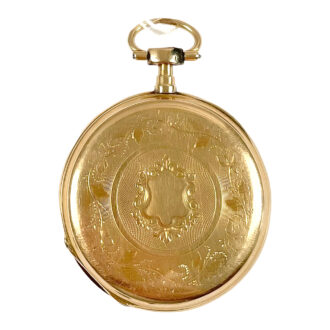
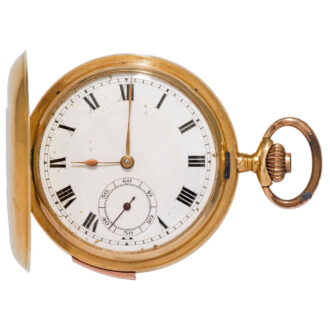
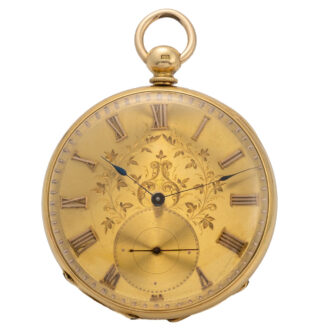
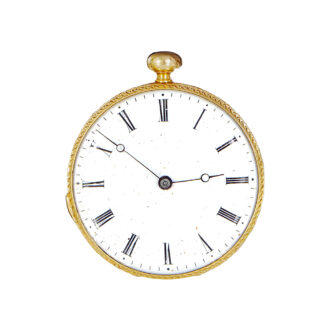
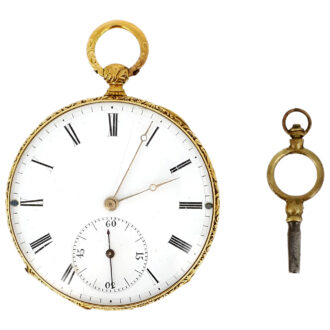
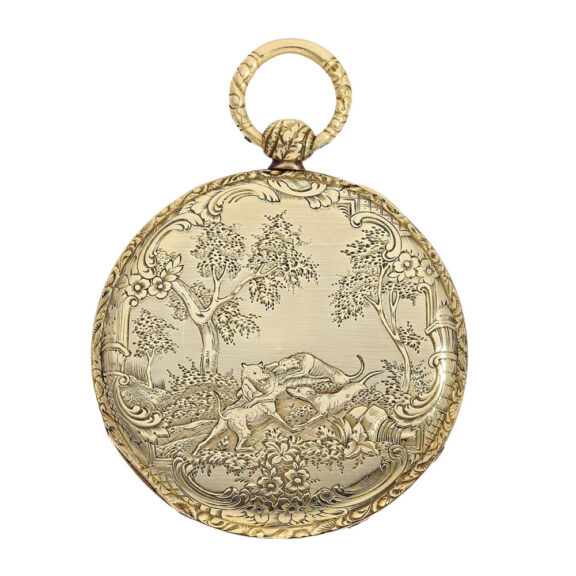
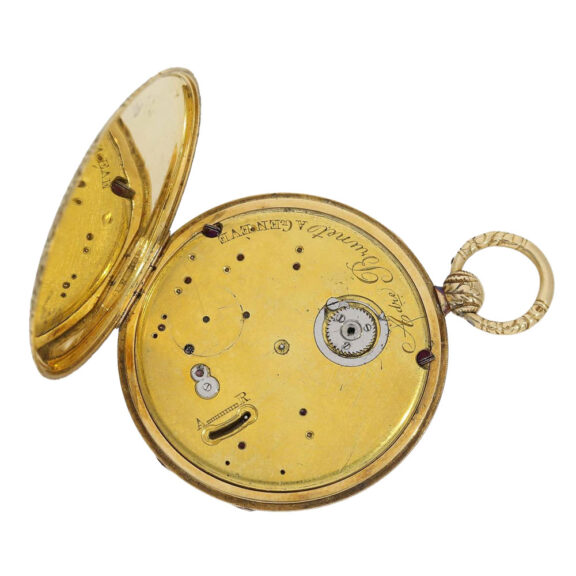
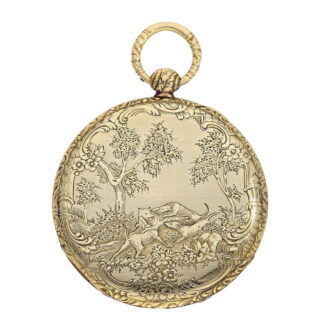
An extremely thin Swiss 18 carat gold Lépine pocket watch made by André Brunet in Geneva, circa 1860. The signed, elaborately decorated case of exceptional quality with an engraved hunting scene on the back showing three hunting dogs fighting a bear. Unique silver dial with an engraved central scene of Lake Geneva through a cathedral window, Roman hour numerals, outer minute divisions and extraordinary steel filigree hands. A very thin cylinder movement, the so-called Bagnolet caliber.
–
Diameter: 46 mm
–
Weight: 40 g
–
Signed: Adre Brunet à Genève
–
The present watch was originally part of the famous Landrock collection.
–
André Brunet was a watchmaker working in Geneva from 1830 to 1850. He specialized in flat and extra flat watches, with special bridge calibers or inverted calibers, known as the Bagnolet, some with a visible balance. His watches are often decorated with enamel or intaglio engravings.
–
In the Bagnolet caliber, the movement is inverted and the train reversed. The idea was to make a very thin watch by reducing the thickness of the bridges and dial, and eliminating the cuvette. Philippe Samuel Meylan is credited with inventing the Bagnolet caliber.
–
A Lépine caliber is a revolutionary watch movement design that replaced traditional full top plates with individual bridges and cocks, allowing watches to be built much thinner and to easily fit into tailored waistcoat pockets.
–
It was invented around 1764–1765 by French master watchmaker Jean Antoine Lépine, royal watchmaker to Louis XV, Louis XVI and Napoleon Bonaparte. This layout formed the technical foundation of nearly all modern mechanical watches.
–
Key characteristics of a Lépine caliber are:
–
A thinner profile: By eliminating the full main plate and the traditional chain and fusee system, internal space was freed up, resulting in a much thinner and lighter movement.
–
The open face pocket watch layout: In pocket watches, the Lépine style refers to a flat, lidless and open faced design in which the winding crown is positioned at 12 o’clock, vertically aligned with a small seconds subdial at 6.
Signed: Lepine Palais Royal Paris
Share this page: