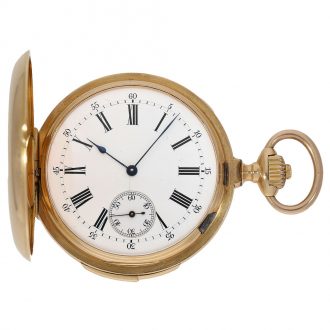
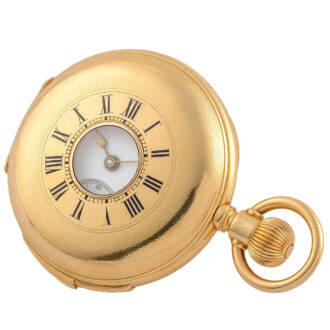
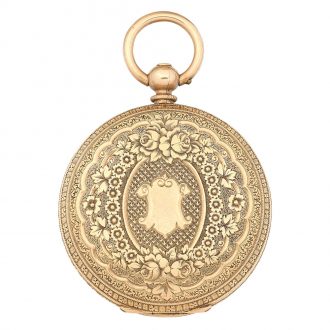
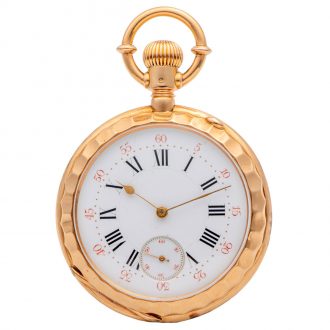
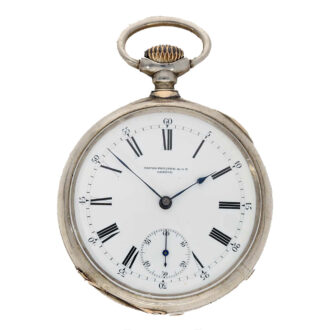
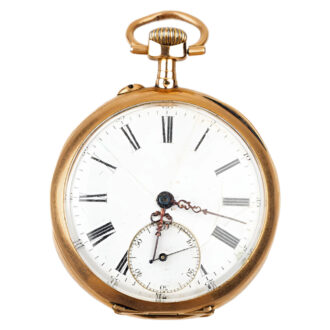
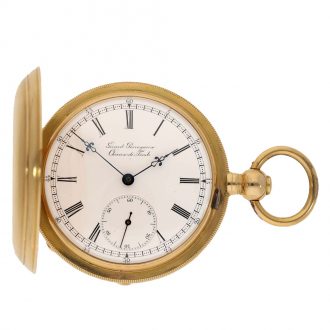
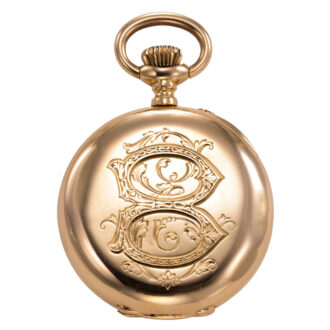
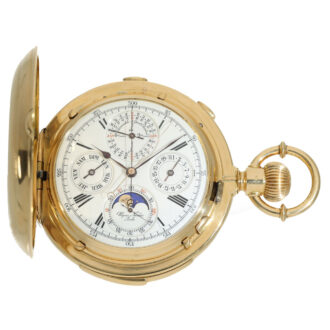
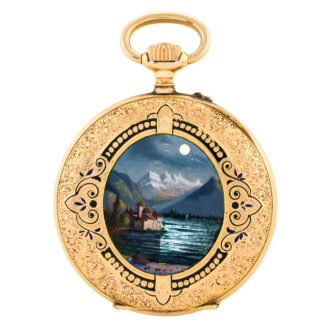
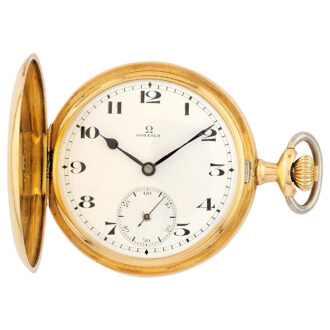
Swiss gold full hunter with jumping hours and minutes Circa 1885
- Kenmerk
- TA5087
- Diameter
- 52 mm
- Estimate
- € 2.750 - 5.000
- Price sold
- € 2.200
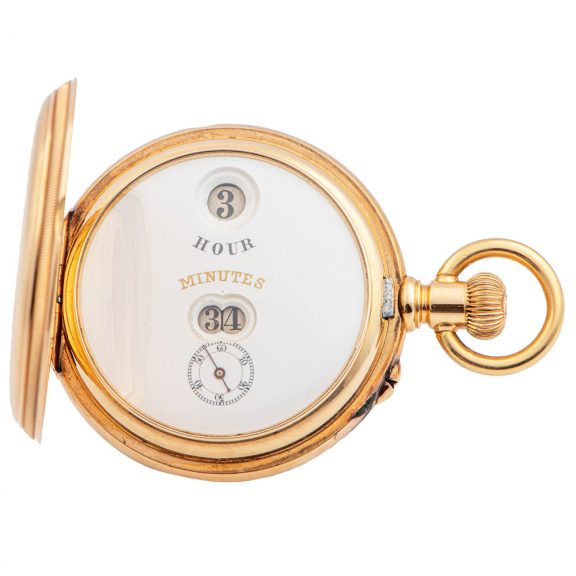
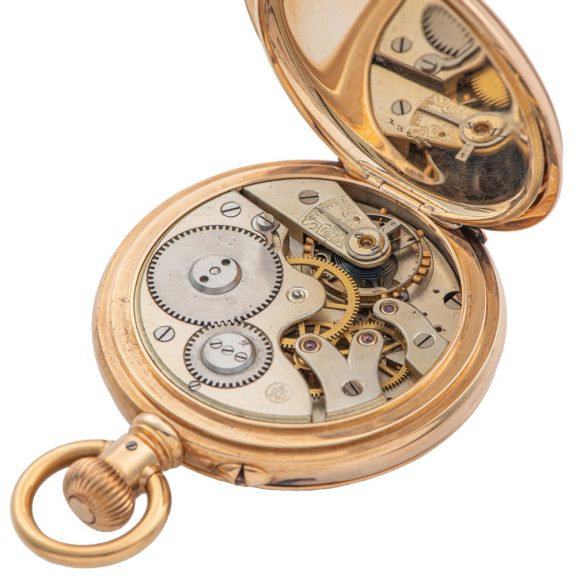
Gold hunting cased Pallweber watch
–
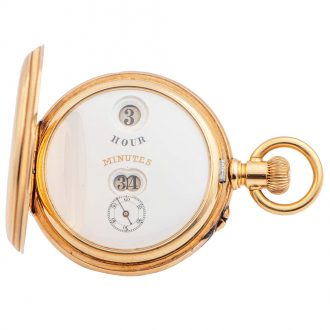
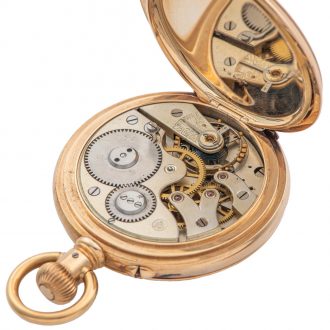
A Swiss 14 carat pink gold keyless lever digital pocket watch with jumping hours and minutes made by International Watch Co. in Schaffhausen, circa 1885. An engine turned cover and case back, with in the center an escutcheon, a gilded metal cuvette.White enamel dial with apertures for the Arabic numerals, patented digital display and subsidiary seconds at 6. A gilt brass movement, going barrel, straight line lever escapement, cut bimetallic compensated balance with gold poising screws and blued steel flat hairspring, polished steel index regulator. The movement is signed.
–
Diameter: 52 mm
–
Weight: 132 g
–
Signed: International Watch Co. Schaffhausen
–
Accompanied by a copy of the invention patent.
–
Movement based on the English invention patent No. 5 863, delivered on December 8, 1882 (letter patents dated July 8, 1883), to Josef (or Joseph) Pallweber, Salzburg (then Austria-Hungary Empire), for Improvements in Time Pieces, for a watch without hands, with a digital jump hours and jump minutes device.
–
Josef Pallweber was an Austrian engineer from Salzburg. His registered residence changed several times within the German Empire, from Furtwangen via Frankfurt am Main to Mannheim. The company name, Josef Pallweber & Sohn, was also known in Austria. He is considered the inventor of watches with jumping numerals, also called Pallweber watches, for which he filed a patent in Salzburg in 1883 at age 25.
–
Pallweber invented the digital time display showing jump hours and minutes for pocket watches with numbers on rotating discs next to the classic hands. Digits indicating the correct hour and minutes were revealed through two apertures on the dial; the seconds were still shown through a small hand on a subsidiary dial. In the late 19th century, many watch manufacturers had the so-called jump hour watches in their range, among them renowned makers such as A. Lange & Söhne in Glashütte, Germany. However, one of the most prolific producers of this type of watch was the International Watch Company Schaffhausen (IWC).
–
IWC brought digital pocket watches to the market based on Pallweber’s patent from approximately 1885 to 1887. Within their production, IWC improved the Pallweber construction twice through small changes in the gears, hence the designations Pallweber I, Pallweber II and Pallweber III. The company produced around 20.000 Pallweber pocket watches. Reportedly, 14.940 examples were made as the calibre 42, Pallweber III. After this successful period, which helped to establish IWC as a serious brand, the interest in these watches waned at the beginning of the 20th century. To mark the 150th anniversary of IWC, the ‘Tribute to Pallweber’ edition was released in 2018. A wristwatch made in limited numbers and priced from $ 30.000.
–
After granting the license to IWC, Josef Pallweber subsequently granted his mechanism to display the time in a digital format to other Swiss watch companies, such as Cortébert and Gédéon Thommen, for the French and Belgian markets. In 2010, the trademark rights of the name Josef Pallweber were acquired by the Swiss Marc Baltensweiler, who presented clearly and succinctly designed models with jumping hours under the motto ‘Time to be different’.
Signed: International Watch Co Schaffhausen
Share this page: