Rare Swiss convertible triple cased pendant watch Circa 1885
- Kenmerk
- AD1300
- Diameter
- 36 mm
- Estimate
- € 50.000 - 100.000
- Price sold
- € 87.500
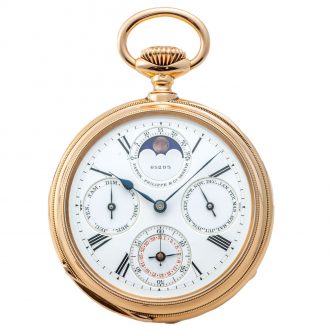
Gold open faced pendant watch by Patek Philippe
–
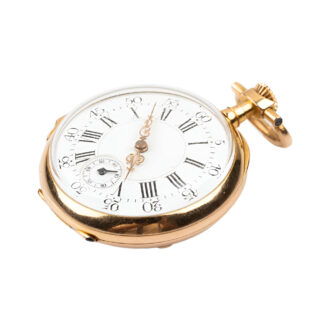
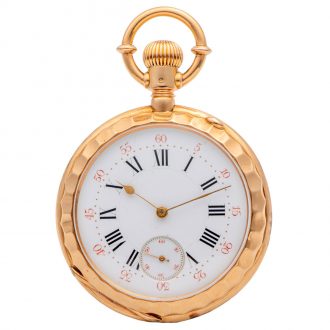
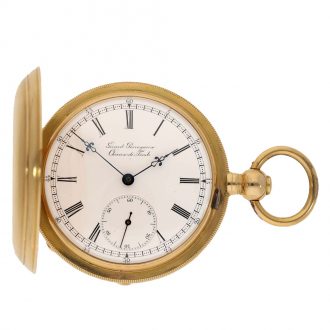
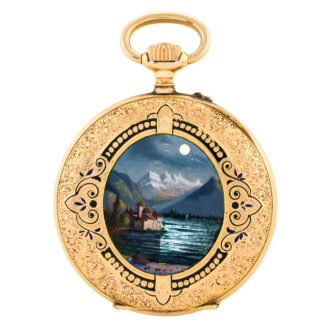
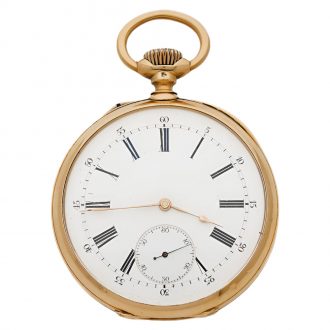
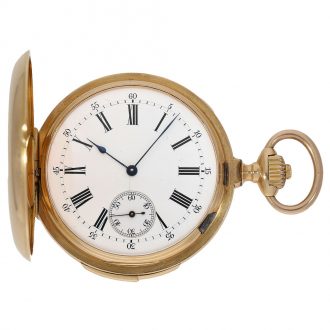
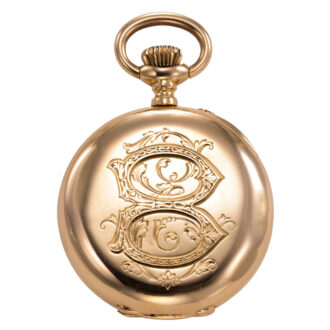
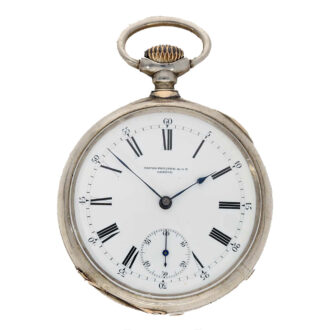
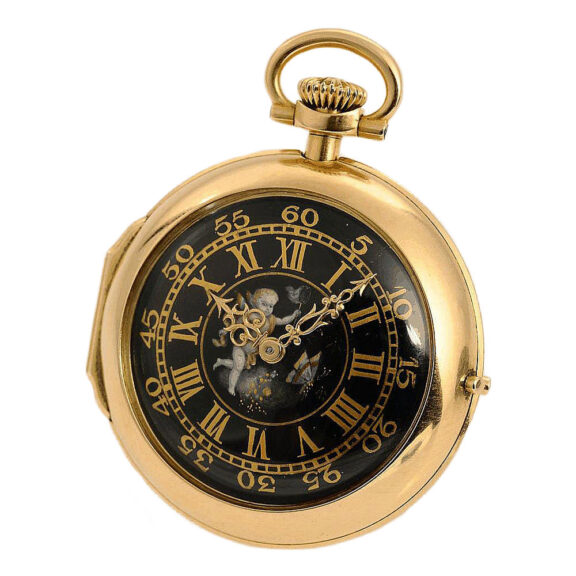
Exceptionally rare and most likely unique, magnificent Swiss 18 Carat gold and painted in relief on enamel open faced triple cased convertible (cabriolet) pendant watch with hand painted enamel dial, circa 1885. Most likely made for an exposition. Sold to Jaques & Marcus, New York on September 15th 1886, for Madame E.S. de C. Nickel silver movement, 18 jewels, wolf’s teeth winding wheels, counterpoised moustache lever, cut bimetallic compensation balance with gold temperature and mean time adjustment screws, blued steel balance spring. Dial with painted on black enamel scene of a cherub chasing a butterfly in the centre, hand painted gold Roman hours, and elaborate gold Louis XVI hands. The two part outer case monogrammed E.S. de C. on the back, the two part middle case entirely enamelled in relief with Amor and Psyche as children playing in the clouds, a polished two part inner case with glazed back, punched with makers mark.
Movement signed. Accompanied by Extract from the Archives.
–
Diameter: 36 mm
–
Weight: 47 g
–
Signed: Patek, Philippe & Cie Genève
–
M. Potocki, in October 1889, writing about the Paris Exposition of the same year devoted a few paragraphs to Patek Philippe who won the Grand Prix. He paid special attention to “a marvel in enamel and gold, in three cases, the middle one, as well as the dial, in enamel showing putti playing in the clouds, in three dimensions like repoussé but in enamel”. There is little doubt that he was describing this or a twin sister watch. The watch is spectacular, not only the back but also the dial are entirely hand painted including the numerals and the minute track. The hand strokes of the painter are visible in the minute markers, as well as in the finish of the numerals. The case is constructed in such a way that it can be either an open face showing the dial or a hunting case showing the enamel. It is also one of only two known Patek Philippe watches having three cases. Patek Philippe began using enamel in their cases already in 1839, the first year of the production. The tradition continued to the modern days. In the 1970’s and 1980’s, the enamel work by such artists as Suzanne Rohr or Luce Chappaz decorated a few special Patek Philippe pocket watches. The highest degree of perfection of Patek Philippe enamels falls in the 1880’s with the three dimensional enamel work of this watch being an apogee of the art. This period, a century later, inspired the company to launch a limited series of modern enamel watches such as the famous ref. 866. There is a mystery in the watch; three years after it was made, in 1889, the year of the Paris Exposition where Patek Philippe won the Grand Prix, William-Adolphe Bouguereau painted his immortal “L’Amour et Psyche”, called also “The First Kiss”. Looking at this watch it is hard to escape the impression that the enamel artist and Bouguereau had more in common than one might think. It is a magnificent piece, a small mysterious marvel, as described by Potocki. No wonder that Patek Philippe won the Grand Prix at the exposition.
Signed: Patek, Philippe & Cie Genève
Share this page: