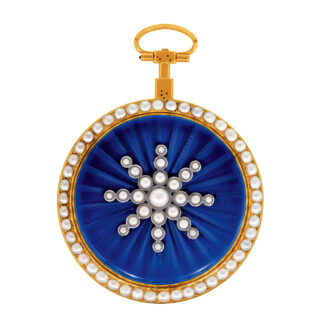
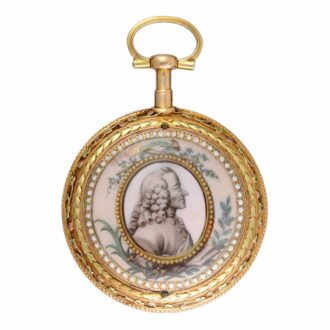
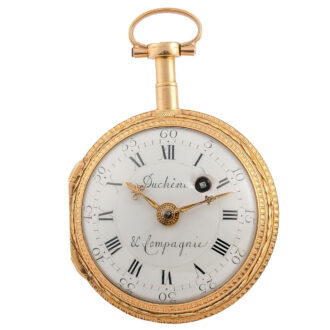
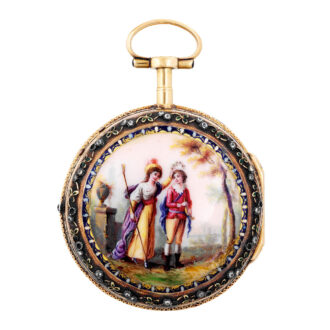
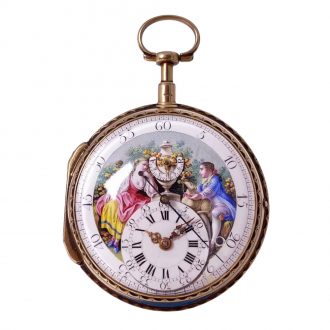
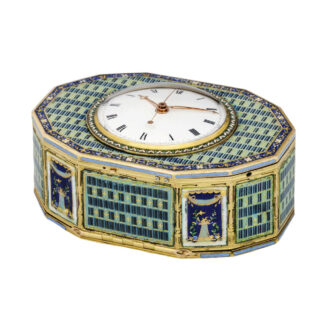
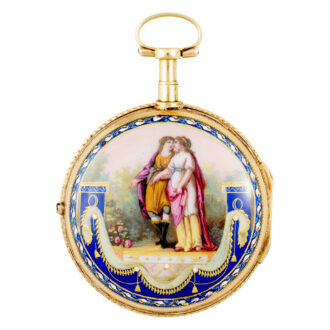
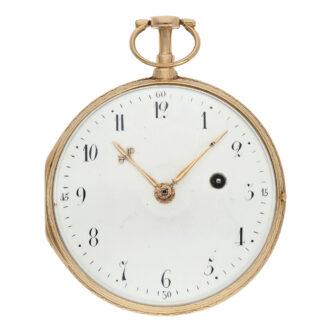
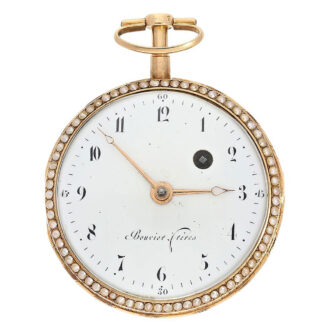
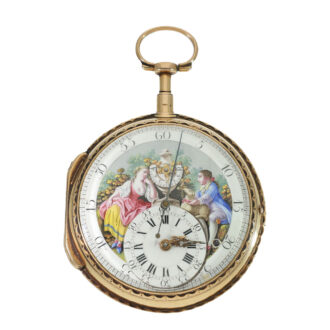
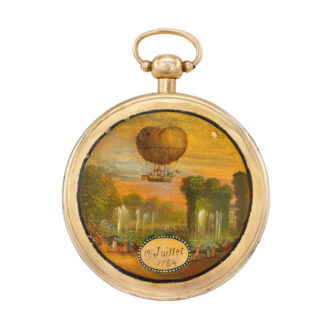
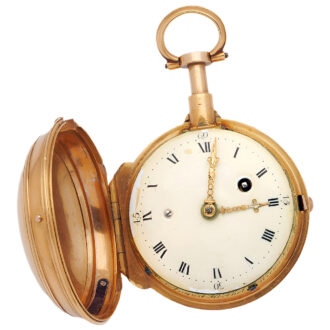
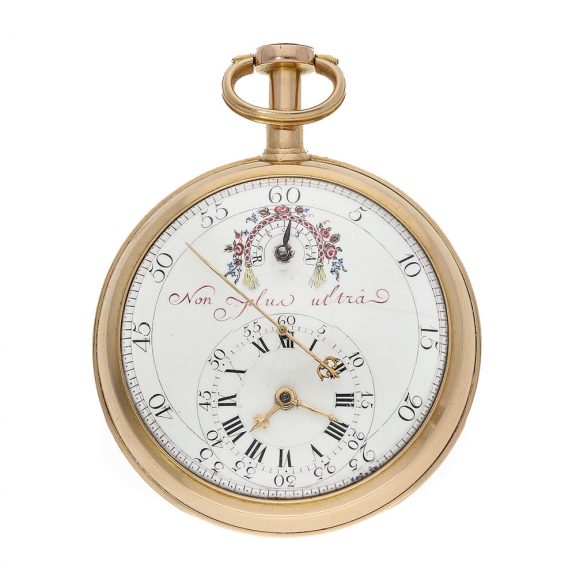
Swiss 18 Carat gold early automatic pocket watch Circa 1785
- Kenmerk
- HC0943
- Diameter
- 51 mm
- Estimate
- € 6.000 - 15.000
- Price sold
- € 9.300
Pocket watch with extremely decorative dial
–
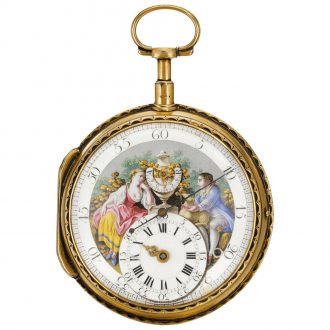
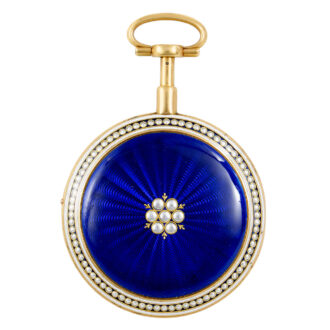
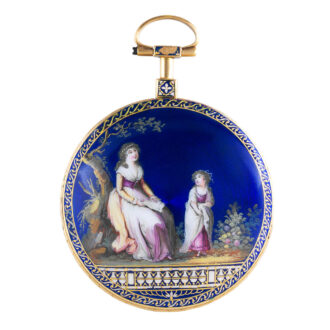
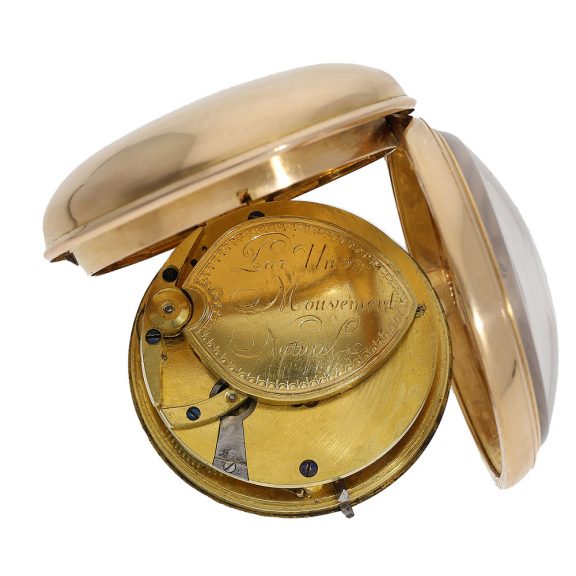
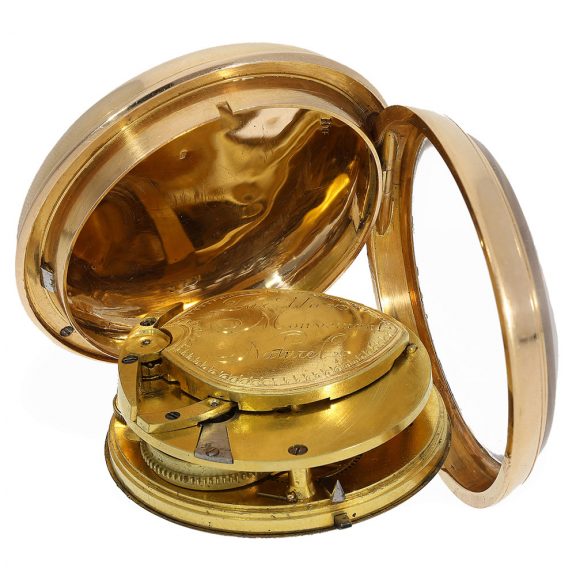
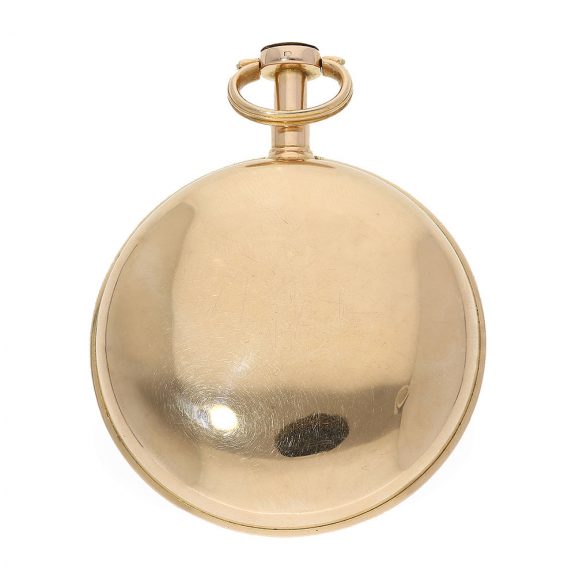
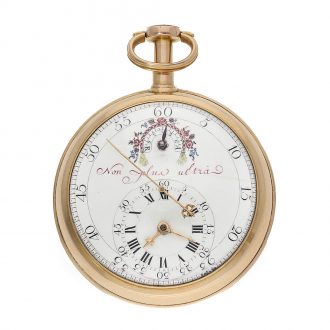
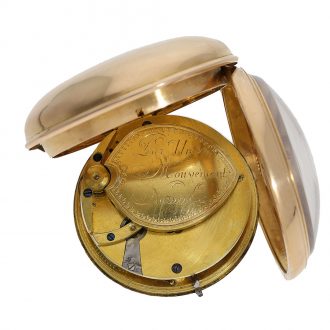
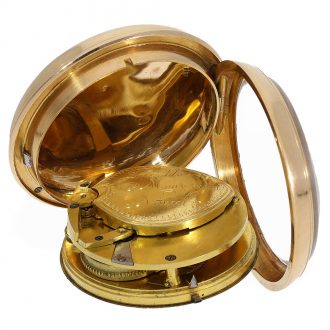
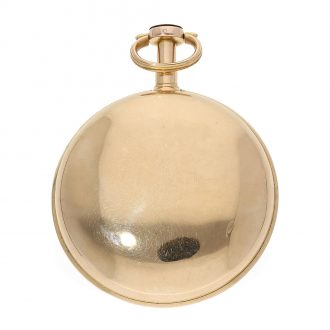
An important early gold automatic watch, attributed to Moÿse Gevril, in le Locle, Switzerland, circa 1785. The numbered open faced plain case is crafted from 18 Carat gold. The extremely decorative white enamel face with enamel painting, has an off center dial at six o’clock with Arabic five minute and Roman hour numerals, a regulation dial at twelve o’clock, center seconds, gold hands and the motto “Non plus ultra”. The movement, with the inscription “Par un movement Naturel”, has a cylinder escapement and an oscillating weight winding the movement.
–
Diameter: 51 mm
–
Weight: 116 g
–
Signed: No name
–
A similar watch was on auction with Antiquorum, Geneva, 20 October 1991, lot 305, sold for the sum of CHF 39.100.
–
Since the publication of the movements by Alfred Chapuis and Eugène Jaquet, this model of an early automatic watch has been attributed to the watchmaker Moÿse Gevril (Le Locle, from 1749), who lived in Crêt-Vaillant du Locle (1952, pp. 179-180; 1956, pp. 188-190). The watch mentioned in these two books bears his name engraved with an etching needle. It is also equipped with a barrel bearing the signature and date “DL 9 c January 14, 1781”, probably for Daniel Henry Lequeureux, maker of barrels, resident in Cret du Locle, who also worked for Philippe DuBois (1738-1808) between 1782 and 1797. In the recent literature, Jean-Claude Sabrier shows 3 similar unsigned watches he attributes to this workshop (2011, pp. 160-173), while Richard Watkins provides some additional information (2013, p. 53, pp. 144-145; 2016, pp. 55-56, pp. 164-165).
–
The watch here is the fourth known example of this type and one of the few known examples with original gold case. Due to the lack of further details, this watch is attributed to this watchmaker working in Le Locle, especially since its case is stamped with the Neuchâtel “Chevrons” punch.
–
Moijse Gevril
Moÿse Gevril (Moÿse – Gevrille) was born in 1749 in Le Locle as the son of Jacques Gevril. He lived in Crêt Vaillant near Le Locle and became a master watchmaker in 1784; Gevril created pocket watches with an automatic winding mechanism by an oscillating weight and sold them to Ph. Du Bois & Fils. In their archive, he is listed with 18 watches, presumably with automatic winding mechanism. Moÿse Gevril founded the company Moÿse Gevril & Fils and died around 1791.
–
Non plus ultra
The Latin phrase ne plus ultra literally means “no more beyond,” and it’s famously said to have been inscribed on the Pillars of Hercules at either side of the Strait of Gibraltar (which marked the edge of the known world in antiquity), in part as a warning to sailors not to travel beyond the edge of the known world. It has metaphorical suggestions of taking risks and striving for excellence.
Share this page: